

|
시장보고서
상품코드
2116739
유럽의 ICT 시장 : 점유율 분석, 업계 동향과 통계, 성장 예측(2026-2031년)Europe ICT - Market Share Analysis, Industry Trends & Statistics, Growth Forecasts (2026 - 2031) |
||||||
 Mordor Intelligence
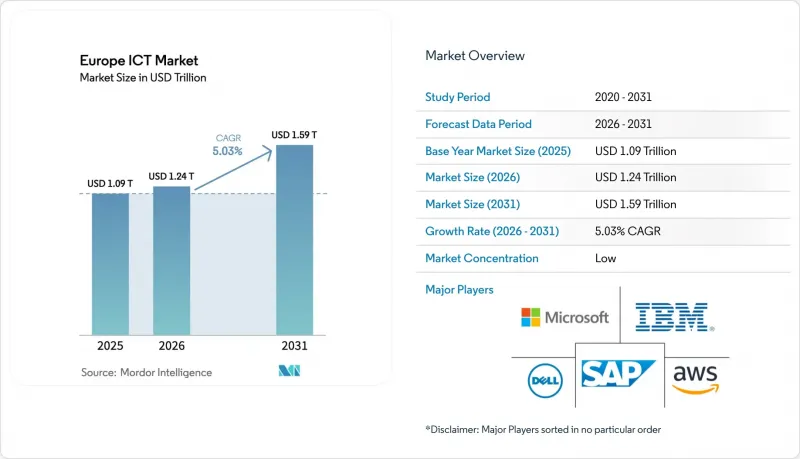
Mordor Intelligence에 의하면, 유럽의 ICT 시장 규모는 2025년 1조 900억 달러에서 2026년에는 1조 2,400억 달러로 확대되어 2031년까지 1조 5,900억 달러에 이를 것으로 예상되고 있어 2026-2031년까지 CAGR 5.03%로 성장할 전망입니다.
본 보고서는 제품 유형(IT 하드웨어, IT 소프트웨어, IT 서비스, IT 인프라, IT 보안·사이버 보안, 통신 서비스), 기업 규모(중소기업, 대기업), 최종 사용자 산업(은행, 금융서비스 및 보험(BFSI), 정부·공공 부문, 제조·산업, 헬스케어, 기타), 지역별로 분류되어 있습니다. 시장 전망은 금액(달러)으로 표시되어 있습니다.
유럽 ICT 시장 동향 및 인사이트
2021-2030년 EU ‘디지털 데케이드’ 자금 지원 가속화가 클라우드 및 5G 확산을 뒷받침
대규모 공공 자금 지원으로 인해 네트워크 인프라 구축 일정이 앞당겨지고 있습니다. 2025년 12월까지 회원국들은 기가비트 연결 및 지방 지역의 5G 커버리지 향상을 위해 이미 580억 유로를 투자했으며, 이전에는 2020년대 말까지 이어지던 프로젝트 주기가 단축되었습니다. Vodafone Germany만 해도 2025년에 1만 5,000곳의 5G 독립형 기지국을 가동하여, 자동차 텔레매틱스 및 원격 수술에 활용되는 네트워크 슬라이싱의 길을 열었습니다. 클라우드 도입 비용의 최대 절반을 지원하는 중소기업용 전환 지원책에 힘입어 플랫폼 공급업체의 잠재 고객 기반이 확대되었으며, 2025년 중소기업의 클라우드 도입률은 전년 대비 34% 증가했습니다. 그러나 국가 보조금 심사에 따른 자금 조달 지연으로 인해 이탈리아와 스페인에서는 자금 결제가 지연되었으며, EU 내 실행 위험이 부각되었습니다.
‘슈렘스 II’ 판결 이후 급증한 주권 클라우드 및 데이터 소재지 요건
EU-미국 프라이버시 실드의 무효화는 워크로드의 광범위한 본국 회귀를 초래했습니다. 2025년까지 유럽 대기업의 3분의 2 가까이가 기밀 데이터를 EU 역내에 거점을 둔 제공업체 또는 On-Premise 환경으로 이전했습니다. OVHcloud는 공공 부문 수주를 바탕으로 두 자릿수 매출 성장을 기록한 반면, 도이치 텔레콤은 대형 하이퍼스케일러와 제휴하여 독일 연방 규정을 준수하는 쿠버네티스 기반 소버린 클라우드를 제공했습니다. 코로케이션 사업자들도 이에 발맞추어, 엄격한 관할권 관리를 요구하는 금융 산업 및 공공 부문 사용자를 지원하기 위해 프랑크푸르트, 암스테르담, 파리에서 저지연 시설을 확충했습니다. 법적 심사 비용의 급등으로 인해 전환 주기는 여전히 장기화되고 있지만, 전반적인 흐름으로는 데이터 주권에 관한 명확한 실적을 보유한 제공업체에게 유리한 상황이 지속되고 있습니다.
전력 소비량이 많은 데이터센터, 치솟는 전기 요금 및 탄소세에 직면
2025년, 데이터센터의 전력 수요는 104테라와트시에 달했으며, 프랑크푸르트, 암스테르담, 더블린 허브가 소비량의 3분의 2 가까이를 차지했습니다. 2026년 1월부터 시행된 톤당 90유로의 탄소 배출권 가격은 재생에너지를 이용하지 않는 시설의 운영비를 두 자릿수 초반의 비율로 끌어올렸습니다. 각국의 개입으로 인해 이러한 압박은 더욱 심화되고 있습니다. 아일랜드의 더블린 신규 연결 일시 중단 및 네덜란드의 대규모 시설에 대한 에너지세 도입으로 인해 사업자들은 북유럽 시장에 추가 용량을 배치하거나 재생에너지 발전 시설 근처에 콜로케이션을 구축해야 하는 상황에 몰리고 있습니다. 독일에서는 10MW를 초과하는 신규 사이트에 대해 수요 반응(Demand Response) 프로그램 참여가 의무화되어 있으며, 이로 인해 아키텍처 재검토가 불가피해지면서 배터리를 갖춘 마이크로그리드 도입이 가속화되고 있습니다.
부문 분석
IT 보안 및 사이버 보안 시장은 18개 주요 부문을 대상으로 하는 NIS2 지침의 24시간 이내 사고 보고 의무에 힘입어 연평균 성장률(CAGR) 7.26%로 확대될 것으로 예측됩니다. ID 및 액세스 관리는 은행 및 공공 서비스 분야에서 다중 요소 인증을 의무화하는 EU 전역의 제로 트러스트 요건을 반영하여 특히 두드러진 성장을 보이고 있습니다. 기업들이 규정 준수 점검을 자동화함에 따라 클라우드 보안 포지션 관리 도구에 대한 수요는 확대되고 있지만, 한편 주요 OS 벤더들의 번들 제공으로 인해 엔드포인트 보호 부문에서는 가격 압박이 심화되고 있습니다. 한편, 유럽 ICT 시장에서 IT 서비스 시장 규모는 여전히 최대 규모를 유지하고 있지만, 풍부한 자동화 기능을 갖춘 플랫폼의 제공으로 인해 기존 형태의 컨설팅 업무는 축소되는 추세입니다. 하이브리드 근무가 정착됨에 따라 하드웨어의 교체 주기는 계속 길어지고 있으며, 데스크톱 및 노트북 PC의 교체 수요는 줄어들고 있습니다. 통신 서비스 수익은 벤더 통합과 분산 근무 직원의 총소유비용(TCO)을 절감하는 통합 커뮤니케이션 번들 제공에 힘입어 견조한 추세를 보이고 있습니다. 인프라 지출은 엣지 디바이스로 이동하고 있으며, 이는 대규모 On-Premise 서버에 대한 수요 감소를 부분적으로 상쇄하고 있습니다.
위협 인텔리전스 피드와 머신러닝 분석을 결합한 2세대 보안 제어 기술은 중요 인프라를 넘어 중견 기업 사용자층으로까지 확대되고 있어, 대상 고객 기반의 확대를 시사하고 있습니다. 네트워크 보안 지출은 에지에서 분산 서비스 거부(DDoS) 공격 완화 기능을 통합한 5G 코어의 도입으로 혜택을 보고 있습니다. 또한, 소프트웨어 벤더가 ‘사이버 복원력 법’에 따른 법적 책임을 지게 됨에 따라 ‘보안 설계(Secure by Design)’ 실천이 촉진되는 가운데, 용도 보안 도입도 증가하고 있습니다. 이러한 추세를 종합해 볼 때, 보안 부문에 대한 투자가 유럽 ICT 시장에서 계속해서 점유율을 확대해 나갈 것임이 입증됩니다.
기타 혜택
- 엑셀 형식 시장 예측(ME) 시트
- 3개월간의 애널리스트 지원
자주 묻는 질문
목차
제1장 서론
제2장 조사 방법
제3장 개요
제4장 시장 구도
제5장 시장 규모와 성장 예측
제6장 경쟁 구도
제7장 시장 기회와 향후 전망
JHS 26.09.01According to Mordor Intelligence, the Europe ICT market size is expected to increase from USD 1.09 trillion in 2025 to USD 1.24 trillion in 2026 and reach 1.59 trillion by 2031, growing at a CAGR of 5.03% over 2026-2031.
This report is Segmented by Product Type (IT Hardware, IT Software, IT Services, IT Infrastructure, IT Security/Cybersecurity, and Communication Services), Enterprise Size (SMEs and Large Enterprises), End-User (BFSI, Government, Manufacturing, Healthcare, and More), and Geography. The Market Forecasts are in Value (USD).
Europe ICT Market Trends and Insights
Accelerated EU Digital Decade Funding 2021-2030 Catalyzing Cloud and 5G Roll-outs
Large-scale public funding is front-loading network infrastructure timelines. By December 2025, member states had already invested EUR 58 billion toward gigabit connectivity and rural 5G coverage, compressing project cycles that previously stretched to the end of the decade. Vodafone Germany alone switched on 15,000 5G standalone sites in 2025, opening network-slicing pathways for automotive telematics and remote surgery. SME migration incentives covering up to half of cloud-adoption costs expanded the addressable base for platform vendors, evidenced by a 34% year-on-year rise in SME cloud take-up in 2025. Funding delays tied to state-aid reviews, however, slowed disbursements in Italy and Spain, highlighting execution risk within the bloc.
Surge in Sovereign Cloud and Data-Residency Requirements Post-Schrems II Ruling
The invalidation of the EU-US Privacy Shield triggered sweeping workload repatriation. By 2025, nearly two-thirds of large European enterprises had shifted sensitive data to EU-domiciled providers or on-premises stacks. OVHcloud booked double-digit revenue growth on the back of public-sector wins, while Deutsche Telekom partnered with a major hyperscaler to deliver a Kubernetes-based sovereign cloud aligned with German federal rules. Colocation operators followed suit, expanding low-latency facilities in Frankfurt, Amsterdam, and Paris to serve finance and public-sector users that demand strict jurisdictional control. Elevated legal-review costs continue to lengthen migration cycles, yet overall momentum favors providers with clear data-sovereignty credentials.
Energy-Intensive Data Centers Facing Escalating Power and Carbon Taxes
Data-center electricity demand hit 104 terawatt-hours in 2025, with hubs in Frankfurt, Amsterdam, and Dublin accounting for almost two-thirds of consumption. A EUR 90-per-tonne carbon-allowance price, effective January 2026, raised operating expenses for non-renewable sites by low-double-digit percentages. National interventions reinforce the pressure: Ireland's moratorium on new Dublin connections and the Netherlands' energy tax on large facilities are prompting operators to place incremental capacity in Nordic markets or to co-locate near renewable-generation assets. Participation in demand-response programs is compulsory for new German sites above 10 MW, forcing architectural redesigns and accelerating the adoption of battery-backed microgrids.
Other drivers and restraints analyzed in the detailed report include:
- Industrial Edge-Computing Demand Driven by Industry 4.0 Corridors
- Rising ICT Sustainability Mandates Under the EU Green Deal Fueling Green Data Centers
- Persistent Digital-Skills Gap Slowing Project Timelines
For complete list of drivers and restraints, kindly check the Table Of Contents.
Segment Analysis
IT security and cybersecurity are projected to expand at a 7.26% CAGR, buoyed by the NIS2 directive's 24-hour incident-reporting rule that covers 18 critical sectors. Identity and access management stands out, reflecting EU-wide zero-trust mandates that require multi-factor authentication across banking and public services. Cloud-security posture-management tools are growing as enterprises automate compliance checks, while endpoint protection faces price compression due to bundled offerings from major operating-system vendors. Meanwhile, the Europe ICT market size for IT services retains scale leadership, yet automation-rich platform offerings are shrinking traditional consulting effort. Hardware refresh cycles continue to stretch as hybrid work stabilizes, compressing demand for desktop and notebook replacements. Communication-services revenues remain steady due to vendor consolidation and unified-communications bundles that lower total cost of ownership for distributed workforces. Infrastructure spending tilts toward edge form factors, partially offsetting softer demand for large on-premises servers.
Second-generation security controls that combine threat-intelligence feeds with machine-learning analytics are spreading beyond critical infrastructure to mid-market users, signaling a deeper addressable base. Network-security spend benefits from 5G core launches, which embed distributed denial-of-service mitigation at the edge. Application-security adoption also rises as software suppliers face liability under the Cyber Resilience Act, incentivizing secure-by-design practices. Collectively, these patterns confirm that security allocations will continue to capture a rising share of the Europe ICT market.
Complete Report Scope:
- By Product Type
- IT Hardware
- Computer Hardware
- Networking Equipment
- Peripherals
- IT Software
- IT Services
- IT Consulting and Implementation
- IT Outsourcing (ITO)
- Business Process Outsourcing (BPO)
- Managed Security Services
- Cloud and Platform Services
- IT Infrastructure
- IT Security/Cybersecurity
- Application Security
- Cloud Security
- Data Security
- Network Security
- Endpoint Security
- Infrastructure Protection
- Integrated Risk Management
- Identity and Access Management (IAM)
- Communication Services
- Fixed Voice and Data
- Mobile Voice and Data
- Unified Communications and Collaboration
- IT Hardware
- By Enterprise Size
- Small and Medium-Sized Enterprises
- Large Enterprises
- By End-User Industry Vertical
- BFSI
- Government and Public Sector
- Oil and Gas
- IT and Telecom
- Retail, E-Commerce and Consumers
- Manufacturing and Industrial
- Energy and Utilities
- Healthcare
- Other End-User Industry Verticals
- By Country
- United Kingdom
- Germany
- France
- Italy
- Spain
- Netherlands
- Nordics
- Rest of Europe
List of Companies Covered in this Report:
- Hewlett Packard Enterprise Development LP
- Dell Technologies Inc.
- Apple Inc.
- Sony Europe B.V.
- Samsung Electronics Co., Ltd.
- Deutsche Telekom AG (T-Systems)
- IBM Corporation
- Capgemini SE
- Microsoft Corporation
- Oracle Corporation
- SAP SE
- Amazon Web Services, Inc.
- Google Cloud (Alphabet Inc.)
- Cisco Systems, Inc.
- Atos SE
- Accenture plc
- Fujitsu Limited
- Salesforce, Inc.
- Ericsson AB
- Nokia Corporation
- Schneider Electric SE
- Equinix, Inc.
- OVHcloud
- Orange Business Services
- Telefonica Tech
- Tata Consultancy Services Limited
- Infosys Limited
- Cognizant Technology Solutions
- NetApp, Inc.
- Sophos Ltd.
- Avast plc
- Darktrace plc
- Kaspersky Lab
- VMware Inc.
- ServiceNow, Inc.
- Zoom Video Communications, Inc.
- Logitech International S.A.
Additional Benefits:
- The market estimate (ME) sheet in Excel format
- 3 months of analyst support
TABLE OF CONTENTS
1 INTRODUCTION
- 1.1 Study Assumptions and Market Definition
- 1.2 Scope of the Study
2 RESEARCH METHODOLOGY
3 EXECUTIVE SUMMARY
4 MARKET LANDSCAPE
- 4.1 Market Overview
- 4.2 Market Drivers
- 4.2.1 Accelerated EU Digital Decade Funding 2021-2030 Catalyzing Cloud and 5G Roll-outs
- 4.2.2 Surge in Sovereign Cloud and Data Residency Requirements Post-Schrems II Ruling
- 4.2.3 Industrial Edge Computing Demand Driven by Europe's Industry 4.0 Corridors
- 4.2.4 Rising ICT Sustainability Mandates (EU Green Deal) Fueling Green Data Centres
- 4.2.5 O-RAN Trials and Early 5G Standalone Deployments Enabling New B2B Services
- 4.2.6 Generative AI Upskilling Programmes Stimulating Software and Consulting Spend
- 4.3 Market Restraints
- 4.3.1 Energy-Intensive Data Centres Facing Escalating Power and Carbon Taxes
- 4.3.2 Persistent Digital Skills Gap Slowing Project Timelines
- 4.3.3 Fragmented Spectrum Policies Hindering 5G Economies of Scale
- 4.3.4 Heightened Cyber-Sovereignty Concerns Limiting US Hyperscaler Penetration
- 4.4 Industry Value Chain Analysis
- 4.5 Regulatory Landscape
- 4.6 Technological Outlook
- 4.7 Porter's Five Forces Analysis
- 4.7.1 Bargaining Power of Suppliers
- 4.7.2 Bargaining Power of Buyers
- 4.7.3 Threat of New Entrants
- 4.7.4 Threat of Substitutes
- 4.7.5 Intensity of Competitive Rivalry
- 4.8 Impact of Macroeconomic Factors
5 MARKET SIZE AND GROWTH FORECASTS (VALUE)
- 5.1 By Product Type
- 5.1.1 IT Hardware
- 5.1.1.1 Computer Hardware
- 5.1.1.2 Networking Equipment
- 5.1.1.3 Peripherals
- 5.1.2 IT Software
- 5.1.3 IT Services
- 5.1.3.1 IT Consulting and Implementation
- 5.1.3.2 IT Outsourcing (ITO)
- 5.1.3.3 Business Process Outsourcing (BPO)
- 5.1.3.4 Managed Security Services
- 5.1.3.5 Cloud and Platform Services
- 5.1.4 IT Infrastructure
- 5.1.5 IT Security/Cybersecurity
- 5.1.5.1 Application Security
- 5.1.5.2 Cloud Security
- 5.1.5.3 Data Security
- 5.1.5.4 Network Security
- 5.1.5.5 Endpoint Security
- 5.1.5.6 Infrastructure Protection
- 5.1.5.7 Integrated Risk Management
- 5.1.5.8 Identity and Access Management (IAM)
- 5.1.6 Communication Services
- 5.1.6.1 Fixed Voice and Data
- 5.1.6.2 Mobile Voice and Data
- 5.1.6.3 Unified Communications and Collaboration
- 5.1.1 IT Hardware
- 5.2 By Enterprise Size
- 5.2.1 Small and Medium-Sized Enterprises
- 5.2.2 Large Enterprises
- 5.3 By End-User Industry Vertical
- 5.3.1 BFSI
- 5.3.2 Government and Public Sector
- 5.3.3 Oil and Gas
- 5.3.4 IT and Telecom
- 5.3.5 Retail, E-Commerce and Consumers
- 5.3.6 Manufacturing and Industrial
- 5.3.7 Energy and Utilities
- 5.3.8 Healthcare
- 5.3.9 Other End-User Industry Verticals
- 5.4 By Country
- 5.4.1 United Kingdom
- 5.4.2 Germany
- 5.4.3 France
- 5.4.4 Italy
- 5.4.5 Spain
- 5.4.6 Netherlands
- 5.4.7 Nordics
- 5.4.8 Rest of Europe
6 COMPETITIVE LANDSCAPE
- 6.1 Market Concentration
- 6.2 Strategic Moves
- 6.3 Market Share Analysis
- 6.4 Company Profiles (includes Global Level Overview, Market Level Overview, Core Segments, Financials as available, Strategic Information, Market Rank/Share, Products and Services, Recent Developments)
- 6.4.1 Hewlett Packard Enterprise Development LP
- 6.4.2 Dell Technologies Inc.
- 6.4.3 Apple Inc.
- 6.4.4 Sony Europe B.V.
- 6.4.5 Samsung Electronics Co., Ltd.
- 6.4.6 Deutsche Telekom AG (T-Systems)
- 6.4.7 IBM Corporation
- 6.4.8 Capgemini SE
- 6.4.9 Microsoft Corporation
- 6.4.10 Oracle Corporation
- 6.4.11 SAP SE
- 6.4.12 Amazon Web Services, Inc.
- 6.4.13 Google Cloud (Alphabet Inc.)
- 6.4.14 Cisco Systems, Inc.
- 6.4.15 Atos SE
- 6.4.16 Accenture plc
- 6.4.17 Fujitsu Limited
- 6.4.18 Salesforce, Inc.
- 6.4.19 Ericsson AB
- 6.4.20 Nokia Corporation
- 6.4.21 Schneider Electric SE
- 6.4.22 Equinix, Inc.
- 6.4.23 OVHcloud
- 6.4.24 Orange Business Services
- 6.4.25 Telefonica Tech
- 6.4.26 Tata Consultancy Services Limited
- 6.4.27 Infosys Limited
- 6.4.28 Cognizant Technology Solutions
- 6.4.29 NetApp, Inc.
- 6.4.30 Sophos Ltd.
- 6.4.31 Avast plc
- 6.4.32 Darktrace plc
- 6.4.33 Kaspersky Lab
- 6.4.34 VMware Inc.
- 6.4.35 ServiceNow, Inc.
- 6.4.36 Zoom Video Communications, Inc.
- 6.4.37 Logitech International S.A.
7 MARKET OPPORTUNITIES AND FUTURE OUTLOOK
- 7.1 White-Space and Unmet-Need Assessment


