

|
시장보고서
상품코드
2116937
중국의 ICT 시장 : 점유율 분석, 업계 동향과 통계, 성장 예측(2026-2031년)China ICT - Market Share Analysis, Industry Trends & Statistics, Growth Forecasts (2026 - 2031) |
||||||
 Mordor Intelligence
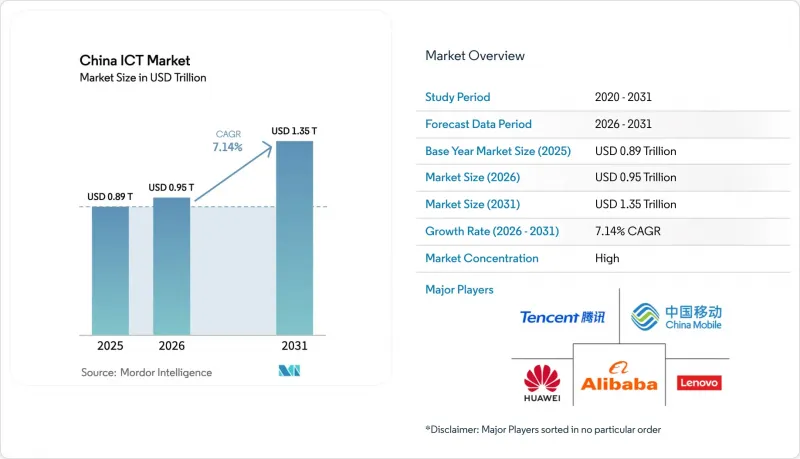
Mordor Intelligence에 의하면, 중국 ICT 시장 규모는 2025년 8,900억 달러에서 2026년에는 9,500억 달러로 확대되어 2026년부터 2031년까지 CAGR 7.14%로 성장을 지속하여, 2031년까지 1조 3,500억 달러에 이를 것으로 예측됩니다.
본 보고서는 유형별(하드웨어, 소프트웨어 등), 기업 규모별(중소기업 및 대기업), 산업별(은행, 금융서비스 및 보험(BFSI), IT 및 통신, 정부·공공 부문 등), 기술 분야별(클라우드 컴퓨팅, 인공지능, 사이버 보안 등) 및 지역별로 분류되어 있습니다. 시장 예측은 금액(달러)으로 제시되어 있습니다.
중국 ICT 시장 동향 및 인사이트
인터넷 및 5G 보급률 상승
2024년에는 전국적인 5G 구축으로 가입자 수가 1억 140만 명을 넘어섰으며, 모바일 인터넷 이용률은 78.6%에 달했습니다. 산업 단지에서는 실시간 품질 관리 및 무인 운반차 운행을 가능하게 하기 위해 사설 5G 네트워크가 도입되고 있습니다. 기지국이 하나 늘어날 때마다 데이터 트래픽이 두 배로 증가하여 엣지 서버와 IoT 게이트웨이가 처리해야 할 워크로드가 늘어납니다. 가격 책정 모델은 대역폭에 따른 종량제 과금에서 측정된 생산성 향상에 서비스 요금을 연동하는 성과 기반 계약으로 전환되고 있습니다. 따라서 기업들이 저지연 연결을 중심으로 프로세스를 재설계하는 가운데, 중국의 ICT 시장은 구독 수익과 고수익률의 통합 서비스를 모두 확보하고 있습니다.
정부의 ‘디지털 차이나’ 및 제14차 5개년 ICT 계획
중앙 정부의 계획에서는 2030년까지 GDP에서 차지하는 비중을 45%로 하는 등 디지털 경제에 관한 명확한 목표가 설정되어 있습니다. 통일된 기술 기준을 통해 스마트 시티, 원격 의료, 전자 정부 플랫폼의 통합 비용이 절감됩니다. ‘동부 데이터, 서부 컴퓨팅’ 프로그램 하에서 성(省)의 보조금을 통해 워크로드가 서부 지역으로 유도되어 에너지 비용이 절감되는 동시에 지역 간 처리 능력의 균형이 맞추어지고 있습니다. 현지 공급업체에 대한 우선 조달 의무로 인해 국내 칩, 서버, 미들웨어 벤더 시장 진입 기회가 확대되고 있습니다. 이처럼 정책 지원에 의해 예측 가능한 수요 사이클이 창출됨에 따라, 중국의 ICT 시장은 수량 면에서도 가치 면에서도 성장을 이루고 있습니다.
국영 기업의 레거시 IT 복잡성
많은 국영 기업은 여전히 수십 년에 걸쳐 도입되어 온 독점적인 메인프레임 환경에 의존하고 있습니다. 클라우드 애플리케이션를 이러한 시스템과 통합하려면 미들웨어나 맞춤형 커넥터가 필요하며, 이로 인해 프로젝트 기간과 비용이 증가합니다. 조달 체계에서는 공급업체의 실적이 중시되기 때문에 신생 소프트웨어 기업 시장 진입이 제한되고 있습니다. 또한, 디지털 워크플로는 기존 업무 절차와 충돌하는 경우가 많아 직원 재교육이 조직적인 과제가 됩니다. 이러한 관성으로 인해 중국 ICT 시장이 중공업의 밸류체인에 침투하는 전반적인 속도는 둔화되고 있습니다.
부문 분석
2025년, 하드웨어 부문은 중국 ICT 시장 매출의 42.65%를 차지했습니다. 5G 기지국, 고밀도 서버, 엣지 게이트웨이에 대한 투자는 전국적인 디지털화에 필수적인 기반을 형성하고 있습니다. 스마트 시티, 교통, 제조 프로젝트와 관련된 조달은 안정적인 장비 교체 주기를 보장하고 있습니다. 데이터센터 사업자들은 수출 위험을 줄이고 가치를 현지에서 창출하기 위해 국산 칩과 스위치 장비를 우선적으로 채택하고 있습니다.
소프트웨어 부문은 현재 규모는 작지만 연평균 성장률(CAGR) 10.09%를 나타낼 것으로 예측되며, 중국 ICT 시장에서 가장 빠르게 성장하는 분야가 될 전망입니다. PaaS(Platform-as-a-Service) 서비스는 코드 배포를 가속화하며, 로우코드(low-code) 도구를 통해 기술적 지식이 없는 직원도 고객용 용도 프로토타입을 제작할 수 있게 해줍니다. 기업들이 레거시 워크로드의 현대화를 추진함에 따라, 시스템 인프라 소프트웨어는 클라우드의 흐름을 타고 있습니다. 하드웨어와 소프트웨어의 융합으로 통합 스택이 탄생했으며, 화웨이(Huawei)와 같은 벤더들은 단일 계약을 통해 반도체, 운영 체제, 클라우드 서비스에서 수익을 창출할 수 있게 되었습니다.
2025년, 대기업들은 맞춤형 통합이 필요한 대규모 ERP, SCM, CRM 도입을 통해 중국 ICT 시장 점유율 63.55%를 유지했습니다. 이 기업들의 디지털 전환 로드맵은 핵심 생산, 재무, 유통 기능에 이르기까지 광범위하여 컨설팅 수요 증가를 확고히 하고 있습니다. 조달 주기는 장기적이지만, 관계가 성숙해지면 수년에 걸쳐 지속적인 수익원을 창출합니다.
중소기업(SME)은 연평균 성장률(CAGR) 10.32%라는 가장 빠른 성장세를 기록하며, 중국 ICT 시장 규모에 새로운 잠재 시장 규모를 더하고 있습니다. 대상 소프트웨어 구매에 대한 세금 환급 등의 재정적 인센티브로 인해 도입 장벽이 낮아지고 있습니다. 구독형 클라우드 제품군을 이용하면 초기 하드웨어 투자 없이도 AI 분석, 사이버 보안, 전자상거래 각 모듈에 접근할 수 있습니다. 피어 투 피어(P2P) 방식의 지식 공유가 신뢰감을 높여주며, 현지 서비스 파트너가 합리적인 가격으로 맞춤형 서비스를 제공합니다. 중소기업의 디지털화가 진행됨에 따라 투자액 1달러당 전반적인 생산성 향상률은 대개 대기업을 상회하고 있어, 이 고객층의 구조적 중요성이 더욱 커지고 있습니다.
기타 혜택:
- 엑셀 형식 시장 예측(ME) 시트
- 3개월간의 애널리스트 지원
자주 묻는 질문
목차
제1장 서론
제2장 조사 방법
제3장 주요 요약
제4장 시장 구도
제5장 시장 규모와 성장 예측
제6장 경쟁 구도
제7장 시장 기회와 향후 동향
JHS 26.09.03According to Mordor Intelligence, the china iCT market size is expected to grow from USD 0.89 trillion in 2025 to USD 0.95 trillion in 2026 and is forecast to reach USD 1.35 trillion by 2031 at 7.14% CAGR over 2026-2031.
This report is Segmented by Type (Hardware, Software, and More), Enterprise Size (Small and Medium Enterprises and Large Enterprises), Industry Vertical (BFSI, IT and Telecom, Government and Public, and More), Technology Domain (Cloud Computing, Artificial Intelligence, Cybersecurity, and More), and Region. The Market Forecasts are Provided in Terms of Value (USD).
China ICT Market Trends and Insights
Rising Internet and 5G Penetration
Nationwide 5G rollout exceeded 101.4 million subscribers in 2024, lifting mobile internet usage to 78.6%. Industrial parks adopt private 5G networks to enable real-time quality control and autonomous guided vehicles. Each additional base station multiplies data traffic, increasing the addressable workload for edge servers and IoT gateways. Pricing models evolve from bandwidth metering toward outcome-based arrangements that link service fees to measured productivity uplifts. The China ICT market, therefore, captures both subscription revenues and high-margin integration services as enterprises redesign processes around low-latency connectivity.
Government "Digital China" and 14th Five-Year ICT Plan
Central planning sets explicit digital-economy targets, including a 45% GDP contribution by 2030. Unified technical standards lower integration costs for smart-city, telemedicine, and e-government platforms. Provincial grants funnel workloads westward under the "Eastern Data, Western Computing" program, cutting energy expenses and balancing regional capacity. Mandatory preference for local suppliers expands market access for domestic chip, server, and middleware vendors. The China ICT market thus gains both volume and value as policy support creates predictable demand cycles.
Legacy IT Complexity in State-Owned Enterprises
Many state actors still depend on proprietary mainframe environments installed over decades. Integrating cloud applications with these systems requires middleware and custom connectors that increase project timelines and costs. Procurement frameworks emphasize vendor track record, restricting market entry for emerging software firms. Workforce retraining adds an organizational challenge because digital workflows often conflict with established operating procedures. This inertia slows the overall pace at which the Chinese ICT market can penetrate heavy-industry value chains.
Other drivers and restraints analyzed in the detailed report include:
- Accelerated Enterprise Cloud Migration
- AI-Driven Productivity Gains Across Sectors
- Escalating Cybersecurity and Data-Sovereignty Risk
For complete list of drivers and restraints, kindly check the Table Of Contents.
Segment Analysis
The hardware segment accounted for 42.65% of China's ICT market revenue in 2025. Investments in 5G base stations, high-density servers, and edge gateways form the indispensable substrate for nationwide digitalization. Procurement linked to smart-city, transportation, and manufacturing projects guarantees a steady equipment refresh cycle. Datacenter operators prioritize domestic chips and switch gear to mitigate export risk, anchoring value locally.
Software, though smaller today, is forecast to post a 10.09% CAGR, making it the fastest-growing component of the China ICT market. Platform-as-a-Service offerings accelerate code deployment, while low-code tools let non-technical staff prototype customer-facing applications. System-infrastructure software rides the cloud wave as enterprises modernize legacy workloads. The convergence of hardware and software yields integrated stacks, allowing vendors such as Huawei to monetize silicon, operating systems, and cloud services in a single contract.
Large organizations retained 63.55% of the China ICT market share in 2025 due to sizable ERP, SCM, and CRM deployments that require bespoke integration. Their digital-transformation roadmaps span core production, finance, and distribution functions, locking in high consulting demand. Procurement cycles are lengthy yet produce multi-year recurring revenue streams once relationships mature.
SMEs log the fastest expansion at 10.32% CAGR, adding fresh addressable volume to the China ICT market size. Fiscal incentives, including tax rebates on qualifying software purchases, lower adoption barriers. Subscription-based cloud suites grant access to AI analytics, cybersecurity, and e-commerce modules without up-front hardware spend. Peer-to-peer knowledge sharing boosts confidence, and local service partners offer affordable customization. As SME digital intensity rises, overall productivity gains per USD invested often exceed those of larger rivals, reinforcing the structural importance of this customer layer.
Complete Report Scope:
- By Type
- Hardware
- Computing Devices
- Network Equipment
- Datacentre Infrastructure
- Software
- System Infrastructure
- Enterprise Applications
- IT Services
- Consulting and Integration
- Managed Services
- Telecommunication Services
- Mobile Services
- Fixed-Line and Broadband
- Hardware
- By Enterprise Size
- Small and Medium Enterprises (SMEs)
- Large Enterprises
- By Industry Vertical
- BFSI
- IT and Telecom
- Government and Public
- Retail and E-commerce
- Manufacturing
- Energy and Utilities
- Healthcare
- Education
- Transportation and Logistics
- Other Industry Verticals
- By Technology Domain
- Cloud Computing
- Artificial Intelligence
- Cybersecurity
- Digital Services (SaaS, PaaS)
- Edge Computing
- Internet of Things
- Blockchain
- By Region
- East China
- South China
- North and Northeast China
- Central China
- West and North-west China
List of Companies Covered in this Report:
- Alibaba Group Holding Ltd.
- Huawei Technologies Co Ltd.
- Tencent Holdings Ltd.
- China Mobile Communications Group Co. Ltd.
- Lenovo Group Ltd.
- Baidu Inc.
- JD.com Inc.
- Xiaomi Corporation
- ZTE Corporation
- Inspur Group Co Ltd.
- Hikvision Digital Technology Co Ltd.
- Dahua Technology Co Ltd.
- Sangfor Technologies Inc.
- Venustech Group Inc.
- H3C Technologies Co Ltd.
- Kingsoft Cloud Holdings Ltd.
- UCloud Technology Co Ltd.
- Kingdee International Software Group Co Ltd.
- Neusoft Corporation
- iFlytek Co Ltd.
- SenseTime Group Inc.
- Cambricon Technologies Corp Ltd.
- GDS Holdings Ltd.
- FiberHome Telecom Technologies Co Ltd.
- China Unicom
- China Telecom
Additional Benefits:
- The market estimate (ME) sheet in Excel format
- 3 months of analyst support
TABLE OF CONTENTS
1 INTRODUCTION
- 1.1 Study Assumptions and Market Definition
- 1.2 Scope of the Study
2 RESEARCH METHODOLOGY
3 EXECUTIVE SUMMARY
4 MARKET LANDSCAPE
- 4.1 Market Overview
- 4.2 Market Drivers
- 4.2.1 Rising internet and 5G penetration
- 4.2.2 Government "Digital China" and 14th Five-Year ICT plan
- 4.2.3 Accelerated enterprise cloud migration
- 4.2.4 AI?driven productivity gains across sectors
- 4.2.5 "XInc.huang" localisation push fuelling domestic demand
- 4.2.6 Carbon-informatisation mandates driving green ICT
- 4.3 Market Restraints
- 4.3.1 Legacy IT complexity in state-owned enterprises
- 4.3.2 Escalating cybersecurity/data-sovereignty risk
- 4.3.3 US export controls on advanced semiconductors
- 4.3.4 Fragmented provIncial procurement processes
- 4.4 Industry Value Chain Analysis
- 4.5 Regulatory Landscape
- 4.6 Technological Outlook
- 4.7 Industry Attractiveness - Porter's Five Forces Analysis
- 4.7.1 Bargaining Power of Suppliers
- 4.7.2 Bargaining Power of Consumers
- 4.7.3 Threat of New Entrants
- 4.7.4 Threat of Substitute Products
- 4.7.5 Intensity of Competitive Rivalry
- 4.8 Impact of Macroeconomic Factors on the Market
5 MARKET SIZE AND GROWTH FORECASTS (VALUES)
- 5.1 By Type
- 5.1.1 Hardware
- 5.1.1.1 Computing Devices
- 5.1.1.2 Network Equipment
- 5.1.1.3 Datacentre Infrastructure
- 5.1.2 Software
- 5.1.2.1 System Infrastructure
- 5.1.2.2 Enterprise Applications
- 5.1.3 IT Services
- 5.1.3.1 Consulting and Integration
- 5.1.3.2 Managed Services
- 5.1.4 Telecommunication Services
- 5.1.4.1 Mobile Services
- 5.1.4.2 Fixed-Line and Broadband
- 5.1.1 Hardware
- 5.2 By Enterprise Size
- 5.2.1 Small and Medium Enterprises (SMEs)
- 5.2.2 Large Enterprises
- 5.3 By Industry Vertical
- 5.3.1 BFSI
- 5.3.2 IT and Telecom
- 5.3.3 Government and Public
- 5.3.4 Retail and E-commerce
- 5.3.5 Manufacturing
- 5.3.6 Energy and Utilities
- 5.3.7 Healthcare
- 5.3.8 Education
- 5.3.9 Transportation and Logistics
- 5.3.10 Other Industry Verticals
- 5.4 By Technology Domain
- 5.4.1 Cloud Computing
- 5.4.2 Artificial Intelligence
- 5.4.3 Cybersecurity
- 5.4.4 Digital Services (SaaS, PaaS)
- 5.4.5 Edge Computing
- 5.4.6 Internet of Things
- 5.4.7 Blockchain
- 5.5 By Region
- 5.5.1 East China
- 5.5.2 South China
- 5.5.3 North and Northeast China
- 5.5.4 Central China
- 5.5.5 West and North-west China
6 COMPETITIVE LANDSCAPE
- 6.1 Market Concentration
- 6.2 Strategic Moves
- 6.3 Market Share Analysis
- 6.4 Company Profiles (includes Global level Overview, Market level overview, Core Segments, Financials as available, Strategic Information, Market Rank/Share for key companies, Products and Services, and Recent Developments)
- 6.4.1 Alibaba Group Holding Ltd.
- 6.4.2 Huawei Technologies Co Ltd.
- 6.4.3 Tencent Holdings Ltd.
- 6.4.4 China Mobile Communications Group Co. Ltd.
- 6.4.5 Lenovo Group Ltd.
- 6.4.6 Baidu Inc.
- 6.4.7 JD.com Inc.
- 6.4.8 Xiaomi Corporation
- 6.4.9 ZTE Corporation
- 6.4.10 Inspur Group Co Ltd.
- 6.4.11 Hikvision Digital Technology Co Ltd.
- 6.4.12 Dahua Technology Co Ltd.
- 6.4.13 Sangfor Technologies Inc.
- 6.4.14 Venustech Group Inc.
- 6.4.15 H3C Technologies Co Ltd.
- 6.4.16 Kingsoft Cloud Holdings Ltd.
- 6.4.17 UCloud Technology Co Ltd.
- 6.4.18 Kingdee International Software Group Co Ltd.
- 6.4.19 Neusoft Corporation
- 6.4.20 iFlytek Co Ltd.
- 6.4.21 SenseTime Group Inc.
- 6.4.22 Cambricon Technologies Corp Ltd.
- 6.4.23 GDS Holdings Ltd.
- 6.4.24 FiberHome Telecom Technologies Co Ltd.
- 6.4.25 China Unicom
- 6.4.26 China Telecom
7 MARKET OPPORTUNITIES AND FUTURE TRENDS
- 7.1 White-Space and Unmet-Need Assessment


