

|
시장보고서
상품코드
2125540
태국의 ICT : 시장 점유율 분석, 업계 동향 및 통계, 성장 예측(2026-2031년)Thailand ICT - Market Share Analysis, Industry Trends & Statistics, Growth Forecasts (2026 - 2031) |
||||||
 Mordor Intelligence
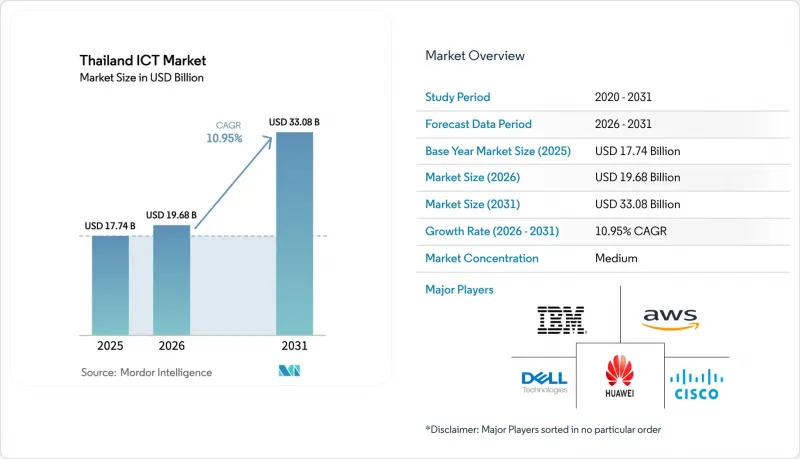
Mordor Intelligence에 의하면, 태국의 ICT 시장 규모는 2025년 177억 4,000만 달러로 평가되었습니다. 2026년에는 196억 8,000만 달러로 확대되어 2026년부터 2031년에 걸쳐 CAGR 10.95%로 성장을 지속하여, 2031년에는 330억 8,000만 달러에 이를 것으로 예측됩니다.
본 보고서는 제품 유형(IT 하드웨어, IT 소프트웨어, IT 서비스, IT 인프라, IT 보안, 통신 서비스), 최종 사용자 기업 규모(중소기업, 대기업), 최종 사용자 업종(정부·공공 행정, 은행, 금융서비스 및 보험(BFSI), 에너지 및 유틸리티 등)별로 분류되어 있습니다. 시장 예측은 금액(달러) 기준으로 제시되어 있습니다.
태국의 ICT 시장 동향 및 인사이트
5G 네트워크의 급속한 확산과 가입자 증가
2024년까지 전국 규모의 5G 구축을 통해 인구의 95%를 커버하게 됨에 따라, 제조업 분야의 예측 유지보수나 물류의 실시간 추적과 같은 엣지 컴퓨팅 활용 사례가 가능해졌습니다. 통신 사업자들은 네트워크 슬라이싱을 도입하여 미션 크리티컬 용도를 위한 전용 처리량을 제공함으로써, 소비자용 음성 및 데이터 통신을 넘어서는 새로운 기업용 수익원을 개척하고 있습니다. 국가방송통신위원회의 주파수 대역 할당 및 인프라 공유에 관한 규정에 따라 지방의 구축 비용이 절감되어 방콕 이외 지역에서의 도입이 가속화되고 있습니다. 동부 경제 회랑의 제조업체들은 5G 센서와 AI 분석을 통합하여 예기치 못한 가동 중단 시간을 줄이고 처리량을 향상시키고 있습니다. 5G 지원 단말기의 보급률 상승이 가입자의 전환을 촉진하고 있으며, 사용자 1인당 월평균 데이터 소비량은 두 자릿수 기가바이트 수준에 달하고 있습니다.
정부의 ‘클라우드 퍼스트’ 정책이 도입을 가속화
2024년 이후, 모든 공공기관은 On-Premise 조달에 대해 예외 사유를 정당화해야 하며, 이에 따라 각 부처는 ISO 27001 및 ‘개인정보보호법’ 인증을 받은 국내 클라우드 리전으로 레거시 시스템을 이전하도록 권장받고 있습니다. 150억 바트(4억 7,000만 달러) 규모의 ‘스마트 네이션, 스마트 라이프(Smart Nation, Smart Life)’ 프로그램은 공유 API 게이트웨이와 정부가 승인한 클라우드에서 호스팅되는 ‘ThaiLLM’이라 불리는 주권형 대규모 언어 모델(LLM) 플랫폼에 자금을 지원하고 있습니다. 국영 기업들은 현재 단일 조달 포털을 통해 서비스 카탈로그를 공개하고 있으며, 민간 공급업체에 통합을 위한 명확한 로드맵을 제공합니다. 이 정책은 규제 대상 산업에서도 유사한 움직임을 촉진하고 있으며, 금융 기관들은 정부의 프레임워크를 기준으로 클라우드 보안 기준을 수립하고 있습니다. 그 결과, 클라우드 기술, 참조 아키텍처, 조달 템플릿이 민간 부문으로 확산되면서 태국의 ICT 시장은 시너지 효과를 누리고 있습니다.
중소기업의 디지털 역량 분산과 사이버 보안 대응 능력 격차
태국 중소기업 10곳 중 9곳은 공식적인 디지털 투자 계획을 수립하지 않았으며, 클라우드로 전환한 기업 중 상당수 역시 다단계 인증이나 역할 기반 접근 제어와 같은 기본적인 보안 설정을 간과하고 있습니다. 제로 트러스트 프레임워크에 대한 인식이 부족하기 때문에 소규모 기업은 피싱이나 랜섬웨어 공격에 노출되어, 업무가 수 주간 마비될 위험에 직면해 있습니다. ‘SME 4.0’ 프로그램에 기반한 정부의 바우처 제도에서는 교육 및 컨설팅 비용을 지원해 주고 있지만, 경영자들이 당면한 현금 흐름 문제를 우선시하고 있어 이용률은 여전히 30% 미만에 머물고 있습니다. 보험사가 중소기업의 정보 유출 빈도 증가를 위험 요인으로 고려한 결과, 사이버 보험료가 상승하고 있습니다. 지속적인 기술 개발이 이루어지지 않을 경우, 태국의 ICT 시장에서 도시 지역 이외의 클라우드 도입 진전이 둔화될 위험이 있습니다.
부문별 분석
2025년 태국의 ICT 시장 점유율에서 IT 서비스가 32.08%로 가장 큰 비중을 차지했으며, 매니지드 서비스 계약과 멀티 클라우드 전환 프로젝트가 이를 견인했습니다. 통신 사업자들은 네트워크 운영 센터를 외부에 위탁하고 있으며, 제조업체들은 예측 유지보수 도입을 위해 시스템 통합 업체를 활용하고 있습니다. 이러한 맥락에서 기업들이 모놀리식 용도를 API 기반 마이크로서비스로 리팩토링함에 따라 클라우드 서비스는 연평균 성장률(CAGR) 11.45%를 나타낼 것으로 예측됩니다. 하드웨어 수요는 5G 무선 설비 업그레이드와 데이터센터에 대한 설비 투자를 배경으로 견조한 추세를 보이고 있는 반면, 사이버 보안에 대한 지출은 끊임없는 위협 요인으로 인해 가속화되고 있습니다.
자본 지출(Capex)에서 운영 비용(OpEx)으로의 전환은 벤더의 수익 모델을 재구성하고 있습니다. PTT Exploration and Production사가 클라우드 네이티브 개발 플랫폼으로 전환한 결과, 애플리케이션 릴리스 주기가 480% 단축되어 레거시 시스템 현대화를 통해 얻을 수 있는 성과가 입증되었습니다. 저지연 요건을 충족하기 위해 제조 공장에서는 엣지 컴퓨팅 어플라이언스가 보급되고 있으며, 이는 태국 국가방송통신위원회(NBTC)의 기준을 인증받은 하드웨어 벤더에게 새로운 수익원이 되고 있습니다. 태국의 ICT 시장에서는 비즈니스 분석가가 용도 프로토타입을 제작할 수 있는 로우코드 개발 도구가 도입되어, 부족한 개발 인력의 부담을 덜어주고 있습니다.
기타 혜택 :
- 엑셀 형식 시장 예측(ME) 시트
- 3개월간의 애널리스트 지원
자주 묻는 질문
목차
제1장 서론
제2장 조사 방법
제3장 주요 요약
제4장 시장 구도
제5장 시장 규모 및 성장 예측
제6장 경쟁 구도
제7장 시장 기회 및 향후 전망
KTH 26.09.16According to Mordor Intelligence, the Thailand ICT market size is expected to grow from USD 17.74 billion in 2025 to USD 19.68 billion in 2026 and is forecast to reach USD 33.08 billion by 2031 at 10.95% CAGR over 2026-2031.
This report is Segmented by Product Type (IT Hardware, IT Software, IT Services, IT Infrastructure, IT Security, Communication Services), End-User Enterprise Size (Small and Medium Enterprises, Large Enterprises), and End-User Industry Vertical (Government and Public Administration, BFSI, Energy and Utilities, and More). The Market Forecasts are Provided in Terms of Value (USD).
Thailand ICT Market Trends and Insights
Rapid 5G Network Deployment and Subscriber Uptake
Nationwide 5G roll-out reached 95% population coverage by 2024, enabling edge-computing use cases for predictive maintenance in manufacturing and real-time logistics tracking. Operators deploy network-slicing to offer dedicated throughput for mission-critical applications, unlocking enterprise revenue streams that move beyond consumer voice and data. The National Broadcasting and Telecommunications Commission's spectrum allocations and infrastructure-sharing rules lower deployment costs for rural areas, accelerating adoption outside Bangkok. Manufacturers in the Eastern Economic Corridor integrate 5G sensors with AI analytics to cut unplanned downtime and boost throughput. Rising 5G handset penetration fuels subscriber migration, pushing average data consumption to double-digit gigabyte levels per user each month.
Government "Cloud-First" Policy Accelerating Adoption
Since 2024, every public-sector agency must justify on-premises procurements as exceptions, prompting ministries to migrate legacy systems onto domestic cloud regions certified under ISO 27001 and the Personal Data Protection Act. The THB 15 billion (USD 0.47 billion) Smart Nation Smart Life program funds shared API gateways and a sovereign large-language-model platform dubbed ThaiLLM hosted in government-approved clouds. State-owned enterprises now publish service catalogs through a single procurement portal, giving private vendors a clear roadmap for integration. The policy has catalyzed similar behavior in regulated industries, with financial institutions benchmarking cloud-security baselines against the government framework. As a result, the Thailand ICT market enjoys a multiplier effect as cloud skills, reference architectures, and procurement templates trickle into the private sector.
Fragmented SME Digital-Skills and Cyber-Readiness Gap
Nine in ten Thai SMEs lack formal digital investment plans, and many who do migrate to cloud overlook basic security configurations such as multi-factor authentication or role-based access. Limited awareness of zero-trust frameworks leaves smaller firms exposed to phishing and ransomware that can cripple operations for weeks. Government vouchers under the SME 4.0 program subsidize training and consulting, yet usage remains below 30% because owners prioritize immediate cash-flow concerns. Cyber-insurance premiums climb as underwriters factor in elevated breach frequency among small businesses. Without continuous skills development, the Thailand ICT market risks slower cloud uptake outside the urban core.
Other drivers and restraints analyzed in the detailed report include:
- Enterprise Industry 4.0 Digital-Transformation Surge
- Hyperscale Data-Center FDI Inflows
- Shortage of Advanced ICT Talent and Rising Labor Cost
For complete list of drivers and restraints, kindly check the Table Of Contents.
Segment Analysis
IT Services contributed the largest 32.08% slice of the Thailand ICT market share in 2025, led by managed services contracts and multi-cloud migration projects. Telecom operators outsource network operations centers, and manufacturers engage system integrators for predictive-maintenance deployments. Within this umbrella, Cloud Services is forecast to grow at an 11.45% CAGR as enterprises refactor monolithic applications into API-driven microservices. Hardware demand holds steady on the back of 5G radio upgrades and data-center capital expenditure, while cybersecurity outlays accelerate due to persistent threat vectors.
The migration from capex to opex spending reshapes vendor revenue models. PTT Exploration and Production's move to a cloud-native development platform reduced application release cycles by 480%, illustrating payoffs realized when legacy systems are modernized. Edge-computing appliances proliferate in manufacturing plants to meet low-latency requirements, creating fresh revenue for hardware vendors certified under National Broadcasting and Telecommunications Commission standards. The Thailand ICT market incorporates low-code development tools that empower business analysts to prototype applications, easing pressure on scarce developer talent.
Complete Report Scope:
- By Product Type
- IT Hardware
- Computer Hardware
- Networking Equipment
- Peripherals
- IT Software
- IT Services
- IT Consulting and Implementation
- IT Outsourcing (ITO)
- Business Process Outsourcing (BPO)
- Managed Security Services
- Cloud and Platform Services
- IT Infrastructure
- IT Security/Cybersecurity
- Communication Services
- IT Hardware
- By Enterprise Size
- Small and Medium-sized Enterprises
- Large Enterprises
- By End-user Industry Vertical
- Government and Public Administration
- BFSI
- IT and Telecom
- Energy and Utilities
- Retail, E-commerce, and Logistics
- Manufacturing and Industry 4.0
- Healthcare and Life Sciences
- Oil and Gas
- Gaming and Esports
- Other Verticals
List of Companies Covered in this Report:
- Advanced Info Service Public Company Limited
- True Corporation Public Company Limited
- National Telecom Public Company Limited
- Huawei Technologies Co., Ltd.
- Cisco Systems, Inc.
- International Business Machines Corporation
- Dell Technologies Inc.
- Amazon Web Services, Inc.
- Google LLC
- Microsoft Corporation
- Oracle Corporation
- SAP SE
- Cognizant Technology Solutions Corporation
- Wipro Limited
- Ericsson AB
- Nokia Corporation
- Check Point Software Technologies Ltd.
- Palo Alto Networks, Inc.
- Alibaba Cloud Computing Co., Ltd.
- VMware, Inc.
- Fujitsu Limited
- NEC Corporation
- Accenture plc
- Hewlett Packard Enterprise Company
- Seagate Technology Holdings plc
Additional Benefits:
- The market estimate (ME) sheet in Excel format
- 3 months of analyst support
TABLE OF CONTENTS
1 INTRODUCTION
- 1.1 Study Assumptions and Market Definition
- 1.2 Scope of the Study
2 RESEARCH METHODOLOGY
3 EXECUTIVE SUMMARY
4 MARKET LANDSCAPE
- 4.1 Market Overview
- 4.2 Market Drivers
- 4.2.1 Rapid 5G network deployment and subscriber uptake
- 4.2.2 Government "Cloud-First" policy accelerating adoption
- 4.2.3 Enterprise Industry 4.0 digital-transformation surge
- 4.2.4 Hyperscale data-center FDI inflows
- 4.2.5 Virtual-bank licensing fuelling fintech infrastructure
- 4.2.6 AI-ready, liquid-cooling data-center hub ambitions
- 4.3 Market Restraints
- 4.3.1 Fragmented SME digital-skills and cyber-readiness gap
- 4.3.2 Shortage of advanced ICT talent and rising labor cost
- 4.3.3 Stricter data-localization mandates increasing TCO
- 4.3.4 Soaring cyber-fraud liability dampening ICT budgets
- 4.4 Value Chain Analysis
- 4.5 Regulatory Landscape
- 4.6 Technological Outlook
- 4.7 Porter's Five Forces Analysis
- 4.7.1 Bargaining Power of Suppliers
- 4.7.2 Bargaining Power of Buyers
- 4.7.3 Threat of New Entrants
- 4.7.4 Threat of Substitutes
- 4.7.5 Intensity of Competitive Rivalry
- 4.8 Investment Analysis
- 4.9 Impact of Macroeconomic Factors
- 4.10 Industry Stakeholder Analysis
5 MARKET SIZE AND GROWTH FORECASTS (VALUE)
- 5.1 By Product Type
- 5.1.1 IT Hardware
- 5.1.1.1 Computer Hardware
- 5.1.1.2 Networking Equipment
- 5.1.1.3 Peripherals
- 5.1.2 IT Software
- 5.1.3 IT Services
- 5.1.3.1 IT Consulting and Implementation
- 5.1.3.2 IT Outsourcing (ITO)
- 5.1.3.3 Business Process Outsourcing (BPO)
- 5.1.3.4 Managed Security Services
- 5.1.3.5 Cloud and Platform Services
- 5.1.4 IT Infrastructure
- 5.1.5 IT Security/Cybersecurity
- 5.1.6 Communication Services
- 5.1.1 IT Hardware
- 5.2 By Enterprise Size
- 5.2.1 Small and Medium-sized Enterprises
- 5.2.2 Large Enterprises
- 5.3 By End-user Industry Vertical
- 5.3.1 Government and Public Administration
- 5.3.2 BFSI
- 5.3.3 IT and Telecom
- 5.3.4 Energy and Utilities
- 5.3.5 Retail, E-commerce, and Logistics
- 5.3.6 Manufacturing and Industry 4.0
- 5.3.7 Healthcare and Life Sciences
- 5.3.8 Oil and Gas
- 5.3.9 Gaming and Esports
- 5.3.10 Other Verticals
6 COMPETITIVE LANDSCAPE
- 6.1 Market Concentration
- 6.2 Strategic Moves
- 6.3 Market Share Analysis
- 6.4 Company Profiles (includes Global level Overview, Market level overview, Core Segments, Financials as available, Strategic Information, Market Rank/Share for key companies, Products and Services, and Recent Developments)
- 6.4.1 Advanced Info Service Public Company Limited
- 6.4.2 True Corporation Public Company Limited
- 6.4.3 National Telecom Public Company Limited
- 6.4.4 Huawei Technologies Co., Ltd.
- 6.4.5 Cisco Systems, Inc.
- 6.4.6 International Business Machines Corporation
- 6.4.7 Dell Technologies Inc.
- 6.4.8 Amazon Web Services, Inc.
- 6.4.9 Google LLC
- 6.4.10 Microsoft Corporation
- 6.4.11 Oracle Corporation
- 6.4.12 SAP SE
- 6.4.13 Cognizant Technology Solutions Corporation
- 6.4.14 Wipro Limited
- 6.4.15 Ericsson AB
- 6.4.16 Nokia Corporation
- 6.4.17 Check Point Software Technologies Ltd.
- 6.4.18 Palo Alto Networks, Inc.
- 6.4.19 Alibaba Cloud Computing Co., Ltd.
- 6.4.20 VMware, Inc.
- 6.4.21 Fujitsu Limited
- 6.4.22 NEC Corporation
- 6.4.23 Accenture plc
- 6.4.24 Hewlett Packard Enterprise Company
- 6.4.25 Seagate Technology Holdings plc
7 MARKET OPPORTUNITIES AND FUTURE OUTLOOK
- 7.1 White-space and unmet-need assessment


