

|
시장보고서
상품코드
2116885
미국의 ICT 시장 : 점유율 분석, 업계 동향과 통계, 성장 예측(2026-2031년)United States ICT - Market Share Analysis, Industry Trends & Statistics, Growth Forecasts (2026 - 2031) |
||||||
 Mordor Intelligence
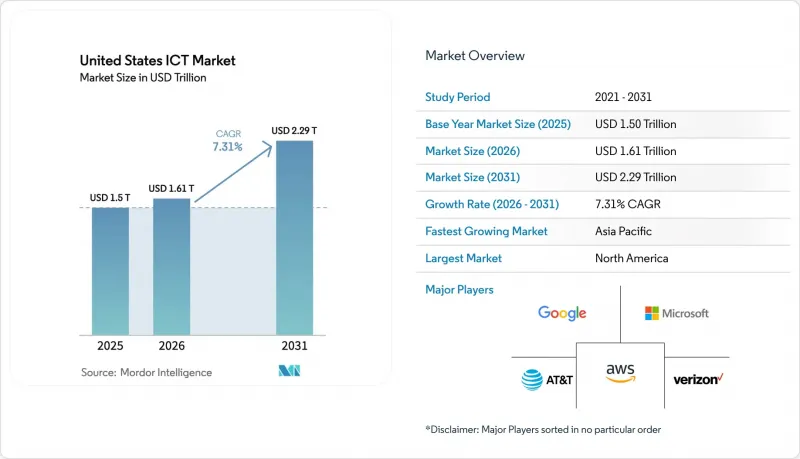
Mordor Intelligence에 의하면, 2026년 미국 ICT 시장 규모는 1조 6,100억 달러로 추정되고 있어 2025년 1조 5,000억 달러에서 확대해, 2031년에는 2조 2,900억 달러에 이를 것으로 예측됩니다.
2026년부터 2031년까지 연평균 성장률(CAGR) 7.31%로 성장할 것으로 전망됩니다.
본 보고서는 유형(IT 하드웨어, IT 소프트웨어, IT 서비스, IT 인프라/데이터센터, IT 보안/사이버 보안, 통신 서비스), 기업 규모(중소기업, 대기업),산업 분야(은행, 금융서비스 및 보험(BFSI), IT 및 통신, 정부 기관, 소매 및 전자상거래, 제조업 등), 배포 모델(On-Premise, 클라우드, 하이브리드)로 분류되어 있습니다. 시장 전망은 금액(달러)으로 표시되어 있습니다.
미국 ICT 시장 동향 및 인사이트
연방 및 주 차원의 광대역 자금 지원 가속화
424억 5,000만 달러 규모의 BEAD 프로그램은 미국 역사상 최대 규모의 광대역 투자로, 현재 총 56개 주 및 준주에 대한 배분이 승인되었습니다. 이 자금은 최소 100/20 Mbps의 서비스를 보장하는 광섬유망 구축을 우선시하고 있어, SaaS 벤더와 관리형 서비스 제공업체의 잠재 고객 기반을 즉각적으로 확대되고 있습니다. 캘리포니아주와 텍사스주 등에서는 연방 정부의 보조금에 각각 130억 달러 및 54억 달러를 추가로 투입하여 지역별 기술 회랑(technology corridor) 형성을 촉진하고 있습니다. 민간 ISP와 하이퍼스케일러는 이러한 공공 자금을 활용하여 백본 회선과 엣지 노드를 확장하고 있으며, 이는 전문 서비스, 유지보수 계약, 클라우드 도입 지원 등 각 분야에 파급 효과를 가져오고 있습니다. 이 프로그램의 저소득 가구를 위한 이용 요금 지원 조치는 신설 네트워크의 장기적인 이용을 보장하고, 연결성 향상을 지속 가능한 수익원으로 연결하고 있습니다.
5G 네트워크의 급속한 확산
2024년 3분기, 기업의 5G 연결 건수는 1억 7,600만 건에 달하여 인구의 47%를 커버하게 되었습니다. 이는 신규 가정용 광대역 가입자의 40%를 고정 무선 액세스(FWA)가 차지했기 때문입니다. 통신 속도 향상과 더불어 프라이빗 5G는 제조 자동화, 원격 의료 모니터링, 스마트 물류 등의 용도를 가능하게 하여 통합 업체에 지속적인 수익을 가져다주고 있습니다. CBRS 주파수 대역에 대한 규제 덕분에 자동차 공장부터 NFL 경기장에 이르기까지 다양한 도입 사례가 생겨나며, 5G의 범용성이 두드러지고 있습니다. 경제 모델에 따르면, 이 기술은 2025년까지 ICT 분야에서 2,512억 달러의 GDP 창출로 이어질 가능성이 있습니다. AI 워크로드가 사용자와 가까운 곳으로 이동함에 따라, 5G의 저지연 통신 경로는 엣지 컴퓨팅 배포의 기반이 되어, 지연에 민감한 추론 작업이 거의 실시간 속도로 실행되도록 보장합니다.
사이버 보안 인력 부족
사이버 보안 분야에서는 여전히 약 44만 8,000건의 인력 부족이 지속되고 있으며, 기업들이 확대되는 공격 표면을 방어하는 데 어려움을 겪는 가운데 디지털 프로젝트의 진척이 더뎌지고 있습니다. 클라우드 보안 아키텍처, AI/ML 방어, 그리고 OT(운영 기술) 보호 분야의 인력 부족으로 인해 클라우드 전환 및 IoT의 확장 속도가 지연되고 있습니다. 사이버 보안 분야 학위 취득자 수는 지난 10년간 271% 증가했지만, 인력 공급은 여전히 수요를 따라가지 못하고 있습니다. 임금 상승은 대기업과 공공 기관에 유리하게 작용하는 반면, 중소기업(SME)은 고숙련 인재 확보 경쟁에 직면해 있습니다. 또한 다양성 측면에서 격차가 존재하여, 히스패닉 및 라틴계 전문 인력은 여전히 과소 대표되고 있어, 활용 가능한 인재 풀을 더욱 좁히고 있습니다. 그 결과, 기업들은 인적 자본의 한계를 보완하기 위해 재교육, 자동화, 관리형 보안 서비스와의 제휴에 투자하고 있습니다.
부문 분석
2025년, IT 서비스는 미국 ICT 시장의 37.65%를 차지하며, 고객이 관리형 전환, 사이버 보안 강화, AI 통합에 의존하고 있음을 여실히 보여줍니다. 이 부문의 규모는 특히 현대화를 서두르면서도 사내 기술 격차로 어려움을 겪고 있는 기업들 사이에서 턴키 방식의 전문 지식에 대한 수요를 반영하고 있습니다. 대조적으로, IT 보안은 전국적인 인력 부족에 힘입어 조직들이 제로 트러스트 프레임워크와 지속적인 위협 모니터링 구독을 추구하는 가운데, 모든 카테고리 중 가장 빠른 연평균 성장률(CAGR) 10.85%를 기록할 전망입니다.
IT 하드웨어 지출은 클라우드 통합으로 인해 계속해서 억제되고 있는 반면, IT 소프트웨어는 구독 모델로의 전환과 생성형 AI 애드온의 보급으로 혜택을 보고 있습니다. 통신 서비스는 5G FWA의 지속적인 보급으로 정기적인 연결 수익이 두 배로 증가함에 따라 성장하고 있습니다. 컨설팅, 도입, 매니지드 서비스 계약을 결합하는 제공업체는 AI 지원 Copilot 솔루션을 제공하기 위해 액센츄어 및 아바나드와 3자 제휴를 맺은 마이크로소프트와 마찬가지로 뛰어난 실적을 올릴 것입니다. 통합된 이용 사례를 둘러싼 하드웨어, 소프트웨어, 연결성의 융합은 향후 이익이 단일 제품이 아닌, 엔드투엔드 밸류체인을 제공하는 플랫폼에서 창출될 것임을 시사합니다. 또한, 컴팩트한 폼 팩터에 보안 및 AI 가속기를 통합하는 엣지 하드웨어 전문 기업들도 인더스트리 4.0의 워크로드가 확대됨에 따라 큰 성장이 예상됩니다.
대기업은 2025년 지출의 62.45%를 차지하며, 다년간의 예산을 활용하여 벤더에게 막대한 의무를 부과하는 복잡한 하이브리드 클라우드 및 사이버 보안 프로그램을 계약하고 있습니다. 반면, 중소기업은 연평균 성장률(CAGR) 9.62%로 성장하고 있으며, 클라우드의 대중화와 로우코드 플랫폼으로 인한 진입 장벽의 낮아짐에 따라 기존의 격차는 점차 줄어들고 있습니다. 중소기업은 막대한 설비 투자가 필요 없이 클라우드 네이티브 ERP, AI 기반 CRM, 구독형 사이버보안을 도입함으로써 기존의 제약을 극복하고 있습니다. 그 결과, 고대역폭 통신 범위를 확대하는 FWA(원격 근무)와 지방 지역의 광섬유 인프라 구축에 힘입어, 미국 중소기업용 ICT 시장 규모는 2031년까지 대폭 확대될 것으로 예측됩니다.
대기업의 구매 담당자들은 멀티 클라우드 거버넌스, 워크로드 이식성, AI 윤리를 점점 더 중요하게 여기게 되면서, 오케스트레이션 플랫폼 및 Compliance-as-a-Service(CaaS) 제공에 새로운 기회가 생겨나고 있습니다. 한편, 중소기업을 대상으로 하는 벤더는 사용 편의성과 합리적인 가격의 균형을 맞추어야 하며, 가격대별 패키지나 종량제 이용 모델이 가장 효과적인 것으로 입증되었습니다. SBA(중소기업청)의 사이버 보안·복원력 프로그램과 같은 정책 인센티브는 중소기업의 보안 지출을 더욱 촉진하고, 대기업과의 위험 노출 격차를 줄일 가능성이 있습니다.
기타 혜택:
- 엑셀 형식 시장 예측(ME) 시트
- 3개월간의 애널리스트 지원
자주 묻는 질문
목차
제1장 서론
제2장 조사 방법
제3장 주요 요약
제4장 시장 구도
제5장 시장 규모와 성장 예측
제6장 경쟁 구도
제7장 시장 기회와 향후 전망
JHS 26.09.03According to Mordor Intelligence, United States ICT market size in 2026 is estimated at USD 1.61 trillion, growing from 2025 value of USD 1.50 trillion with 2031 projections showing USD 2.29 trillion, growing at 7.31% CAGR over 2026-2031.
This report is Segmented by Type (IT Hardware, IT Software, IT Services, IT Infrastructure, Communication Services), Enterprise Size (Small and Medium Enterprises, Large Enterprises), Industry Vertical (BFSI, IT and Telecom, Government, Retail and E-Commerce, Manufacturing, and More), and Deployment Model (On-Premises, Cloud, Hybrid). The Market Forecasts are Provided in Terms of Value (USD).
United States ICT Market Trends and Insights
Accelerated Federal and State Broadband Funding
The USD 42.45 billion BEAD program marks the largest broadband investment in U.S. history, with all 56 states and territories now approved for allocations . Funding prioritizes fiber builds that guarantee minimum 100/20 Mbps service, immediately expanding the addressable base for SaaS vendors and managed service providers. States such as California and Texas have layered additional USD 13 billion and USD 5.4 billion, respectively, onto federal grants, catalyzing regional technology corridors [GOVTECH.COM]. Private ISPs and hyperscalers are leveraging these public funds to extend backbone routes and edge nodes, creating multiplier effects across professional services, maintenance contracts, and cloud on-ramps. The program's affordability provisions for low-income households secure long-run utilization of newly built networks, translating connectivity gains into sustainable revenue streams.
Rapid 5G Network Roll-Out
Enterprise 5G connections climbed to 176 million in Q3 2024, representing 47% population coverage as fixed-wireless access (FWA) accounted for 40% of new home broadband additions. Beyond speed improvements, private 5G enables manufacturing automation, remote healthcare monitoring, and smart-logistics applications that generate recurring integrator revenue. CBRS spectrum rules have seeded diverse deployments from automotive plants to NFL stadiums highlighting 5G versatility. Economic modeling suggests the technology could unlock USD 251.2 billion in GDP for the ICT domain by 2025. As AI workloads migrate closer to users, 5G's low-latency pathways form the backbone for edge-computing rollouts, ensuring that latency-sensitive inference tasks operate at near-real-time speeds.
Cyber-Security Talent Shortage
Roughly 448,000 cybersecurity vacancies persist, curbing the pace of digital projects as enterprises struggle to secure expanded attack surfaces . Shortfalls in cloud-security architecture, AI/ML defense, and OT protection delay cloud migrations and IoT scale-outs. While degree completions in cyber fields grew 271% over the past decade, supply still trails demand. Wage inflation favors large enterprises and public agencies, leaving SMEs exposed to skilled-labor bidding wars. Diversity gaps-Hispanic and Latino professionals remain underrepresented-further shrink the available pool, compelling firms to invest in reskilling, automation, and managed-security partnerships that offset human-capital constraints.
Other drivers and restraints analyzed in the detailed report include:
- Enterprise Migration to Hybrid Multi-Cloud
- Edge-Computing Demand from Industry 4.0
- Rising Energy Costs and Sustainability Pressure on Data Centers
For complete list of drivers and restraints, kindly check the Table Of Contents.
Segment Analysis
IT Services retained 37.65% of the United States ICT market in 2025, underscoring client reliance on managed migrations, cybersecurity hardening, and AI integration. The segment's scale reflects demand for turnkey expertise, especially among firms racing to modernize but battling internal skills gaps. In contrast, IT Security, bolstered by the national talent deficit, is set to post an 10.85% CAGR, the fastest across categories, as organizations pursue zero-trust frameworks and continuous threat-monitoring subscriptions.
Spending on IT Hardware remains tempered by cloud consolidation, while IT Software benefits from subscription transitions and generative-AI add-ons. Communication Services lift on sustained 5G FWA uptake that multiplies recurring-connectivity revenue. Providers blending consulting, implementation, and managed-service contracts will outperform, mirroring Microsoft's tri-partite partnership with Accenture and Avanade to deliver AI-enabled Copilot solutions. The convergence of hardware, software, and connectivity around integrated use-cases signals that future gains will accrue to platforms offering end-to-end value chains rather than single-point products. Edge hardware specialists that embed security and AI accelerators into compact form factors are also positioned for outsized upside as Industry 4.0 workloads proliferate.
Large Enterprises controlled 62.45% of 2025 spend, leveraging multi-year budgets to contract complex hybrid-cloud and cybersecurity programs that lock in sizable vendor obligations. Yet Small & Medium Enterprises are advancing at a 9.62% CAGR, shrinking historical disparities as cloud democratization and low-code platforms lower entry barriers. SMEs leapfrog legacy constraints, adopting cloud-native ERP, AI-driven CRM, and subscription-based cybersecurity without heavy capital outlays. The United States ICT market size for SMEs is therefore projected to widen meaningfully by 2031, supported by FWA and rural fiber builds that extend high-bandwidth reach.
Large-enterprise buyers increasingly emphasize multi-cloud governance, workload portability, and AI ethics, generating opportunities for orchestration platforms and compliance-as-a-service offerings. Meanwhile, vendors courting the SME cohort must balance ease-of-use with affordability-tiered packages and pay-as-you-go consumption models have proven most effective. Policy incentives such as the SBA's Cybersecurity Resilience Program may further catalyze SME security spend, narrowing risk exposure differentials with corporate peers.
Complete Report Scope:
- By Type
- IT Hardware
- Computer Hardware
- Networking Equipment
- Peripherals
- IT Software
- IT Services
- Managed Services
- Business Process Services
- Business Consulting Services
- Cloud Services
- IT Infrastructure / Data Centers
- Colocation Data Centers
- Storage
- Servers
- Compute
- IT Security / Cyber-security
- Application Security
- Cloud Security
- Data Security
- Identity and Access Management
- Infrastructure Protection
- Integrated Risk Management
- Network Security Equipment
- Endpoint Security
- Communication Services
- IT Hardware
- By Enterprise Size
- Small and Medium Enterprises
- Large Enterprises
- By Industry Vertical
- BFSI
- IT and Telecom
- Government
- Retail and E-commerce
- Manufacturing
- Energy and Utilities
- Others
- By Deployment Model
- On-premises
- Cloud-only
- Hybrid
List of Companies Covered in this Report:
- AT&T Inc.
- Verizon Communications Inc.
- Microsoft Corporation
- International Business Machines Corporation
- Amazon Web Services, Inc.
- Alphabet Inc. (Google Cloud)
- Oracle Corporation
- Adobe Inc.
- Dell Technologies Inc.
- Cisco Systems, Inc.
- T-Mobile US, Inc.
- Comcast Corporation
- Charter Communications, Inc.
- Lumen Technologies, Inc.
- Cognizant Technology Solutions Corp.
- Wipro Limited
- HCL Technologies Ltd.
- Salesforce, Inc.
- PayPal Holdings, Inc.
- Capgemini SE
Additional Benefits:
- The market estimate (ME) sheet in Excel format
- 3 months of analyst support
TABLE OF CONTENTS
1 INTRODUCTION
- 1.1 Study Assumptions and Market Definition
- 1.2 Scope of the Study
2 RESEARCH METHODOLOGY
3 EXECUTIVE SUMMARY
4 MARKET LANDSCAPE
- 4.1 Market Overview
- 4.2 Market Drivers
- 4.2.1 Accelerated federal and state broadband funding
- 4.2.2 Rapid 5G network roll-out
- 4.2.3 Enterprise migration to hybrid multi-cloud
- 4.2.4 Edge-computing demand from Industry 4.0
- 4.2.5 Hyperscale data-center expansion in secondary U.S. metros
- 4.2.6 Surge in AI/ML GPU server spending
- 4.3 Market Restraints
- 4.3.1 Cyber-security talent shortage
- 4.3.2 Advanced-node semiconductor supply constraints
- 4.3.3 Patchwork state-level data-privacy legislation
- 4.3.4 Rising energy costs and sustainability pressure on data centers
- 4.4 Value / Supply-Chain Analysis
- 4.5 Regulatory Landscape
- 4.6 Technological Outlook
- 4.7 Porter's Five Forces Analysis
- 4.7.1 Bargaining Power of Suppliers
- 4.7.2 Bargaining Power of Consumers
- 4.7.3 Threat of New Entrants
- 4.7.4 Threat of Substitutes
- 4.7.5 Intensity of Competitive Rivalry
5 MARKET SIZE and GROWTH FORECASTS (VALUE, USD)
- 5.1 By Type
- 5.1.1 IT Hardware
- 5.1.1.1 Computer Hardware
- 5.1.1.2 Networking Equipment
- 5.1.1.3 Peripherals
- 5.1.2 IT Software
- 5.1.3 IT Services
- 5.1.3.1 Managed Services
- 5.1.3.2 Business Process Services
- 5.1.3.3 Business Consulting Services
- 5.1.3.4 Cloud Services
- 5.1.4 IT Infrastructure / Data Centers
- 5.1.4.1 Colocation Data Centers
- 5.1.4.2 Storage
- 5.1.4.3 Servers
- 5.1.4.4 Compute
- 5.1.5 IT Security / Cyber-security
- 5.1.5.1 Application Security
- 5.1.5.2 Cloud Security
- 5.1.5.3 Data Security
- 5.1.5.4 Identity and Access Management
- 5.1.5.5 Infrastructure Protection
- 5.1.5.6 Integrated Risk Management
- 5.1.5.7 Network Security Equipment
- 5.1.5.8 Endpoint Security
- 5.1.6 Communication Services
- 5.1.1 IT Hardware
- 5.2 By Enterprise Size
- 5.2.1 Small and Medium Enterprises
- 5.2.2 Large Enterprises
- 5.3 By Industry Vertical
- 5.3.1 BFSI
- 5.3.2 IT and Telecom
- 5.3.3 Government
- 5.3.4 Retail and E-commerce
- 5.3.5 Manufacturing
- 5.3.6 Energy and Utilities
- 5.3.7 Others
- 5.4 By Deployment Model
- 5.4.1 On-premises
- 5.4.2 Cloud-only
- 5.4.3 Hybrid
6 COMPETITIVE LANDSCAPE
- 6.1 Market Concentration
- 6.2 Strategic Moves
- 6.3 Market Share Analysis
- 6.4 Company Profiles (includes Global-level Overview, Market-level Overview, Core Segments, Financials as available, Strategic Information, Market Rank/Share, Products and Services, Recent Developments)
- 6.4.1 AT&T Inc.
- 6.4.2 Verizon Communications Inc.
- 6.4.3 Microsoft Corporation
- 6.4.4 International Business Machines Corporation
- 6.4.5 Amazon Web Services, Inc.
- 6.4.6 Alphabet Inc. (Google Cloud)
- 6.4.7 Oracle Corporation
- 6.4.8 Adobe Inc.
- 6.4.9 Dell Technologies Inc.
- 6.4.10 Cisco Systems, Inc.
- 6.4.11 T-Mobile US, Inc.
- 6.4.12 Comcast Corporation
- 6.4.13 Charter Communications, Inc.
- 6.4.14 Lumen Technologies, Inc.
- 6.4.15 Cognizant Technology Solutions Corp.
- 6.4.16 Wipro Limited
- 6.4.17 HCL Technologies Ltd.
- 6.4.18 Salesforce, Inc.
- 6.4.19 PayPal Holdings, Inc.
- 6.4.20 Capgemini SE
7 MARKET OPPORTUNITIES and FUTURE OUTLOOK
- 7.1 White-space and Unmet-Need Assessment


