

|
시장보고서
상품코드
2119802
중동 및 북아프리카의 정보 통신 기술(ICT) : 시장 점유율 분석, 업계 동향 및 통계, 성장 예측(2026-2031년)MENA Information And Communications Technology (ICT) - Market Share Analysis, Industry Trends & Statistics, Growth Forecasts (2026 - 2031) |
||||||
 Mordor Intelligence
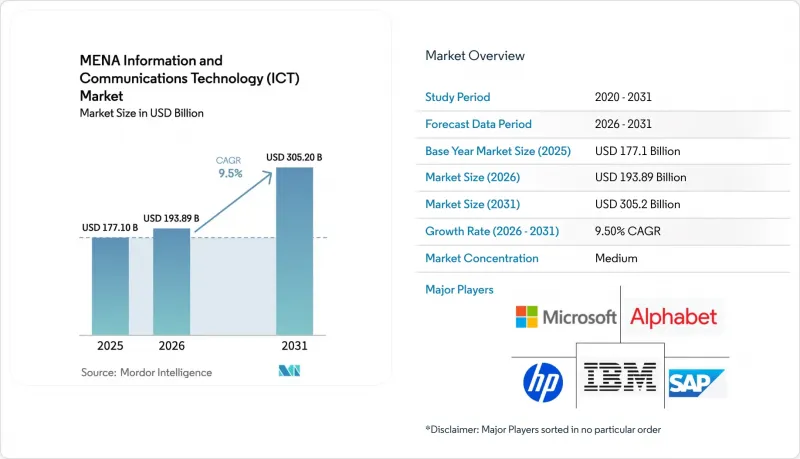
Mordor Intelligence에 의하면, 중동 및 북아프리카의 정보 통신 기술(ICT) 시장 규모는 2025년 1,771억 달러로 평가되었습니다. 2026년에는 1,938억 9,000만 달러로 확대되어 2026-2031년에 걸쳐 CAGR 9.5%로 성장을 지속하여, 2031년에는 3,052억 달러에 이를 것으로 예측됩니다.
본 보고서는 유형(IT 하드웨어, IT 소프트웨어, 기타), 기업 규모(중소기업, 대기업), 배포 모델(On-Premise, 클라우드, 하이브리드), 최종 사용자 산업(정부·공공 행정, 은행, 금융서비스 및 보험(BFSI), 기타), 국가(사우디아라비아, 카타르, 기타)별로 분류되어 있습니다. 시장 예측은 금액(달러)으로 표시됩니다.
중동 및 북아프리카의 정보 통신 기술(ICT) 시장 동향 및 인사이트
정부 주도의 스마트 시티 메가 프로젝트
사우디아라비아의 NEOM은 교통, 에너지, 시민 서비스 시스템을 통합하는 기술 플랫폼에 50억 달러를 배정하고 있습니다. 또한, 아랍에미리트의 ‘두바이 2040 도시 마스터플랜’은 2025년까지 정부 서비스의 25%를 AI로 제공했습니다. 이러한 노력은 초기 건설 주기를 훨씬 넘어 클라우드 용량, IoT 센서, 사이버 보안 솔루션에 대한 지속적인 수요를 창출하고 있습니다. 지자체는 교통, 유틸리티, 공공안전 각 부문에 걸친 데이터를 통합하는 상호운용 가능한 플랫폼을 필요로 하고 있으며, 이를 통해 엣지 컴퓨팅 및 분석 기능의 도입이 가속화되고 있습니다. GCC(걸프협력회의) 차원의 정책 조정을 통해 벤더의 표준화가 진행되어 지역 공급업체의 통합 비용이 절감되고 있습니다. ‘스마트 두바이’ 프로젝트 하에서 처리된 24억 건의 디지털 거래 등 성공적인 시범 프로젝트는 추가적인 정부 펀드의 지원을 유치할 수 있는 규모의 경제성을 보여주고 있습니다.
하이퍼스케일 클라우드 및 데이터센터에 대한 투자
마이크로소프트의 21억 달러 규모 사우디아라비아 데이터센터 복합 시설, Oracle의 15억 달러 규모 리야드 지역 프로젝트, AWS의 53억 달러 규모 다년간 확장 계획은 중동 및 북아프리카의 정보 통신 기술(ICT) 시장이 세계 공급업체들에게 우선순위임을 입증하고 있습니다. 현지 거점 확충은 데이터 주권에 관한 규제를 충족하는 동시에 기업의 워크로드 지연을 줄이고, 네트워크 장비, 관리형 서비스, 코로케이션 공간에 대한 2차 수요를 유발하고 있습니다. 아랍에미리트가 Core42와 체결한 130억 디르함(35억 4,000만 달러) 규모의 소버린 클라우드 제휴는 이 모델을 공공 부문의 워크로드로까지 확대하여, 다른 국가 정부들도 채택하고 있는 청사진이 되고 있습니다. 게임, 자율주행차, 실시간 분석을 지원하기 위해 인구 밀집 지역 근처에 엣지 노드가 급증하고 있으며, 인프라의 발자취를 더욱 넓혀가고 있습니다.
사이버 보안 인력 부족
2024년, 사우디아라비아에서는 사이버 보안 미충원 직위가 26.8%, 아랍에미리트에서는 9.7% 증가했습니다. 이는 노동력이 두 자릿수 성장세를 보였음에도 불구하고 발생한 것으로, 지역 내 인력 부족이 확대되고 있음을 보여줍니다. 이 때문에 기업들은 클라우드 전환을 연기하거나 고액의 컨설턴트에 의존할 수밖에 없는 상황에 처해 있습니다. 공공 부문 네트워크는 하루 평균 약 5만 건의 사이버 공격 시도에 노출되어 있지만, 보안 책임자의 51%는 자금 부족을 주요 장애 요인으로 꼽고 있습니다. 대학 교육 프로그램은 클라우드 보안 아키텍트 및 사고 대응 분석가에 대한 수요 및 공급 비율이 3대 1인 상황에 제대로 대응하지 못하고 있습니다. 사우디아라비아 국가사이버보안청의 장학금 제도를 포함한 정부 주도의 노력은 5년 이내에 이러한 격차를 해소하는 것을 목표로 하고 있지만, 단기적인 인력 부족은 여전히 지속되고 있습니다. 이로 인해 기업들이 멀티클라우드 분석 등 보안상 중요한 고도의 워크로드를 도입하는 속도가 제한되고 있습니다.
부문 분석
2025년, IT 서비스 부문은 중동 및 북아프리카 ICT 시장의 27.10%를 차지하며, 복잡한 클라우드 전환 과정에서 통합 전문 지식이 필수적임을 여실히 보여주었습니다. 데이터 주권을 준수하는 아키텍처에 대한 수요가 가속화되는 가운데, 시스템 통합사업자와 관리형 서비스 제공업체는 하이퍼스케일러와 기업 모두에게 전략적 파트너로서의 입지를 확고히 하고 있습니다. 이 부문은 수년에 걸친 변혁 프로그램, 사이버 보안 감사, 애플리케이션 현대화 계약과 연계된 지속적인 수익 모델의 혜택을 받고 있습니다. PaaS(Platform-as-a-Service) 솔루션의 채택이 진행됨에 따라, 조직이 레거시 워크로드를 플랫폼으로 이전하는 과정에서 자문 업무의 기회가 더욱 확대되고 있습니다. 현지 제공업체들은 아랍어 지원 및 지역 규제 프레임워크에 대한 전문 지식을 통해 차별화를 꾀하고 있으며, 이는 순수 국제 컨설팅 기업들에게 진입 장벽으로 작용하고 있습니다.
클라우드 서비스는 연평균 성장률(CAGR) 9.85%라는 가장 높은 성장 궤적을 기록하고 있으며, 2031년까지 IT 서비스와의 수익 격차를 좁힐 것으로 예측됩니다. Microsoft, Oracle, AWS에 의한 주권 클라우드 리전 구축은 지연 및 규정 준수상의 장벽을 완화하고 워크로드 이전을 가속화하고 있습니다. 기업들은 벤더 종속을 피하기 위해 멀티클라우드 전략을 점점 더 많이 채택하고 있으며, 이에 따라 오케스트레이션 도구와 비용 최적화 서비스에 대한 수요가 증가하고 있습니다. AI 모델 훈련 및 실시간 분석과 같은 데이터 집약형 용도의 급증은 IaaS(Infrastructure-as-a-Service)의 이용을 확대시키고 있습니다. 한편, IT 하드웨어는 5G 백홀 및 엣지 컴퓨팅 노드에 여전히 필수적이지만, 가상화 추세로 인해 서비스 중심 카테고리에 비해 성장세가 둔화되고 있습니다.
2025년에는 대기업이 지출의 61.35%를 차지하며, 그 규모를 활용하여 ERP 현대화, 사이버 보안 통합, AI 실험에 이르는 종단간 디지털 이니셔티브를 추진했습니다. 이 계층은 하이퍼스케일러 및 통신 사업자로부터 우대 가격을 확보하고 있어 조달에 대한 영향력을 강화하고 있습니다. 에너지, 항공, 금융 부문의 다국적 기업들은 다지역 클라우드 도입을 주도하며, 데이터 거버넌스 소프트웨어 및 SD-WAN 솔루션과 같은 관련 부문의 성장을 뒷받침하고 있습니다.
중소기업은 고급 소프트웨어 제품군에 대한 진입 장벽을 낮추는 ‘클라우드 우선’ 정책에 힘입어 연평균 성장률(CAGR) 10.04%를 기록하며 전체 시장 성장률을 상회할 것으로 전망됩니다. 아랍에미리트의 ‘모하메드 빈 라시드 혁신 펀드’와 사우디아라비아의 ‘카팔라 프로그램’은 중소기업이 전자 조달 의무(MBRF.AE)를 이행할 수 있도록 기술 업그레이드에 자금을 투입하고 있습니다. 중소기업의 SaaS(Software-as-a-Service) 도입은 2022년 이후 3배로 증가했으며, 특히 CRM, 회계, 엔드포인트 보안 도구에서 두드러집니다. 공급망의 디지털화가 진행됨에 따라 대기업은 틈새 AI, 블록체인, IoT 기능에 대해 점점 더 중소 벤더에 의존하게 되었으며, 이를 통해 중소기업이 지역 생태계에 통합되고 있습니다.
기타 혜택
- 엑셀 형식 시장 예측(ME) 시트
- 3개월간의 애널리스트 지원
자주 묻는 질문
목차
제1장 서론
제2장 조사 방법
제3장 주요 요약
제4장 시장 구도
제5장 시장 규모 및 성장 예측
제6장 경쟁 구도
제7장 시장 기회 및 향후 전망
KTH 26.09.10According to Mordor Intelligence, the Middle East and North Africa ICT market size is expected to grow from USD 177.1 billion in 2025 to USD 193.89 billion in 2026 and is forecast to reach USD 305.2 billion by 2031 at 9.5% CAGR over 2026-2031.
This report is Segmented by Type (IT Hardware, IT Software, and More), Enterprise Size (Small and Medium Enterprises, Large Enterprises), Deployment Model (On-Premise, Cloud, Hybrid), End-User Industry Vertical (Government and Public Administration, BFSI, and More), Country (Saudi Arabia, Qatar, and More). The Market Forecasts are Provided in Terms of Value (USD).
MENA Information And Communications Technology (ICT) Market Trends and Insights
Government-led Smart City Mega-projects
Saudi Arabia's NEOM allocates USD 5 billion for technology platforms that integrate traffic, energy, and citizen-service systems; UAE's Dubai 2040 Urban Master Plan targets AI delivery of 25% of government services by 2025. These initiatives generate recurring demand for cloud capacity, IoT sensors, and cybersecurity solutions well beyond initial construction cycles. Municipalities require interoperable platforms that aggregate data across transport, utilities, and public-safety domains, accelerating procurement of edge computing and analytics capabilities. GCC-level policy coordination enables vendor standardization, reducing integration costs for regional suppliers. Successful pilots, such as the 2.4 billion digital transactions processed under Smart Dubai, showcase scale economics that entice additional sovereign wealth-fund backing.
Hyperscale Cloud and Data-center Investments
Microsoft's USD 2.1 billion Saudi data-center complex, Oracle's USD 1.5 billion Riyadh region, and AWS's USD 5.3 billion multi-year expansion validate the Middle East and North Africa ICT market as a priority for global providers. Local presence satisfies data-sovereignty regulations while cutting latency for enterprise workloads, spurring secondary demand for networking gear, managed services, and colocation space. The UAE's AED 13 billion (USD 3.54 billion) sovereign-cloud partnership with Core42 extends the model to public-sector workloads, creating a blueprint other governments are adopting. Edge nodes are proliferating near population centers to support gaming, autonomous vehicles, and real-time analytics, further widening the infrastructure footprint.
Cyber-skill Shortages
Unfilled cybersecurity positions grew 26.8% in Saudi Arabia and 9.7% in the UAE during 2024, despite double-digit workforce expansion, widening a regional talent gap that forces enterprises to delay cloud migrations or rely on costly consultants. Public-sector networks endure about 50,000 daily cyberattack attempts, yet 51% of security leaders cite under-funding as their main obstacle. University programs cannot keep pace with 3:1 demand-supply ratios for cloud-security architects and incident-response analysts. Government initiatives, including Saudi Arabia's National Cybersecurity Authority scholarships, aim to close the gap within five years, but near-term shortages persist. This limits the speed at which enterprises adopt advanced, security-sensitive workloads such as multicloud analytics.
Other drivers and restraints analyzed in the detailed report include:
- 5G-driven Mobile Data-traffic Explosion
- National Digital-transformation Agendas
- Energy-subsidy Reforms Raising DC OPEX
For complete list of drivers and restraints, kindly check the Table Of Contents.
Segment Analysis
The IT Services segment accounted for 27.10% of the Middle East and North Africa ICT market in 2025, underscoring the need for integration expertise during complex cloud migrations. Accelerating demand for data-sovereignty compliant architectures positions system integrators and managed service providers as strategic partners to both hyperscalers and enterprises. The segment benefits from recurring revenue models tied to multiyear transformation programs, cybersecurity audits, and application modernization contracts. Rising adoption of platform-as-a-service solutions further expands advisory opportunities as organizations re-platform legacy workloads. Local providers differentiate through Arabic language support and familiarity with regional regulatory frameworks, creating barriers to entry for purely international consultancies.
Cloud Services recorded the highest growth trajectory at a 9.85% CAGR and are expected to narrow the revenue gap with IT Services by 2031. Establishment of sovereign cloud regions by Microsoft, Oracle, and AWS reduces latency and compliance hurdles, accelerating workload migration. Enterprises increasingly adopt multicloud strategies to avoid vendor lock-in, driving demand for orchestration tools and cost-optimization services. The surge in data-intensive applications such as AI model training and real-time analytics amplifies infrastructure-as-a-service consumption. Meanwhile, IT Hardware remains essential for 5G backhaul and edge-computing nodes, although its growth lags service-centric categories due to virtualization trends.
Large enterprises generated 61.35% of spending in 2025, leveraging scale to pursue end-to-end digital initiatives spanning ERP modernization, cybersecurity consolidation, and AI experimentation. This cohort secures preferential pricing from hyperscalers and telecom operators, reinforcing its procurement influence. Multinational corporations in the energy, aviation, and finance sectors anchor multi-region cloud deployments that uplift ancillary segments such as data-governance software and SD-WAN solutions.
Small and medium enterprises are set to outpace overall market growth with a 10.04% CAGR, underpinned by cloud-first policies that lower entry barriers to sophisticated software suites. UAE's Mohammed Bin Rashid Innovation Fund and Saudi Arabia's Kafalah program funnel capital toward technology upgrades that enable SMEs to fulfill electronic procurement mandates MBRF.AE. Software-as-a-service adoption among SMEs tripled since 2022, particularly in CRM, accounting, and endpoint-security tools. As supply-chain digitization deepens, large enterprises increasingly rely on SME tech vendors for niche AI, blockchain, and IoT capabilities, weaving smaller firms into regional ecosystems.
Complete Report Scope:
- By Type
- IT Hardware
- Computer Hardware
- Networking Equipment
- Peripherals
- IT Software
- IT Services
- Managed Services
- Business Process Services
- Business Consulting Services
- Cloud Services
- IT Infrastructure
- IT Security
- Communication Services
- IT Hardware
- By Enterprise Size
- Small and Medium Enterprises
- Large Enterprises
- By Deployment Model
- On-premise
- Cloud
- Hybrid
- By End-user Industry Vertical
- Government and Public Administration
- BFSI
- Energy and Utilities
- Retail, E-commerce and Logistics
- Manufacturing and Industry 4.0
- Healthcare and Life Sciences
- (Up/Mid/Down-stream)
- Gaming and Esports
- By Country
- Saudi Arabia
- United Arab Emirates
- Qatar
- Oman
- Egypt
- Rest of MENA
List of Companies Covered in this Report:
- Alphabet Inc. (Google LLC)
- IBM Corporation
- Microsoft Corporation
- HP Inc.
- SAP SE
- Emirates Telecommunications Group Company PJSC (e&)
- Oracle Corporation
- Salesforce Inc.
- Accenture plc
- Amazon Web Services, Inc.
- Cisco Systems, Inc.
- Huawei Investment and Holding Co., Ltd.
- Dell Technologies Inc.
- Orange Business Services S.A.
- Saudi Telecom Company (stc solutions)
- Ooredoo Q.P.S.C.
- Injazat Data Systems LLC
- Gulf Business Machines FZ-LLC
- Etihad Etisalat Co. (Mobily)
- Mobile Telecommunications Company K.S.C.P. (Zain Group)
- Ericsson AB
- Nokia Corporation
Additional Benefits:
- The market estimate (ME) sheet in Excel format
- 3 months of analyst support
TABLE OF CONTENTS
1 INTRODUCTION
- 1.1 Study Assumptions and Market Definition
- 1.2 Scope of the Study
2 RESEARCH METHODOLOGY
3 EXECUTIVE SUMMARY
4 MARKET LANDSCAPE
- 4.1 Market Overview
- 4.2 Market Drivers
- 4.2.1 Government-led smart city mega-projects
- 4.2.2 National digital transformation agendas
- 4.2.3 Hyperscale cloud and data-center investments
- 4.2.4 5G-driven mobile data-traffic explosion
- 4.2.5 Sovereign-wealth AI and semiconductor funding
- 4.2.6 Data-residency mandates boosting local IaaS
- 4.3 Market Restraints
- 4.3.1 Cyber-skill shortages
- 4.3.2 Energy-subsidy reforms raising DC OPEX
- 4.3.3 Water-power nexus limiting N. Africa DCs
- 4.3.4 Political risk in Levant fiber corridors
- 4.4 Industry Value Chain Analysis
- 4.5 Regulatory Landscape
- 4.6 Impact of Macroeconomic Factors
- 4.7 Technological Outlook
- 4.8 Porter's Five Forces Analysis
- 4.8.1 Bargaining Power of Suppliers
- 4.8.2 Bargaining Power of Consumers
- 4.8.3 Threat of New Entrants
- 4.8.4 Threat of Substitutes
- 4.8.5 Intensity of Competitive Rivalry
- 4.9 Key Use-Cases
- 4.10 Government Projects and Initiatives
- 4.11 Ecosystem Analysis
5 MARKET SIZE AND GROWTH FORECASTS (VALUE)
- 5.1 By Type
- 5.1.1 IT Hardware
- 5.1.1.1 Computer Hardware
- 5.1.1.2 Networking Equipment
- 5.1.1.3 Peripherals
- 5.1.2 IT Software
- 5.1.3 IT Services
- 5.1.3.1 Managed Services
- 5.1.3.2 Business Process Services
- 5.1.3.3 Business Consulting Services
- 5.1.3.4 Cloud Services
- 5.1.4 IT Infrastructure
- 5.1.5 IT Security
- 5.1.6 Communication Services
- 5.1.1 IT Hardware
- 5.2 By Enterprise Size
- 5.2.1 Small and Medium Enterprises
- 5.2.2 Large Enterprises
- 5.3 By Deployment Model
- 5.3.1 On-premise
- 5.3.2 Cloud
- 5.3.3 Hybrid
- 5.4 By End-user Industry Vertical
- 5.4.1 Government and Public Administration
- 5.4.2 BFSI
- 5.4.3 Energy and Utilities
- 5.4.4 Retail, E-commerce and Logistics
- 5.4.5 Manufacturing and Industry 4.0
- 5.4.6 Healthcare and Life Sciences
- 5.4.7 (Up/Mid/Down-stream)
- 5.4.8 Gaming and Esports
- 5.5 By Country
- 5.5.1 Saudi Arabia
- 5.5.2 United Arab Emirates
- 5.5.3 Qatar
- 5.5.4 Oman
- 5.5.5 Egypt
- 5.5.6 Rest of MENA
6 COMPETITIVE LANDSCAPE
- 6.1 Market Concentration
- 6.2 Strategic Moves
- 6.3 Market Share Analysis
- 6.4 Company Profiles (includes Global level Overview, Market level overview, Core Segments, Financials as available, Strategic Information, Market Rank/Share for key companies, Products and Services, and Recent Developments)
- 6.4.1 Alphabet Inc. (Google LLC)
- 6.4.2 IBM Corporation
- 6.4.3 Microsoft Corporation
- 6.4.4 HP Inc.
- 6.4.5 SAP SE
- 6.4.6 Emirates Telecommunications Group Company PJSC (e&)
- 6.4.7 Oracle Corporation
- 6.4.8 Salesforce Inc.
- 6.4.9 Accenture plc
- 6.4.10 Amazon Web Services, Inc.
- 6.4.11 Cisco Systems, Inc.
- 6.4.12 Huawei Investment and Holding Co., Ltd.
- 6.4.13 Dell Technologies Inc.
- 6.4.14 Orange Business Services S.A.
- 6.4.15 Saudi Telecom Company (stc solutions)
- 6.4.16 Ooredoo Q.P.S.C.
- 6.4.17 Injazat Data Systems LLC
- 6.4.18 Gulf Business Machines FZ-LLC
- 6.4.19 Etihad Etisalat Co. (Mobily)
- 6.4.20 Mobile Telecommunications Company K.S.C.P. (Zain Group)
- 6.4.21 Ericsson AB
- 6.4.22 Nokia Corporation
7 MARKET OPPORTUNITIES AND FUTURE OUTLOOK
- 7.1 White-space and Unmet-Need Assessment


