
|
시장보고서
상품코드
2125686
유럽의 데이터센터 건설 시장 : 점유율 분석, 업계 동향과 통계, 성장 예측(2026-2031년)Europe Data Center Construction - Market Share Analysis, Industry Trends & Statistics, Growth Forecasts (2026 - 2031) |
||||||
 Mordor Intelligence
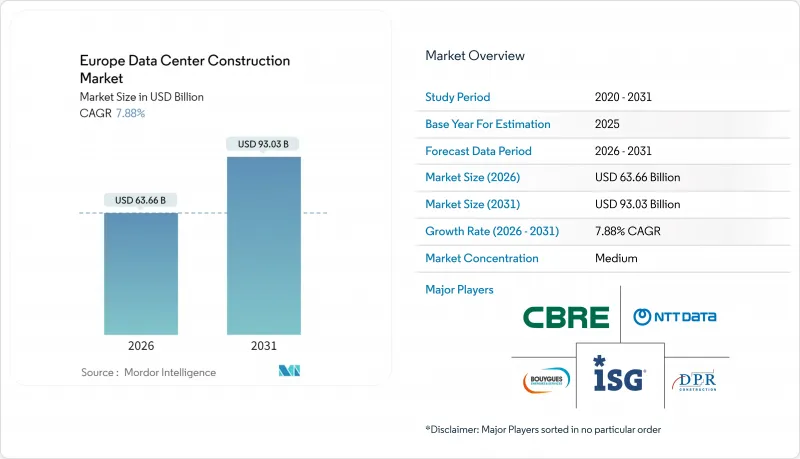
Mordor Intelligence에 의하면, 유럽 데이터센터 건설 시장 규모는 2026년에 636억 6,000만 달러가 되어, 2031년까지 930억 3,000만 달러에 이를 것으로 예측되며, 예측 기간중은 CAGR 7.88%로 성장할 전망입니다.
본 보고서는 티어 유형(Tier 1 및 2, Tier 3, Tier 4), 데이터센터 규모(소규모, 중규모, 대규모, 하이퍼스케일), 데이터센터 유형(코로케이션, 하이퍼스케일러/클라우드 서비스 제공업체, 엔터프라이즈 및 엣지), 인프라(전기, 기계, 일반 건설, 서비스)별로 분류되어 있습니다. 시장 전망은 금액(달러) 기준으로 제시되어 있습니다.
유럽 데이터센터 건설 시장 동향 및 인사이트
생성형 AI 및 빅데이터 워크로드 증가
랙당 50-100kW를 소비하는 GPU 클러스터가 설계 기준을 재정의함에 따라, 사업자들은 주요 캠퍼스 전체에 수냉식 랙을 도입하고 있습니다. 마이크로소프트의 스웨덴 시설에서는 2024년에 전력 사용 효율(PUE)이 1.2 미만으로 떨어졌는데, 이는 공랭식으로는 달성할 수 없는 수준입니다. 최첨단 모델의 훈련은 몇 주에 걸쳐 중단 없이 진행되기 때문에 20-30%의 추가 비용이 발생함에도 불구하고 Tier 4 수준의 내결함성 아키텍처에 대한 수요가 증가하고 있습니다. 퍼블릭 클라우드에서 지연 시간 목표를 달성하지 못하는 기업들은 On-Premise 사이트 개조를 추진하고 있으며, N+2 냉각 루프 및 400볼트 무정전 전원 장치(UPS)에 대한 주문이 가속화되고 있습니다. 생성형 AI 워크로드는 향후 10년 후반에 추가 용량의 상당 부분을 차지할 것으로 예상되어, 조달 동향을 고밀도 서버 인클로저로 전환시키고 있습니다. 이러한 변화로 인해 전력망의 내결함성에 대한 관심도 높아지고 있으며, 훈련 주기 중 전압 강하를 완화하기 위한 온사이트 배터리 저장 장치에 대한 관심이 증가하고 있습니다.
하이퍼스케일 및 코로케이션 시설의 급증
하이퍼스케일 사업자들은 IT 용량이 1기가와트를 초과하는 멀티캠퍼스 시설로 부하를 통합하고 있으며, 현물 가격보다 낮은 가격으로 재생에너지 대량 구매 계약을 체결할 수 있게 되었습니다. 아마존 웹 서비스(Amazon Web Services)의 78억 유로 규모 브란덴부르크 프로그램은 총 1.2기가와트 규모의 3개 사이트에 걸쳐 있으며, 장기적인 전력망 예약량을 확보하고 있습니다. 코로케이션 전문 기업들은 테넌트가 자체 냉각 시스템이나 네트워크 패브릭을 통합할 수 있는 ‘전원 완비 쉘’ 형태의 임대 계약으로 이에 대응하고 있으며,콜트 데이터센터 서비스(Colt Data Centre Services)는 2024년 독일에서 20억 유로(24억 달러) 규모의 확장을 통해 이 모델을 추진했습니다. 2025년에 인도될 시설의 평균 규모는 2020년의 28메가와트에서 45메가와트로 확대되었으며, 모듈식 전원실을 대규모로 통합할 수 있는 시공업체에 대한 수요가 증가하고 있습니다. 또한, 규모의 경제로 인해 캠퍼스 간 이중화 체계가 가능해지면서 예비 용량의 과잉 확보가 줄어들고 있습니다. 이러한 동향이 맞물려 마드리드나 밀라노와 같은 2차 대도시권에서도 건설 활동이 활발해지고 있습니다.
전력 비용 및 부동산 비용의 급등
2025년 독일 및 영국의 산업용 전기 요금은 kW시당 평균 0.15-0.25유로(0.18-0.30달러)가 될 전망이며, 가동률 80%의 10메가와트 규모 시설의 경우,연간 전력 비용은 1,190만-1,980만 달러에 달할 전망입니다. 프랑크푸르트의 토지 가격은 2025년에 1제곱미터당 1,200유로를 돌파하여, 2022년 대비 40% 상승했습니다. 이는 사업자들이 기존 송전망에 연결이 완료된 부지를 확보하기 위해 치열한 경쟁을 벌이고 있기 때문입니다. 또한, 재취득 원가에 연동되는 영국의 부동산세 산정 방식에 따라, 2메가와트 규모 시설 건설 시 연간 1,000만-1,500만 달러의 추가 부담이 발생합니다. 이러한 압박으로 인해 투자는 비용이 낮은 2선 도시로 이동하고 있으며, 도매 가격이 1kW시당 0.06유로 미만인 북유럽 국가들에서는 수년에 걸친 재생에너지 PPA의 인기가 높아지고 있습니다. 또한, 개발업자들은 제한된 부지 면적을 효율적으로 활용하기 위해 수직형 데이터 홀이나 옥상 태양광 캐노피로의 전환을 추진하고 있으나, 이러한 대응으로 인해 구조용 강재 사용량과 초기 투자 비용이 증가하게 됩니다.
부문 분석
2025년, Tier 3는 유럽 데이터센터 건설 시장 지출의 57.14%를 차지하며, 이는 예산과 가동률의 균형이 잘 잡혀 있음을 반영합니다. 금융 서비스 및 정부 기관 임차인들이 99.995%의 가용성을 요구하는 가운데, 티어 4에 할당된 유럽 데이터센터 건설 시장 규모는 연평균 성장률(CAGR) 8.42%로 확대되고 있습니다. 내결함성 2N+1 이중화를 통해 단일 고장 지점이 제거됩니다. 이는 실시간 결제 시스템이나 국방 지휘 시스템에 있어 필수적인 요건입니다. 가동 중단으로 인한 손실이 초기 비용을 훨씬 상회하기 때문에 사업자들은 20-30%의 자본 지출(CAPEX) 추가 비용을 감수하고 있습니다. 프랑크푸르트와 런던에서는 Tier 4에 대한 수요가 가장 높지만, 송전망의 용량 제약으로 인해 프로젝트가 브란덴부르크와 웨일스로 이동하고 있습니다. 모듈식 개폐 장치와 핫 스왑 지원 UPS 스키드가 Tier 4 도입의 표준이 되어 설계 주기를 단축하고 있습니다. 전력 공급에는 Tier 4, 냉각에는 Tier 3를 적용하는 하이브리드 설계를 시도하는 클라우드 제공업체들은 세밀한 위험 계층화 전략을 반영하고 있습니다.
2025년에는 사업자들이 비중복 레이아웃을 폐지함에 따라 Tier 1 및 Tier 2 건설이 유럽 데이터센터 건설 시장 점유율의 10% 미만으로 떨어졌습니다. 중소기업은 여전히 비용 측면에서 Tier 3 코로케이션 스위트를 수용하고 있지만, AI 추론 부하 증가로 인해 이러한 아키텍처의 한계가 드러날 가능성이 있습니다. 유럽의 보험사들은 Tier 3 중단을 이유로 보험료를 가산하고 있으며, 이로 인해 더 높은 티어로의 전환이 가속화되고 있습니다. 한편, 중요 인프라의 내결함성을 중시하는 EU의 분류 체계 규정에 따라 자금 조달은 티어 4 채권으로 이동하고 있습니다. 벤더들은 사전 인증된 티어 4 키트를 제공함으로써 이에 대응하고 있으며, 시운전 기간을 20개월 미만으로 단축하고 있습니다. 생성형 AI의 밀도와 가동 시간 리스크의 상호작용이 이처럼 티어 4로의 전환 추세를 뒷받침하고 있습니다.
2025년, 하이퍼스케일 캠퍼스는 유럽 데이터센터 건설 시장 규모의 60.75%를 차지하며, 2031년까지 연평균 성장률(CAGR) 8.23%로 성장할 전망입니다. 50-250메가와트 규모의 시설에서는 사업자가 수 기가와트 규모의 재생에너지 PPA를 협상하여 에너지 비용 곡선을 평준화할 수 있습니다. 유럽 데이터센터 건설 시장에서 하이퍼스케일 시설의 점유율은 특히 전력 쉘 및 열교환기 조달에 있어 통합을 통한 경제적 효과의 혜택을 받고 있습니다. 브란덴부르크, 흐로닝언, 베스테로스에서는 지방 자치 단체가 대규모 재생에너지 통합을 위한 허가 절차를 신속하게 처리하고 있어, 이들 지역이 거래의 중심지가 되고 있습니다. 투자자들은 하이퍼스케일 시설의 앵커 테넌트가 체결한 임대 계약이 가져다주는 예측 가능한 현금 흐름을 중요하게 여기며, 이를 통해 소규모 시설에 비해 가중평균자본비용(WACC)이 낮아집니다.
대규모(10-50메가와트) 및 중규모(2-10메가와트) 시설은 지역 집약형 네트워크에서 여전히 중요한 역할을 수행하며, 엣지 노드에 전력을 공급하는 동시에 버스트 용량도 제공합니다. 2메가와트 미만의 엣지 및 마이크로 엣지 사이트는 자율주행차 및 산업용 IoT 텔레메트리용으로 20밀리초 미만의 지연을 보장하기 위해 도심에서 급속히 증가하고 있습니다. 소매 단지 주차장에 설치 가능한 조립식 컨테이너 모듈 덕분에 건설 기간이 12-18개월로 단축됩니다. 하이퍼스케일 프로젝트의 평균 규모는 2020년 28메가와트에서 2025년 45메가와트로 확대되고 있으며, 칩 로드맵에 따라 발열량 상한선이 높아짐에 따라 이러한 추세는 앞으로도 지속될 전망입니다. 구글의 흐로닝언 캠퍼스는 완공 시 200메가와트를 목표로 하고 있어 이러한 추세를 여실히 보여주고 있습니다.
기타 혜택:
- 엑셀 형식 시장 예측(ME) 시트
- 3개월간의 애널리스트 지원
자주 묻는 질문
목차
제1장 서론
제2장 조사 방법
제3장 주요 요약
제4장 시장 구도
제5장 시장 규모와 성장 예측
제6장 경쟁 구도
제7장 시장 기회와 향후 전망
JHS 26.09.11According to Mordor Intelligence, the Europe data center construction market size stands at USD 63.66 billion in 2026 and is projected to reach USD 93.03 billion by 2031, advancing at a 7.88% CAGR over the forecast period.
This report is Segmented by Tier Type (Tier 1 and 2, Tier 3, and Tier 4), Data Center Size (Small, Medium, Large, and Hyperscale), Data Center Type (Colocation, Hyperscalers/Cloud Service Providers, and Enterprise and Edge), Infrastructure (Electrical, Mechanical, General Construction, and Services). The Market Forecasts are Provided in Terms of Value (USD).
Europe Data Center Construction Market Trends and Insights
Rising Generative-AI and Big-Data Workloads
GPU clusters that draw 50-100 kilowatts per rack are redefining design baselines, prompting operators to deploy liquid-cooled racks across flagship campuses. Microsoft's Swedish facilities reached power-usage-effectiveness ratios below 1.2 in 2024, a threshold unattainable with air cooling. Training runs for frontier models run uninterrupted for weeks, pushing demand for Tier 4 fault-tolerant architectures despite a 20-30% cost premium. Enterprises that cannot meet latency targets in public clouds are retrofitting on-premises sites, accelerating orders for N+2 cooling loops and 400-volt uninterruptible power supplies. Generative-AI workloads are expected to dominate incremental capacity additions late in the decade, reshaping procurement toward high-density server enclosures. The shift also sharpens focus on grid resiliency, driving interest in on-site battery storage to mitigate brownouts during training cycles.
Surge in Hyperscale and Colocation Build-Outs
Hyperscale operators are consolidating loads into multi-campus estates that clear 1 gigawatt of IT capacity, enabling bulk renewable power purchase agreements at below-spot pricing. Amazon Web Services' EUR 7.8 billion Brandenburg program spans three sites totaling 1.2 gigawatts, locking in long-term grid reservations. Colocation specialists respond with powered-shell leases that let tenants fit bespoke cooling and network fabrics, a model Colt Data Centre Services advanced through EUR 2 billion (USD 2.4 billion) in German expansions in 2024. Average facility size for 2025 deliveries rose to 45 megawatts, up from 28 megawatts in 2020, intensifying demand for contractors capable of integrating modular power rooms at scale. The economies of scale also unlock cross-campus redundancy schemes, trimming reserve-capacity over-provisioning. These dynamics collectively boost construction intensity even in secondary metros such as Madrid and Milan.
Escalating Power and Real-Estate Costs
Industrial electricity in Germany and the United Kingdom averaged EUR 0.15-0.25 (USD 0.18-0.30) per kilowatt-hour in 2025, translating into USD 11.9-19.8 million in annual power costs for a 10-megawatt site operating at 80% utilization. Frankfurt land crossed EUR 1,200 per square meter in 2025, up 40% from 2022, as operators chase parcels with pre-existing grid access. The United Kingdom's property tax formula, pegged to replacement cost, adds USD 10-15 million per year to a 20-megawatt build. These pressures divert investment toward lower-cost secondary metros and drive the popularity of multi-year renewable PPAs in the Nordics, where wholesale rates sit below EUR 0.06 per kilowatt-hour. Developers are also pivoting to vertical data halls and rooftop solar canopies to stretch constrained footprints, though such adaptations increase structural steel tonnage and upfront capital costs.
Other drivers and restraints analyzed in the detailed report include:
- Cloud Service Provider Regional Expansion
- EU Green Deal Waste-Heat Reuse Incentives
- Grid-Connection Approval Bottlenecks
For complete list of drivers and restraints, kindly check the Table Of Contents.
Segment Analysis
Tier 3 captured 57.14% of Europe data center construction market spending in 2025, reflecting its balance between budget and uptime. Europe data center construction market size allocated to Tier 4 is growing at an 8.42% CAGR as financial services and government tenants press for 99.995% availability. Fault-tolerant 2N+1 redundancy eliminates single points of failure, a prerequisite for instant-settlement payment rails and defense command systems. Operators absorb the 20-30% capex premium because downtime penalties far outweigh initial costs. Frankfurt and London see the heaviest Tier 4 demand, though grid capacity constraints are redirecting projects to Brandenburg and Wales. Modular switchgear and hot-swappable UPS skids are standardizing Tier 4 deployments, trimming engineering cycles. Cloud providers experimenting with hybrid designs - Tier 4 for power and Tier 3 for cooling - reflect a nuanced risk-tiering strategy.
Tier 1 and Tier 2 builds fell below 10% of Europe data center construction market share in 2025 as operators abandon non-redundant layouts. Small and medium enterprises still accept Tier 3 colocation suites on cost grounds, but rising AI inference loads may stretch those architectures. European insurers are adding premium surcharges for Tier 3 outages, accelerating migration to higher tiers. Meanwhile, EU taxonomy rules favoring fault tolerance for critical infrastructure tilt financing toward Tier 4 bonds. Component vendors respond with pre-certified Tier 4 kits, compressing commissioning to under 20 months. The interplay between generative-AI density and uptime risk thus reinforces the Tier 4 trajectory.
Hyperscale campuses secured 60.75% of Europe data center construction market size in 2025, advancing at an 8.23% CAGR through 2031. Facilities in the 50-250 megawatt bracket let operators bargain for multi-gigawatt renewable PPAs, smoothing energy cost curves. Europe data center construction market share for hyperscale builds benefits from consolidation economies, particularly in power shell and heat-exchanger procurement. Brandenburg, Groningen, and Vasteras headline deal flow, where local governments fast-track permits for large-scale renewable integrations. Investors prize the predictable cash flows of hyperscale anchor leases, lowering weighted average cost of capital against smaller formats.
Large (10-50 megawatt) and medium (2-10 megawatt) facilities retain a role in regional aggregation networks, feeding edge nodes while providing burst capacity. Edge and micro-edge sites under 2 megawatts proliferate in urban cores to guarantee sub-20-millisecond latency for autonomous vehicles and industrial-IoT telemetry. Prefabricated container modules, deployable on retail-park car lots, compress construction to 12-18 months. Average hyperscale project scope climbed from 28 megawatts in 2020 to 45 megawatts in 2025, a trend likely to continue as chip roadmaps push thermal envelopes upward. Google's Groningen campus targets 200 megawatts at full build, illustrating the trajectory.
Complete Report Scope:
- By Tier Type
- Tier 1 and 2
- Tier 3
- Tier 4
- By Data Center Size
- Small
- Medium
- Large
- Hyperscale
- By Data Center Type
- Colocation Data Center
- Hyperscalers/Cloud Service Provider (CSPs)
- Enterprise and Edge Data Center
- By Infrastructure
- Electrical Infrastructure
- Power Distribution Solution
- Power Backup Solutions
- Mechanical Infrastructure
- Cooling Systems
- Racks and Cabinets
- Servers and Storage
- Other Mechanical Infrastructure
- General Construction
- Services - Design and Consulting, Integration, Support and Maintenance
- Electrical Infrastructure
- By Country
- Germany
- United Kingdom
- France
- Italy
- Spain
- Rest of Europe
List of Companies Covered in this Report:
- AECOM
- NTT Ltd.
- Rider Levett Bucknall LLP
- The Whiting-Turner Contracting Co.
- Jacobs Solutions Inc.
- DPR Construction
- Collen Construction Ltd.
- Mercury Engineering Unlimited Co.
- Hensel Phelps Construction Co.
- Hochtief AG
- Gilbane Building Co.
- Vinci Construction
- Clune Construction Co. LP
- Bouygues Energies and Services SAS
- CBRE Group Inc.
- Fluor Corp.
- ISG plc
- Skanska AB
- Arup Group Ltd.
- Lendlease Corporation Ltd.
Additional Benefits:
- The market estimate (ME) sheet in Excel format
- 3 months of analyst support
TABLE OF CONTENTS
1 INTRODUCTION
- 1.1 Study Assumptions and Market Definition
- 1.2 Scope of the Study
2 RESEARCH METHODOLOGY
3 EXECUTIVE SUMMARY
4 MARKET LANDSCAPE
- 4.1 Market Overview
- 4.2 Market Drivers
- 4.2.1 Rising Generative-AI and Big-Data Workloads
- 4.2.2 Surge in Hyperscale and Colocation Build-Outs
- 4.2.3 Cloud Service Provider Regional Expansion
- 4.2.4 EU Green Deal Waste-Heat Reuse Incentives
- 4.2.5 Nordic Renewable-Energy PPAs Lowering TCO
- 4.2.6 Prefabricated Modular Power Rooms Adoption
- 4.3 Market Restraints
- 4.3.1 Escalating Power and Real-Estate Costs
- 4.3.2 Grid-Connection Approval Bottlenecks
- 4.3.3 Stricter EU Taxonomy on Non-Green Materials
- 4.3.4 Skilled-Labour Gap for Advanced Commissioning
- 4.4 Industry Supply-Chain Analysis
- 4.5 Regulatory Landscape
- 4.6 Technological Outlook
- 4.7 Porter's Five Forces Analysis
- 4.7.1 Bargaining Power of Suppliers
- 4.7.2 Bargaining Power of Consumers
- 4.7.3 Threat of New Entrants
- 4.7.4 Threat of Substitutes
- 4.7.5 Intensity of Competitive Rivalry
- 4.8 Key Data Center Statistics
- 4.8.1 Exhaustive Data Center Operators in Europe (in MW)
- 4.8.2 List of Major Upcoming Data Center Projects in Europe (2025-2030)
- 4.8.3 CAPEX and OPEX For Europe Data Center Construction
- 4.8.4 Data Center Power Capacity Absorption In MW, Selected Cities, Europe, 2023 and 2024
- 4.9 Artificial Intelligence (AI) Inclusion in Data Center Construction in Europe
- 4.10 Regulatory and Compliance Framework
- 4.11 Impact of Macroeconomic Factors on the Market
5 MARKET SIZE AND GROWTH FORECASTS (VALUE)
- 5.1 By Tier Type
- 5.1.1 Tier 1 and 2
- 5.1.2 Tier 3
- 5.1.3 Tier 4
- 5.2 By Data Center Size
- 5.2.1 Small
- 5.2.2 Medium
- 5.2.3 Large
- 5.2.4 Hyperscale
- 5.3 By Data Center Type
- 5.3.1 Colocation Data Center
- 5.3.2 Hyperscalers/Cloud Service Provider (CSPs)
- 5.3.3 Enterprise and Edge Data Center
- 5.4 By Infrastructure
- 5.4.1 Electrical Infrastructure
- 5.4.1.1 Power Distribution Solution
- 5.4.1.2 Power Backup Solutions
- 5.4.2 Mechanical Infrastructure
- 5.4.2.1 Cooling Systems
- 5.4.2.2 Racks and Cabinets
- 5.4.2.3 Servers and Storage
- 5.4.2.4 Other Mechanical Infrastructure
- 5.4.3 General Construction
- 5.4.4 Services - Design and Consulting, Integration, Support and Maintenance
- 5.4.1 Electrical Infrastructure
- 5.5 By Country
- 5.5.1 Germany
- 5.5.2 United Kingdom
- 5.5.3 France
- 5.5.4 Italy
- 5.5.5 Spain
- 5.5.6 Rest of Europe
6 COMPETITIVE LANDSCAPE
- 6.1 Market Concentration
- 6.2 Strategic Moves
- 6.3 Market Share Analysis
- 6.4 Data Center Infrastructure Investment Based on Megawatt (MW) Capacity, 2024 vs 2030
- 6.5 Data Center Construction Landscape (Key Vendors Listings)
- 6.6 Company Profiles (includes Global Level Overview, Market Level Overview, Core Segments, Financials as Available, Strategic Information, Market Rank/Share for Key Companies, Products and Services, Recent Developments)
- 6.6.1 AECOM
- 6.6.2 NTT Ltd.
- 6.6.3 Rider Levett Bucknall LLP
- 6.6.4 The Whiting-Turner Contracting Co.
- 6.6.5 Jacobs Solutions Inc.
- 6.6.6 DPR Construction
- 6.6.7 Collen Construction Ltd.
- 6.6.8 Mercury Engineering Unlimited Co.
- 6.6.9 Hensel Phelps Construction Co.
- 6.6.10 Hochtief AG
- 6.6.11 Gilbane Building Co.
- 6.6.12 Vinci Construction
- 6.6.13 Clune Construction Co. LP
- 6.6.14 Bouygues Energies and Services SAS
- 6.6.15 CBRE Group Inc.
- 6.6.16 Fluor Corp.
- 6.6.17 ISG plc
- 6.6.18 Skanska AB
- 6.6.19 Arup Group Ltd.
- 6.6.20 Lendlease Corporation Ltd.
- 6.7 List of Data Center Construction Companies
7 MARKET OPPORTUNITIES AND FUTURE OUTLOOK
- 7.1 White-Space and Unmet-Need Assessment