
|
시장보고서
상품코드
2125684
남미의 데이터센터 건설 시장 : 점유율 분석, 업계 동향과 통계, 성장 예측(2026-2031년)South America Data Center Construction - Market Share Analysis, Industry Trends & Statistics, Growth Forecasts (2026 - 2031) |
||||||
 Mordor Intelligence
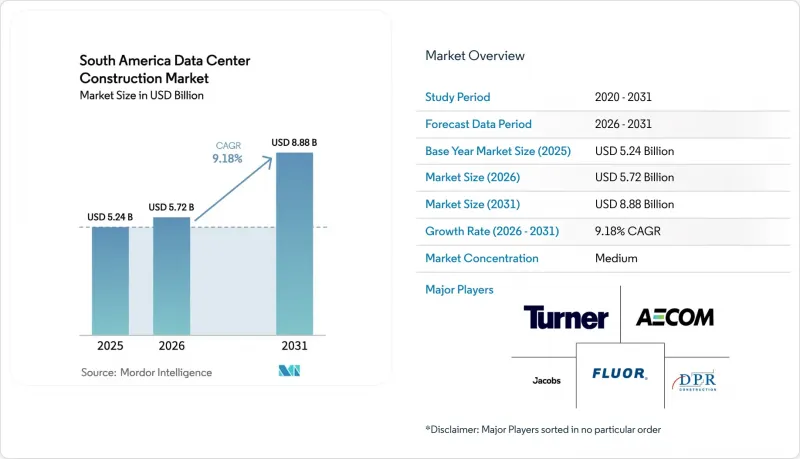
Mordor Intelligence에 의하면, 2026년 남미 데이터센터 건설 시장 규모는 57억 2,000만 달러로 추정되고 있어 2025년 52억 4,000만 달러에서 확대해, 2031년에는 88억 8,000만 달러에 이를 것으로 예측됩니다.
2026년부터 2031년까지 연평균 성장률(CAGR) 9.18%로 성장할 것으로 전망됩니다.
본 보고서는 티어 유형(Tier 1 및 2, Tier 3 및 Tier 4), 데이터센터 유형(코로케이션, 자체 구축형 하이퍼스케일러(CSP), 엔터프라이즈, 엣지), 인프라(전기 인프라, 기계 인프라)별로 분류되어 있습니다. 시장 전망은 금액(달러) 기준으로 제시되어 있습니다.
남미 데이터센터 건설 시장 동향 및 인사이트
‘클라우드 퍼스트’를 내세우는 기업의 디지털화 물결
기업들이 하이브리드 클라우드를 도입함에 따라 기존의 On-Premise 환경에서 전환이 진행되고 있으며, 건설의 우선순위가 재정의되고 있습니다. 포르탈레자 같은 지방 도시는 16개의 해저 케이블이 주요 대도시에 필적하는 세계적 연결성을 제공하고 있어 전략적 허브로 부상하고 있습니다. 콜롬비아는 이러한 추세를 여실히 보여주고 있으며, 인터넷 보급률이 인구의 3분의 2를 넘고 전자상거래가 급증함에 따라 캐리어 중립적인 시설에 대한 수요가 높아지고 있습니다. 브라질에 본사를 둔 파트리아(Patria)사는 이러한 기업의 워크로드를 대상으로 한 새로운 플랫폼에 10억 달러를 투자하며, 이 시장의 기회 규모를 보여주고 있습니다. 지역 전체에 걸쳐 데이터 주권에 관한 규제가 도입됨에 따라, 기업들이 규정 준수를 충족하는 환경을 추구하는 가운데 코로케이션 도입이 더욱 가속화되고 있습니다. 하이브리드 클라우드 게이트웨이와 견고한 규정 준수 체계를 제공할 수 있는 공급업체들이 남미의 데이터센터 건설 시장에서 점유율을 확대되고 있습니다.
하이퍼스케일 및 코로케이션 설비 투자 확대 가속화
주요 클라우드 기업들은 2030년까지 80억 달러를 초과하는 신규 사이트 건설을 발표했으며, 기존 건설 일정은 최단 18개월로 단축되었습니다. AWS의 40억 달러 규모 칠레 지역 및 18억 달러 규모 브라질 확장 계획과 V.tal의 10억 달러 규모 포르탈레자 캠퍼스는 지역 공급망을 활성화시키고 있습니다. Scala Data Centers가 제안한 4.7GW를 목표로 하는 500억 달러 규모의 ‘AI City’ 계획은 슈퍼스케일로 나아가겠다는 야망을 여실히 보여주고 있습니다. 하이퍼스케일 건설 일정을 맞추기 위해 모듈식 설계와 조립식 전원실이 현재 주류를 이루고 있습니다. 소규모 사업자들은 남미 데이터센터 건설 시장에서 경쟁력을 유지하기 위해 사업 통합을 추진하거나 건설 전문 기업과 제휴하고 있습니다.
급등하는 전력 및 부동산 비용
상파울루에서는 하이퍼스케일 캠퍼스에 적합한 토지의 평가액이 현재 급등하고 있어, 개발업자들은 더 광대한 부지와 충분한 전력 여력을 제공하는 캄피나스 등의 2차 지역으로 눈을 돌리고 있습니다. 브라질 전력의 85%는 재생에너지에서 비롯되지만, 반복되는 가뭄으로 수력 발전량이 감소하고 전력 가격이 상승하면서 시설 운영 비용에 영향을 미치고 있습니다. 데이터센터가 주택용 전력 공급을 위협할 수 있다는 시민들의 우려 속에서 송전망에 가해지는 부하에 대한 여론의 관심이 높아지고 있습니다. 이에 대응해 개발사들은 부지 내 태양광 발전, 배터리 저장 시스템, 전력 구매 계약(PPA)을 활용하고 있으며, 이러한 노력들이 남미 데이터센터 건설 시장의 건설 계획을 형성하고 있습니다.
부문 분석
2025년에는 Tier 3 시설이 총 수익의 54.12%를 차지했습니다. 이는 기업들이 내결함성이 높으면서도 비용 효율성이 뛰어난 설계를 선호하는 경향을 반영한 것입니다. 이 범주 내에서 은행 및 디지털 퍼스트 소매업체들이 이중화된 전원 시스템과 멀티패스 광섬유에 대한 투자의 대부분을 차지하고 있습니다. 클라우드 리전이 인접한 상호 연결 공간을 요구함에 따라, 남미 데이터센터 건설 시장 내 Tier 3 시설 시장 규모는 꾸준히 확대될 것으로 예측됩니다. Tier 4의 용량은 현재로서는 소규모이지만, AI 모델 훈련, 정부의 퍼블릭 클라우드 도입 의무화, 그리고 핀테크 플랫폼이 99.995%의 가동률을 요구하고 있기 때문에 2031년까지 연평균 성장률(CAGR) 11.24%를 나타낼 것으로 전망됩니다. 따라서 티어 4 건설과 관련된 남미 데이터센터 건설 시장 점유율은 상승할 전망이며, 유지보수성과 내결함성을 동시에 실현할 수 있는 시공업체를 둘러싼 경쟁이 격화될 것입니다.
상위 티어의 경우, 이중 유틸리티 공급, 액티브-액티브형 전력 아키텍처, 그리고 시운전 주기를 장기화시키는 엄격한 인증 감사가 요구됩니다. 따라서 복잡한 기계·전기·배관 시스템을 전문으로 하는 시공사는 가격 면에서 프리미엄을 요구할 수 있습니다. HostDime사가 브라질에서 ISO 27701 인증을 획득한 사례는 규정 준수 인증이 티어 결정과 어떻게 관련되어 있는지를 보여줍니다.
기업들이 네트워크의 다양성과 규제 준수를 유지하면서 On-Premise 서버를 대체할 확장 가능한 대안을 모색하는 가운데, 코로케이션은 2025년 매출의 55.63%를 계속 차지했습니다. 주요 대도시권의 캐리어 중립 시설은 거의 만실 상태에 이르렀으며, 신규 건설은 교외 및 지방 도시로 이동하고 있습니다. 동시에, 자체 건설한 하이퍼스케일 시설은 2031년까지 연평균 성장률(CAGR) 11.76%를 기록하며, 남미 데이터센터 건설 시장에서 자체 캠퍼스 규모를 확대되고 있습니다. AWS, Microsoft, Google은 게임 및 핀테크 거래에 필수적인 1밀리초 미만의 지연 시간에 최적화된 클라우드 리전 및 엣지 노드를 지원하기 위해 사업 거점을 확대되고 있습니다.
각 하이퍼스케일러 기업들은 일정상의 위험을 줄이고 벤더 인증 절차를 간소화하는 재현 가능한 설계 템플릿을 도입하고 있으며, 이에 따라 개폐 장치, 발전기, 조립식 모듈의 대량 조달이 진행되고 있습니다. 이러한 표준화는 현지 공급망 전반으로 파급되어 부품 제조업체들이 세계 사양을 준수하도록 촉진하고 있습니다. 코로케이션 사업자들은 크로스 커넥트 패브릭 및 클라우드 온램프를 제공하는 생태계가 잘 갖춰진 캠퍼스를 통해 이에 대응하며, 남미 데이터센터 건설 시장에서 차별화를 꾀하고 있습니다.
기타 혜택:
- 엑셀 형식 시장 예측(ME) 시트
- 3개월간의 애널리스트 지원
자주 묻는 질문
목차
제1장 서론
제2장 조사 방법
제3장 주요 요약
제4장 시장 구도
제5장 시장 규모와 성장 예측
제6장 경쟁 구도
제7장 시장 기회와 향후 전망
JHS 26.09.11According to Mordor Intelligence, South America data center construction market size in 2026 is estimated at USD 5.72 billion, growing from 2025 value of USD 5.24 billion with 2031 projections showing USD 8.88 billion, growing at 9.18% CAGR over 2026-2031.
This report is Segmented by Tier Type (Tier 1 and 2, Tier 3 and Tier 4), Data Center Type(Colocation, Self-Built Hyperscalers (CSPs), Enterprise, and Edge), and Infrastructure (Electrical Infrastructure, Mechanical Infrastructure). The Market Forecasts are Provided in Terms of Value (USD).
South America Data Center Construction Market Trends and Insights
Cloud-first Enterprise Digitalization Wave
Enterprise adoption of hybrid cloud is reshaping construction priorities as organizations exit legacy on-premises environments. Secondary cities such as Fortaleza have emerged as strategic hubs because sixteen submarine cables deliver global connectivity that rivals major metros. Colombia illustrates the trend, with internet penetration surpassing two-thirds of the population and e-commerce surging, which increases demand for carrier-neutral facilities. Brazil-based Patria committed USD 1 billion to a new platform targeting these enterprise workloads, signalling the scale of opportunity. Data sovereignty rules across the region further accelerate colocation uptake as enterprises seek compliant environments. Providers able to deliver hybrid cloud gateways and robust compliance frameworks are gaining share in the South America data center construction market.
Hyperscale and Colocation Capex Build-out Acceleration
Cloud majors have announced more than USD 8 billion in new sites through 2030, compressing traditional build schedules to as little as 18 months. AWS's USD 4 billion Chile region and USD 1.8 billion Brazil expansion, along with V.tal's USD 1 billion Fortaleza campus, are catalyzing regional supply chains. Scala Data Centers' USD 50 billion AI City proposal targeting 4.7 GW exemplifies superscale ambition. Modular designs and prefabricated power rooms are now mainstream to meet hyperscale timelines. Smaller operators are consolidating or partnering with construction specialists to remain competitive in the South America data center construction market.
Escalating Power and Real-estate Costs
Land suitable for hyperscale campuses in Sao Paulo now commands premium valuations, pushing developers toward secondary zones such as Campinas that offer larger parcels and improved power headroom. Brazil sources 85% of its electricity from renewables, yet drought cycles reduce hydropower output and raise electricity prices, affecting facility operating costs. Public concern about grid stress has grown as citizens fear data centers may jeopardize the residential supply. Developers respond with on-site solar, battery storage, and power purchase agreements that shape construction blueprints in the South America data center construction market.
Other drivers and restraints analyzed in the detailed report include:
- AI / GPU-dense Workloads Driving High-density Designs
- Government "Neutral Host" Tax Incentives in Brazil and Chile
- Long Lead-time for Utility Grid Interconnects
For complete list of drivers and restraints, kindly check the Table Of Contents.
Segment Analysis
Tier 3 sites captured 54.12% of overall revenue in 2025, reflecting enterprise preference for resilient yet cost-balanced designs. Within this category, banks and digital-first retailers account for the majority of spend on redundant power trains and multi-path fibre. The South America data center construction market size for Tier 3 facilities is projected to expand steadily as cloud regions seek adjacent interconnection space. Tier 4 capacity, while smaller today, shows an 11.24% CAGR through 2031 as AI model training, government public-cloud mandates, and fintech platforms demand 99.995% uptime. The South America data center construction market share associated with Tier 4 builds is therefore positioned to rise, intensifying competition for contractors able to deliver concurrent maintainability and fault tolerance.
Higher tiers require dual utility feeds, active-active power architectures, and stringent certification audits that lengthen commissioning cycles. Contractors specialising in complex mechanical, electrical, and plumbing systems thus command price premiums. HostDime's ISO 27701 achievement in Brazil illustrates how compliance certifications intersect with tiering decisions
Colocation retained 55.63% of 2025 revenue as enterprises sought scalable alternatives to on-premises servers while maintaining network diversity and regulatory compliance. Carrier-neutral sites in major metros recorded near-full occupancy, pushing new builds toward suburbs and secondary cities. Simultaneously, self-built hyperscale sites register a 11.76% CAGR to 2031, elevating the South America data center construction market size for proprietary campuses. AWS, Microsoft, and Google expand footprints to support cloud regions and edge nodes tuned for sub-1 ms latency critical to gaming and fintech transactions.
Hyperscalers deploy repeatable design templates that compress schedule risk and simplify vendor qualification, leading to bulk procurement of switchgear, generators, and prefabricated modules. This standardisation cascades through local supply chains, incentivising parts manufacturers to align with global specifications. Colocation operators respond with ecosystem-rich campuses offering cross-connect fabrics and cloud on-ramps to differentiate in the South America data center construction market.
Complete Report Scope:
- By Tier Type
- Tier 1 and 2
- Tier 3
- Tier 4
- By Data Center Type
- Colocation
- Self-build Hyperscalers (CSPs)
- Enterprise and Edge
- By Infrastructure
- By Electrical Infrastructure
- Power Distribution Solution
- Power Backup Solutions
- By Mechanical Infrastructure
- Cooling Systems
- Racks and Cabinets
- Servers and Storage
- Other Mechanical Infrastructure
- General Construction
- Service - Design and Consulting, Integration, Support and Maintenance
- By Electrical Infrastructure
- Tier 1 and 2
List of Companies Covered in this Report:
- AECOM
- Turner Construction Company
- Jacobs Solutions Inc.
- DPR Construction
- Fluor Corporation
- Constructora Andrade Gutierrez
- Sonda Ingenieria e Implementacion
- Mercury Engineering
- Hensel Phelps
- Gilbane Building Company
- McCarthy Building Companies
- Balfour Beatty US
- Rider Levett Bucknall
- Fonseca Mercadante Constructor
- GSI Ingenieria & Construccion
- Quark Datacenter Solutions
- ACECO TI
- Whiting-Turner Contracting Company
- Synergy Engenharia
- Constructora Sudamericana
Additional Benefits:
- The market estimate (ME) sheet in Excel format
- 3 months of analyst support
TABLE OF CONTENTS
1 INTRODUCTION
- 1.1 Study Assumptions and Market Definition
- 1.2 Scope of the Study
2 RESEARCH METHODOLOGY
3 EXECUTIVE SUMMARY
4 MARKET LANDSCAPE
- 4.1 Market Overview
- 4.2 Market Drivers
- 4.2.1 Cloud-first enterprise digitalization wave
- 4.2.2 Hyperscale and colocation capex build-out acceleration
- 4.2.3 AI / GPU-dense workloads driving high-density designs
- 4.2.4 Government neutral host tax incentives in Brazil and Chile
- 4.2.5 Green financing access for Tier III+ energy-efficient builds
- 4.2.6 Sub-1 ms latency demand from fintech and gaming hubs
- 4.3 Market Restraints
- 4.3.1 Escalating power and real-estate costs
- 4.3.2 Long lead-time for utility grid interconnects
- 4.3.3 Skilled labor shortages for complex MEP installations
- 4.3.4 Water-stress regulations limiting evaporative cooling adoption
- 4.4 Supply-Chain Analysis
- 4.5 Regulatory Landscape
- 4.6 Technological Outlook
- 4.7 Porter's Five Forces Analysis
- 4.7.1 Bargaining Power of Suppliers
- 4.7.2 Bargaining Power of Consumers
- 4.7.3 Threat of New Entrants
- 4.7.4 Threat of Substitutes
- 4.7.5 Intensity of Competitive Rivalry
- 4.8 Key Data Center Statistics
- 4.8.1 Exhaustive Data Center Operators in South America(in MW)
- 4.8.2 List of Major Upcoming Data Center Projects in South America (2025-2030)
- 4.8.3 CAPEX and OPEX For South AmericaData Center Construction
- 4.8.4 Data Center Power Capacity Absorption In MW, Selected Cities, South America, 2023 and 2024
- 4.9 Artificial Intelligence (AI) Inclusion in Data Center Construction in South America
- 4.10 Regulatory and Compliance Framework
5 MARKET SIZE AND GROWTH FORECASTS (VALUE)
- 5.1 By Tier Type
- 5.1.1 Tier 1 and 2
- 5.1.1.1 Tier 3
- 5.1.1.2 Tier 4
- 5.1.2 By Data Center Type
- 5.1.2.1 Colocation
- 5.1.2.2 Self-build Hyperscalers (CSPs)
- 5.1.2.3 Enterprise and Edge
- 5.1.3 By Infrastructure
- 5.1.3.1 By Electrical Infrastructure
- 5.1.3.1.1 Power Distribution Solution
- 5.1.3.1.2 Power Backup Solutions
- 5.1.3.2 By Mechanical Infrastructure
- 5.1.3.2.1 Cooling Systems
- 5.1.3.2.2 Racks and Cabinets
- 5.1.3.2.3 Servers and Storage
- 5.1.3.2.4 Other Mechanical Infrastructure
- 5.1.3.3 General Construction
- 5.1.3.4 Service - Design and Consulting, Integration, Support and Maintenance
- 5.1.3.1 By Electrical Infrastructure
- 5.1.1 Tier 1 and 2
6 COMPETITIVE LANDSCAPE
- 6.1 Market Concentration
- 6.2 Strategic Moves
- 6.3 Market Share Analysis
- 6.4 Data Center Infrastructure Investment Based on Megawatt (MW) Capacity, 2024 vs 2030
- 6.5 Data Center Construction Landscape (Key Vendors Listings)
- 6.6 Company Profiles (includes Global level Overview, Market level overview, Core Segments, Financials as available, Strategic Information, Market Rank/Share for key companies, Products and Services, Recent Developments)
- 6.6.1 AECOM
- 6.6.2 Turner Construction Company
- 6.6.3 Jacobs Solutions Inc.
- 6.6.4 DPR Construction
- 6.6.5 Fluor Corporation
- 6.6.6 Constructora Andrade Gutierrez
- 6.6.7 Sonda Ingenieria e Implementacion
- 6.6.8 Mercury Engineering
- 6.6.9 Hensel Phelps
- 6.6.10 Gilbane Building Company
- 6.6.11 McCarthy Building Companies
- 6.6.12 Balfour Beatty US
- 6.6.13 Rider Levett Bucknall
- 6.6.14 Fonseca Mercadante Constructor
- 6.6.15 GSI Ingenieria & Construccion
- 6.6.16 Quark Datacenter Solutions
- 6.6.17 ACECO TI
- 6.6.18 Whiting-Turner Contracting Company
- 6.6.19 Synergy Engenharia
- 6.6.20 Constructora Sudamericana
7 MARKET OPPORTUNITIES AND FUTURE OUTLOOK
- 7.1 White-space and Unmet-need Assessment