
|
시장보고서
상품코드
2119871
베트남의 데이터센터 네트워킹 : 시장 점유율 분석, 업계 동향 및 통계, 성장 예측(2026-2031년)Vietnam Data Center Networking - Market Share Analysis, Industry Trends & Statistics, Growth Forecasts (2026 - 2031) |
||||||
 Mordor Intelligence
Mordor Intelligence에 의하면, 베트남의 데이터센터 네트워킹 시장 규모는 2025년에 4억 5,659만 달러로 평가되었습니다. 2026년 4억 8,744만 달러에서 2031년까지 6억 7,663만 달러에 이를 것으로 예상되며, 예측 기간(2026-2031년) CAGR은 6.76%를 나타낼 전망입니다.
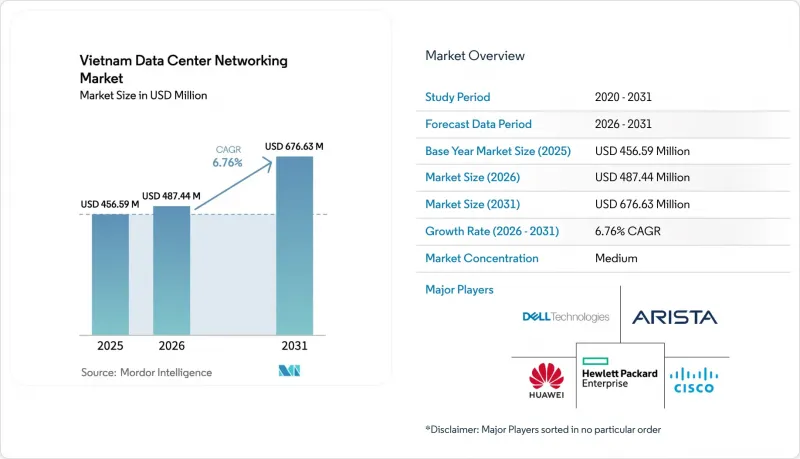
본 보고서는 구성 요소(제품 및 서비스), 최종 사용자(IT 및 통신, 은행 및 금융 서비스·보험(BFSI),정부·국방, 기타), 데이터센터 유형(코로케이션, 하이퍼스케일러·클라우드 서비스 제공업체, 엣지·마이크로 데이터센터), 대역폭(10GbE 이하, 25-40GbE, 기타)별로 분류되어 있습니다. 시장 예측은 금액(달러) 기준으로 제시되어 있습니다.
베트남의 데이터센터 네트워킹 시장 동향 및 인사이트
베트남 내 하이퍼스케일 및 클라우드에 대한 자본 지출(CAPEX) 확대
통신 사업자들이 데이터 현지화 규제에 대응하고 지역 허브로서의 야망을 실현하기 위해 경쟁하는 가운데, 하이퍼스케일 시설 건설이 현재 막대한 ICT 지출의 상당 부분을 차지하고 있습니다. Viettel의 2억 6,100만 달러, 140MW 규모의 캠퍼스는 AI 워크로드에 최적화된 10kW 랙을 제공하며 국내의 새로운 벤치마크를 확립했습니다. VNPT의 하노이에 위치한 2만 3,000m² 규모의 시설(랙 2,000개)은 랙당 2Gbps를 지원하며, 1GbE에서 25GbE 및 100GbE 스위칭 백본으로의 급속한 전환을 뒷받침하고 있습니다. 2030년까지 국내 총 용량 870MW를 달성하겠다는 정부의 목표는 고대역폭 라우팅, 광전송, 소프트웨어 정의 패브릭에 대한 다년간 수요를 뒷받침하고 있습니다. 알리바바 클라우드(Alibaba Cloud)와 같은 해외 클라우드 제공업체들은 스토리지 규정을 준수하기 위해 현지 지사 개설을 발표했으며, 이로 인해 베트남의 데이터센터 네트워킹 시장에 새로운 조달 수요가 발생하고 있습니다.
스마트 시티 및 제조 프로젝트에서의 엣지 컴퓨팅 수요 급증
삼성은 200억 달러를 투자해 9억 2,500만 대의 휴대전화를 생산하는 클러스터를 운영하고 있으며, 이 과정에서 로컬 컴퓨팅 노드와 저지연 이더넷 패브릭이 필요한 1,000대의 실시간 품질 관리 센서를 가동하고 있습니다. 폭스콘이 6개 공장에 2,500대의 VDI를 도입한 것은 공장 현장의 마이크로 데이터센터 및 SDN 컨트롤러로의 전환을 뒷받침하고 있습니다. 빈즈엉성과 다낭시의 프로젝트로 인해 공공 부문의 엣지 수요가 증가하여 스위치와 방화벽의 출하 대수를 끌어올리고 있습니다. 통신 사업자들이 5G 무선 기지국의 고밀도화를 추진하는 가운데, 타워형 마이크로 데이터센터는 베트남의 데이터센터 네트워킹 시장 규모를 더욱 확대되고 있습니다.
수출 규제로 인한 ASIC 리드타임 리스크
미국의 이중용도 규제 확대로 인해, 고성능 스위칭용 반도체의 리드타임은 현재 40-60주가 소요되어 기존 기준의 2배에 달하며, 자본 지출(CAPEX)을 증가시키고 있습니다. 베트남은 여전히 연간 500억 달러 상당의 전자 부품을 수입하고 있으며, 현지 데이터센터 건설은 출하 지연 및 가격 급등의 위험에 노출되어 있습니다. 전 세계 조사에 따르면, 통신 사업자의 44%가 부품 부족으로 인한 서비스 중단을 경험한 바 있으며, 이는 베트남의 데이터센터 네트워킹 시장의 운영 리스크를 여실히 드러내고 있습니다.
부문 분석
2025년, 베트남의 데이터센터 네트워킹 시장 매출의 71.95%를 제품 부문이 차지했으며, 이는 베트남의 디지털 인프라 구축이 하드웨어 중심 단계에 있음을 반영합니다. 코어에서 엣지에 이르는 스위치 교체(1GbE에서 25GbE 및 100GbE로의 전환)가 그 대부분을 차지하는 반면, 라우터 업그레이드는 5G 백홀의 확장과 연동되어 있습니다. 데이터 현지화 관련 법규로 인해 국내 스토리지 및 보안 수요가 증가하는 가운데, 스토리지 영역 네트워크(SAN), 용도 전달 컨트롤러, 차세대 방화벽이 매출을 서서히 끌어올리고 있습니다. 베트남의 데이터센터 네트워킹 시장에서 제품 부문 시장 규모는 서비스 부문에 비해 성장률이 둔화되겠지만, 절대값으로는 확대될 것으로 예측됩니다. 서비스 부문은 2025년 지출에서 차지하는 비중이 28.05%에 그치겠지만, 2031년까지 연평균 성장률(CAGR) 6.88%로 성장할 전망입니다. 인력 부족으로 인해 설계, 마이그레이션, 라이프사이클 지원 분야에서 전문 서비스가 필수적입니다. 매니지드 네트워크 서비스는 자본 지출(CAPEX)을 절감하고 운영 위험을 낮추는 성과 기반 계약을 원하는 중견 제조업체나 은행에게 특히 매력적입니다. SDN 및 인텐트 기반 플랫폼이 보급됨에 따라, 벤더들은 컨트롤러 라이선싱, 네트워크 분석 구독, 보안 조치의 자동화를 통해 지속적인 수익을 창출하고 있으며, 이는 베트남의 데이터센터 네트워킹 산업 전반의 서비스 성장 추세를 뒷받침하고 있습니다.
통신 및 IT 사업자는 2025년 수익의 35.30%를 차지했으며, 이는 Viettel, VNPT, FPT의 5G 및 클라우드 적극적인 확장을 반영한 것입니다. Techcombank의 LinuxONE 스택은 트랜잭션 처리량을 4배로 확대함으로써, 금융 기관 역시 엔터프라이즈급 라우팅 및 스위칭 수요를 주도하고 있음을 보여줍니다. 국가 디지털 ID와 관련된 정부 프로젝트가 사용자 기반을 확대하는 한편, 미디어,의료, 교육 부문에서는 UHD 스트리밍 및 원격 의료 서비스와 같은 새로운 워크로드가 추가되고 있습니다. ‘차이나 플러스 원’에 따른 생산 거점 이전의 호재에 힘입은 제조·산업 부문은 연평균 성장률(CAGR) 7.05%를 나타낼 것으로 전망됩니다. 삼성의 타이응옌과 박닌에 위치한 공장에서는 AI를 활용한 결함 검사 및 IoT 텔레메트리 기술이 요구되고 있으며, 이에 따라 마이크로 데이터센터와 고대역폭 스위치의 도입이 진행되고 있습니다. 산업 단지에서도 유사한 모델이 채택되고 있어, 베트남의 데이터센터 네트워킹 시장이 기존 메트로 허브를 넘어 확장될 것으로 확실시되고 있습니다.
기타 혜택
- 엑셀 형식 시장 예측(ME) 시트
- 3개월간의 애널리스트 지원
자주 묻는 질문
목차
제1장 서론
제2장 조사 방법
제3장 주요 요약
제4장 시장 구도
제5장 시장 규모 및 성장 예측
제6장 경쟁 구도
제7장 시장 기회 및 향후 전망
KTHAccording to Mordor Intelligence, the Vietnam data center networking market size was valued at USD 456.59 million in 2025 and estimated to grow from USD 487.44 million in 2026 to reach USD 676.63 million by 2031, at a CAGR of 6.76% during the forecast period (2026-2031).
This report is Segmented by Component (Product and Services), End User( IT and Telecommunications, Banking, Financial Services and Insurance (BFSI), Government and Defense and More), Data Center Type (Colocation, Hyperscalers/Cloud Service Providers, Edge/Micro Data Centers), by Bandwidth (<=10 GbE, 25-40 GbE and More). The Market Forecasts are Provided in Terms of Value (USD).
Vietnam Data Center Networking Market Trends and Insights
Growing hyperscale and cloud CAPEX in Vietnam
Hyperscale builds now dominate large-ticket ICT spending as operators race to satisfy data-localization rules and regional hub ambitions. Viettel's USD 261 million, 140 MW campus sets a new domestic benchmark, offering 10 kW racks that are optimised for AI workloads. VNPT's 23,000 m2 Hanoi facility with 2,000 racks supports 2 Gbps per rack, underscoring the rapid transition from 1 GbE to 25 GbE and 100 GbE switching backbones. Government targets calling for 870 MW of national capacity by 2030 underpin multi-year demand for high-bandwidth routing, optical-transport, and software-defined fabrics. Foreign cloud providers such as Alibaba Cloud have announced local zones to comply with storage rules, bringing new procurement volume to the Vietnam data center networking market.
Surge in edge-computing needs for smart-city and manufacturing projects
Samsung's USD 20 billion cluster-producing 925 million handsets-operates thousands of real-time quality-control sensors that require local compute nodes and low-latency Ethernet fabrics. Foxconn's deployment of 2,500 VDIs across six plants demonstrates the shift toward micro data centers and SDN controllers at factory floors. Binh Duong and Da Nang city programs add public-sector edge demand, driving incremental switch and firewall shipments. As operators densify 5G radios, tower-based micro data centers further enlarge the Vietnam data center networking market footprint.
Export-control-driven ASIC lead-time risk
Advanced switching silicon now requires 40-60 week lead times because of expanded U.S. dual-use controls, doubling historical norms and inflating capex.Vietnam still imports USD 50 billion in electronic parts annually, exposing local data-center builds to shipment slips and price spikes. Global surveys show 44% of operators suffered outages tied to parts shortages, underscoring operational risk within the Vietnam data center networking market.
Other drivers and restraints analyzed in the detailed report include:
- Government incentives (National DC Strategy 2025)
- Shift toward SDN and intent-based networking
- Shortage of advanced network-architecture talent
For complete list of drivers and restraints, kindly check the Table Of Contents.
Segment Analysis
Products generated 71.95% of Vietnam data center networking market revenue in 2025, reflecting the hardware-intensive stage of the country's digital build-out. Core-to-edge switch refreshes from 1 GbE to 25 GbE and 100 GbE contribute the bulk, while router upgrades align with 5G backhaul expansion. Storage-area networking, application delivery controllers, and next-generation firewalls add incremental volume as data-localization laws amplify in-country storage and security needs. The Vietnam data center networking market size for Products is expected to widen in absolute terms even as growth decelerates relative to Services.Services, though only 28.05% of the 2025 spend, will advance at a 6.88% CAGR through 2031. Skill shortages make professional services indispensable for design, migration, and lifecycle support. Managed network services are especially attractive to mid-sized manufacturers and banks seeking outcome-based contracts that trim capex and de-risk operations. As SDN and intent-based platforms proliferate, vendors earn recurring revenue from controller licensing, network-analytics subscriptions, and security-policy automation, reinforcing the services uptrend across the Vietnam data center networking industry.
Telecom and IT operators commanded 35.30% of 2025 revenue, mirroring Viettel, VNPT, and FPT's aggressive 5G and cloud rollouts. Techcombank's LinuxONE stack that quadrupled transaction throughput demonstrates how financial institutions also drive enterprise-grade routing and switching demand. Government projects tied to national digital identity broaden the user base, while media, healthcare, and education add new workloads such as UHD streaming and telehealth services.Manufacturing and Industrial verticals, buoyed by China-plus-one relocations, are poised for a 7.05% CAGR. Samsung's factories in Thai Nguyen and Bac Ninh require AI-enabled defect inspection and IoT telemetry, prompting micro data center and high-bandwidth switch installations. Industrial parks replicate this template, ensuring that the Vietnam data center networking market expands beyond the traditional metro hubs.
Complete Report Scope:
- By Component
- Products
- Ethernet Switches
- Routers
- Storage Area Network (SAN)
- Application Delivery Controllers (ADC)
- Network Security Appliances
- Software-Defined Networking (SDN) Controllers
- Optical Interconnects
- Services
- Installation and Integration
- Training and Consulting
- Support and Maintenance
- Managed Network Services
- Products
- By End-User
- IT and Telecommunications
- Banking, Financial Services and Insurance (BFSI)
- Government and Defense
- Media and Entertainment
- Healthcare and Life Sciences
- Manufacturing and Industrial
- Other End-Users
- By Data-Center Type
- Colocation
- Hyperscalers/Cloud Service Providers
- Edge/Micro Data Centers
- By Bandwidth
- less than or equal to10 GbE
- 25-40 GbE
- 50-100 GbE
- Greater than 100 GbE
List of Companies Covered in this Report:
- Cisco Systems Inc.
- Arista Networks Inc.
- Dell Technologies Inc.
- Hewlett Packard Enterprise
- Huawei Technologies Co. Ltd.
- Juniper Networks Inc.
- VMware Inc.
- Broadcom Inc.
- Intel Corporation
- NVIDIA Corporation
- NEC Corporation
- IBM Corporation
- Schneider Electric SE
- Siemens AG
- FPT Telecom International
- Viettel IDC
- VNPT Technology
- CMC Telecom
- Netnam Corporation
- Supermicro Computer Inc.
- Edgecore Networks Corp.
- Extreme Networks Inc.
- Palo Alto Networks
- Fortinet Inc.
Additional Benefits:
- The market estimate (ME) sheet in Excel format
- 3 months of analyst support
TABLE OF CONTENTS
1 INTRODUCTION
- 1.1 Study Assumptions and Market Definition
- 1.2 Scope of the Study
2 RESEARCH METHODOLOGY
3 EXECUTIVE SUMMARY
4 MARKET LANDSCAPE
- 4.1 Market Overview
- 4.2 Market Drivers
- 4.2.1 Growing hyperscale and cloud CAPEX in Vietnam
- 4.2.2 Surge in edge-computing needs for smart-city and manufacturing projects
- 4.2.3 Government incentives (National DC Strategy 2025)
- 4.2.4 Shift toward SDN and intent-based networking
- 4.2.5 5G rollout driving DC router refresh
- 4.2.6 Corporate ESG mandates favoring energy-efficient silicon
- 4.3 Market Restraints
- 4.3.1 Export-control-driven ASIC lead-time risk
- 4.3.2 Shortage of advanced network-architecture talent
- 4.3.3 Rising electricity tariffs eroding TCO
- 4.3.4 Persistent cybersecurity gaps in enterprises
- 4.4 Supply-Chain Analysis
- 4.5 Regulatory Landscape
- 4.6 Technological Outlook
- 4.7 Porter's Five Forces
- 4.7.1 Threat of New Entrants
- 4.7.2 Bargaining Power of Buyers
- 4.7.3 Bargaining Power of Suppliers
- 4.7.4 Threat of Substitutes
- 4.7.5 Intensity of Competitive Rivalry
- 4.8 Assessment of Macroeconomic Factors on the Market
5 MARKET SIZE and GROWTH FORECASTS (VALUE)
- 5.1 By Component
- 5.1.1 Products
- 5.1.1.1 Ethernet Switches
- 5.1.1.2 Routers
- 5.1.1.3 Storage Area Network (SAN)
- 5.1.1.4 Application Delivery Controllers (ADC)
- 5.1.1.5 Network Security Appliances
- 5.1.1.6 Software-Defined Networking (SDN) Controllers
- 5.1.1.7 Optical Interconnects
- 5.1.2 Services
- 5.1.2.1 Installation and Integration
- 5.1.2.2 Training and Consulting
- 5.1.2.3 Support and Maintenance
- 5.1.2.4 Managed Network Services
- 5.1.1 Products
- 5.2 By End-User
- 5.2.1 IT and Telecommunications
- 5.2.2 Banking, Financial Services and Insurance (BFSI)
- 5.2.3 Government and Defense
- 5.2.4 Media and Entertainment
- 5.2.5 Healthcare and Life Sciences
- 5.2.6 Manufacturing and Industrial
- 5.2.7 Other End-Users
- 5.3 By Data-Center Type
- 5.3.1 Colocation
- 5.3.2 Hyperscalers/Cloud Service Providers
- 5.3.3 Edge/Micro Data Centers
- 5.4 By Bandwidth
- 5.4.1 less than or equal to10 GbE
- 5.4.2 25-40 GbE
- 5.4.3 50-100 GbE
- 5.4.4 Greater than 100 GbE
6 COMPETITIVE LANDSCAPE
- 6.1 Market Concentration
- 6.2 Strategic Moves
- 6.3 Market Share Analysis
- 6.4 Company Profiles (includes Global level Overview, Market level overview, Core Segments, Financials as available, Strategic Information, Market Rank/Share for key companies, Products and Services, and Recent Developments)
- 6.4.1 Cisco Systems Inc.
- 6.4.2 Arista Networks Inc.
- 6.4.3 Dell Technologies Inc.
- 6.4.4 Hewlett Packard Enterprise
- 6.4.5 Huawei Technologies Co. Ltd.
- 6.4.6 Juniper Networks Inc.
- 6.4.7 VMware Inc.
- 6.4.8 Broadcom Inc.
- 6.4.9 Intel Corporation
- 6.4.10 NVIDIA Corporation
- 6.4.11 NEC Corporation
- 6.4.12 IBM Corporation
- 6.4.13 Schneider Electric SE
- 6.4.14 Siemens AG
- 6.4.15 FPT Telecom International
- 6.4.16 Viettel IDC
- 6.4.17 VNPT Technology
- 6.4.18 CMC Telecom
- 6.4.19 Netnam Corporation
- 6.4.20 Supermicro Computer Inc.
- 6.4.21 Edgecore Networks Corp.
- 6.4.22 Extreme Networks Inc.
- 6.4.23 Palo Alto Networks
- 6.4.24 Fortinet Inc.
7 MARKET OPPORTUNITIES and FUTURE OUTLOOK
- 7.1 White-space and Unmet-Need Assessment