
|
시장보고서
상품코드
2125721
유럽의 실내 LED 조명 시장 : 점유율 분석, 업계 동향과 통계, 성장 예측(2026-2031년)Europe Indoor LED Lighting - Market Share Analysis, Industry Trends & Statistics, Growth Forecasts (2026 - 2031) |
||||||
 Mordor Intelligence
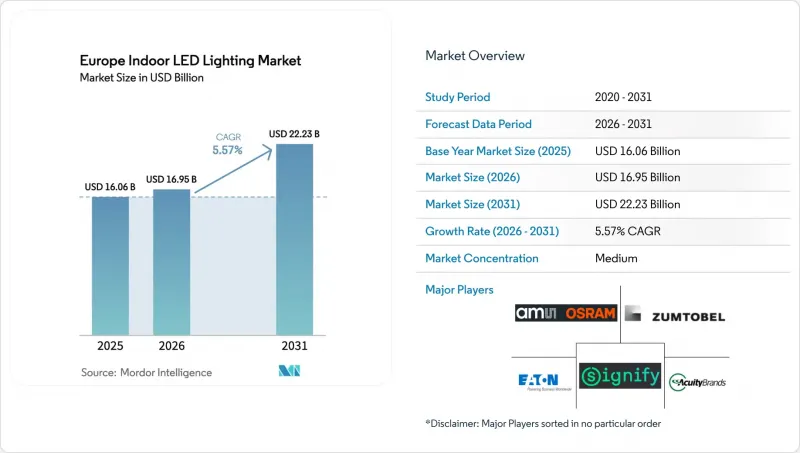
Mordor Intelligence에 의하면, 2026년 유럽 실내 LED 조명 시장 규모는 169억 5,000만 달러로 추정되고 있어 2025년 160억 6,000만 달러에서 성장하여 2031년에는 222억 3,000만 달러에 이를 것으로 예측됩니다.
2026년부터 2031년까지의 연평균 성장률(CAGR)은 5.57%를 나타낼 전망입니다.
본 보고서는 제품 유형(램프, 조명 기구), 용도(주택, 상업용 사무실, 소매점 등), 설치 유형(신규 설치, 개조 설치), 유통 채널(직접 판매, 도매·소매, 전자상거래) 및 지역(독일, 프랑스 등)별로 분류되어 있습니다. 시장 전망은 금액(달러) 기준으로 제시되어 있습니다.
유럽 실내 LED 조명 시장 동향 및 인사이트
형광등 단계적 폐지 가속화(EU RoHS)
EU 전역에서 T8, T5 및 소형 형광등의 단계적 폐지에 따라 건물 소유주는 약 5억 개의 조명 기구를 교체해야만 하게 되었으며, 이로 인해 유럽 LED 조명 업계 전반에 걸쳐 교체 수요가 가속화되고 있습니다. 이에 따라 조명 기구, 램프 및 제어 기기의 판매량을 동시에 끌어올리는 확실한 교체 주기가 형성되고 있습니다. 설치 프로젝트에서는 센서 업그레이드나 비상 조명 적합성 점검이 세트로 진행되는 경우가 많아, 이로 인해 평균 리모델링 비용이 상승하고 있으며, 턴키 솔루션이나 탄탄한 시공업체 지원 네트워크를 갖춘 공급업체에 이점이 돌아가고 있습니다.
넷 제로 건축을 향한 ‘리노베이션 웨이브’의 자금 조달
유럽연합 집행위원회의 1,500억 유로 규모 ‘리노베이션 웨이브’ 계획은 철저한 에너지 절약 개보수를 위한 보조금을 유도하고 있으며, 조명은 대상 지출의 15-20%를 차지할 수 있습니다. 저금리 대출과 직접 보조금을 통해 첨단 LED 시스템의 투자 회수 기간이 단축되고 있으며, 그 결과 건물 에너지 관리 대시보드와 연동되는 커넥티드 조명 기구에 대한 수요가 촉진되고 있습니다. 각국의 프로그램이 EU의 자금 흐름과 조화를 이루고 있어 북유럽 국가들이 가장 큰 혜택을 받고 있으며, 스웨덴과 덴마크에서는 LED 보급률이 80%에 육박하고 있습니다.
희토류 형광체공급망 가격 충격
2024년에 유로퓸 가격이 40% 급등하면서 LED 형광체의 이익률이 압박을 받았습니다. 이는 중국의 수출 규제로 인해 유럽의 원자재 의존도가 드러났기 때문입니다. 형광체는 칩 비용의 최대 12%를 차지하며, 색 재현성이 중요한 용도가 가장 먼저 그 영향을 받고 있습니다. 양자점이나 페로브스카이트를 이용한 대체 기술은 양산화까지 앞으로 3-5년이 더 소요될 것으로 예상되므로, 고급 조명 기구 라인의 단기적인 취약성은 지속될 것으로 보입니다.
부문별 분석
조명 기구는 단가 상승과 다수의 개보수 프로젝트에서 기구 교체 의무화로 인해 2025년 매출의 59.48%를 차지했습니다. 유럽 실내 LED 조명 시장에서 조명 기구 시장 규모는 2025년 95억 5,000만 달러에서 2031년까지 130억 5,000만 달러로 확대될 전망입니다. 센서가 내장된 건축용 모델은 평균 판매 가격을 끌어올려 차별화를 촉진하고 있습니다. LEDVANCE의 프레임리스 천장 패널은 이러한 프리미엄화 추세를 상징하는 제품으로, 기본적인 트로퍼형 조명 기구보다 소매 가격이 40% 높지만 설치 시간을 단축시켜 줍니다.
램프 부문은 규모는 작지만, 형광등 사용 금지 조치로 인해 일괄 교체가 진행되고 있어 2031년까지 연평균 성장률(CAGR) 7.10%를 나타낼 것으로 예측됩니다. 플러그 앤 플레이 방식의 스마트 튜브에는 조광 기능이나 재실 감지 기능이 통합되면서 카테고리 간의 경계가 모호해지고 있습니다. 낮은 초기 비용은 대규모 개보수를 미루고 있는 시설 관리자들의 관심을 끌고 있지만, 2026년에 교체 수요가 정점에 달하면 매출 점유율은 정체될 것으로 예측됩니다. 폭넓은 램프 제품 포트폴리오와 유연한 물류 체계를 갖춘 공급업체는 이러한 시간적 제약이 있는 수요를 최대한 활용할 수 있는 위치에 있습니다.
주거용 시장은 이미 2025년 매출의 40.88%를 차지하고 있습니다. 스마트 스피커 생태계가 보급되어 음성으로 조명을 제어할 수 있게 되고, 젊은 주택 소유자들이 에너지 효율 향상을 우선시하게 됨에 따라 유럽 가정용 실내 LED 조명 시장 점유율은 확대될 것으로 예측됩니다. 진입 가격 하락과 DIY에 적합한 키트 덕분에 도입 주기가 단축되고 있습니다. 초기 구매 단계에서는 네트워크 지원 전구나 유연한 스트립 조명이 주류를 이루지만, 이후 방 전체의 조명 기구로 업그레이드되면서 평균 거래액을 끌어올리고 있습니다.
상업용 사무실 및 소매 분야에서는 여전히 큰 판매량을 유지하고 있지만, 성장 추세는 분야별로 엇갈리고 있습니다. 사무실에서는 웰빙과 공간 활용 효율에 관한 데이터를 중시하는 반면, 소매 분야에서는 고객의 체류 시간에 영향을 미치는 색조 조절이 가능한 스포트라이트에 중점을 두고 있습니다. 의료시설에서는 생체 리듬에 미치는 효과가 입증됨에 따라, 병동 단위에서 색조 조절이 가능한 시스템의 시범 도입이 진행되고 있습니다. 산업 분야의 구매자들은 고가의 가동 중단이 발생하기 전에 온도 이상을 경고하는 예측 유지보수 센서가 탑재된 하이베이 조명 기구를 선호하는 경향이 있습니다.
기타 혜택:
- 엑셀 형식 시장 예측(ME) 시트
- 3개월간의 애널리스트 지원
자주 묻는 질문
목차
제1장 서론
제2장 조사 방법
제3장 주요 요약
제4장 시장 구도
제5장 시장 규모와 성장 예측
제6장 경쟁 구도
제7장 시장 기회와 향후 전망
JHS 26.09.11According to Mordor Intelligence, Europe indoor LED lighting market size in 2026 is estimated at USD 16.95 billion, growing from 2025 value of USD 16.06 billion with 2031 projections showing USD 22.23 billion, growing at 5.57% CAGR over 2026-2031.

This report is Segmented by Product Type (Lamps, and Luminaires/Fixtures), Application (Residential, Commercial Offices, Retail Stores, and More), Installation Type (New Installation, and Retrofit Installation), Distribution Channel (Direct Sales, Wholesale Retail, E-Commerce), and Geography (Germany, France, and More). The Market Forecasts are Provided in Terms of Value (USD).
Europe Indoor LED Lighting Market Trends and Insights
Accelerated Phase-Out of Fluorescent Lamps (EU RoHS)
The EU-wide withdrawal of T8, T5, and compact fluorescent lamps forces building owners to convert an estimated 500 million fixtures, accelerating replacement demand across the Europe LED lighting industry and creating a captive replacement cycle that drives up volumes of luminaires, lamps, and control gear in tandem. Installation projects frequently bundle sensor upgrades and emergency-lighting compliance checks, raising average retrofit values and rewarding suppliers with turnkey solutions and robust contractor support networks.
Renovation-Wave Funding for Net-Zero Buildings
The European Commission's EUR 150 billion Renovation Wave steers subsidies toward deep-energy refurbishments, and lighting can claim 15-20% of eligible spend. Low-interest loans and direct grants reduce the payback periods for advanced LED systems, thereby spurring demand for connected fixtures that interface with building energy dashboards. Northern Europe benefits most as national programs align with EU capital flows, yielding LED penetration rates approaching 80% in Sweden and Denmark.
Supply-Chain Price Shocks for Rare-Earth Phosphors
A 40% price spike for europium in 2024 tightened LED phosphor margins, as Chinese export curbs exposed Europe's raw-material dependency. Phosphors account for up to 12% of chip costs, and color-critical applications are the first to feel the pinch. Quantum-dot and perovskite substitutes remain three to five years from scale, sustaining near-term vulnerability for premium fixture lines.
Other drivers and restraints analyzed in the detailed report include:
- Corporate ESG Mandates Driving Connected-Lighting Retrofits
- CAPEX Shift to Human-Centric and Circadian-Tuned Lighting
- Installers' Skills Gap for PoE / Wireless Controls
For complete list of drivers and restraints, kindly check the Table Of Contents.
Segment Analysis
Luminaires captured 59.48% of 2025 revenue thanks to higher unit pricing and mandatory fixture swaps in many retrofit scenarios. Europe indoor LED lighting market size for luminaires is set to expand from USD 9.55 billion in 2025 to USD 13.05 billion by 2031. Architectural models with embedded sensors raise average selling prices and support differentiation. LEDVANCE's frameless ceiling panels exemplify this premium trend, retailing 40% above basic troffers while cutting installation time.
The lamps segment, although smaller, is projected to grow at a 7.10% CAGR through 2031, driven by bans on fluorescent bulbs, which are prompting bulk replacements. Plug-and-play smart tubes now integrate dimming and occupancy sensing, blurring the lines between categories. Upfront cost advantages appeal to facility managers, who are delaying deeper renovations, but the revenue share is forecast to plateau once replacement peaks in 2026. Vendors with broad lamp portfolios and logistics agility are best positioned to harvest this time-sensitive demand.
Residential use already accounts for 40.88% of 2025 sales. The Europe indoor LED lighting market share in homes is expected to increase as smart-speaker ecosystems become more prevalent, enabling voice-based lighting control, and as younger homeowners prioritize energy rating upgrades. Falling entry prices and DIY-friendly kits shorten adoption cycles. Connected bulbs and flexible strip lights dominate early purchases, later segueing into whole-room fixture upgrades that bolster ticket size.
Commercial offices and retail maintain significant volumes, but growth splits by specialization. Offices prioritize wellness and space-utilization data, while retail focuses on color-tunable spotlights that influence shopper dwell time. Healthcare facilities, spurred by the demonstrated benefits of circadian rhythms, are trialing tunable systems at the ward level. Industrial buyers tend to favor high-bay luminaires equipped with predictive-maintenance sensors that alert to temperature anomalies before costly downtime occurs.
Complete Report Scope:
- By Product Type
- Lamps
- Luminaires/Fixtures
- By Application
- Residential
- Commercial Offices
- Retail Stores
- Hospitality
- Industrial Facilities
- Healthcare and Education
- Other Applications
- By Installation Type
- New Installation
- Retrofit Installation
- By Distribution Channel
- Direct Sales
- Wholesale Retail
- E-commerce
- By Country
- Germany
- United Kingdom
- France
- Italy
- Spain
- Netherlands
- Sweden
- Norway
- Denmark
- Finland
- Belgium
- Austria
- Switzerland
- Poland
- Czech Republic
- Rest of Europe
List of Companies Covered in this Report:
- Signify N.V.
- ams-OSRAM AG
- Zumtobel Group AG
- Acuity Brands, Inc.
- Eaton Corporation plc
- Legrand SA
- Hubbell Incorporated
- Dialight plc
- LEDVANCE GmbH
- Fagerhult Group AB
- Trilux GmbH & Co. KG
- ERCO GmbH
- Glamox AS
- Cree, Inc.
- Lutron Electronics Co., Inc.
- Schneider Electric SE
- Panasonic Holdings Corporation
- GE Current Lighting Solutions, LLC
- Opple Lighting Co., Ltd.
- LEDiL Oy
Additional Benefits:
- The market estimate (ME) sheet in Excel format
- 3 months of analyst support
TABLE OF CONTENTS
1 INTRODUCTION
- 1.1 Study Assumptions and Market Definition
- 1.2 Scope of the Study
2 RESEARCH METHODOLOGY
3 EXECUTIVE SUMMARY
4 MARKET LANDSCAPE
- 4.1 Market Overview
- 4.2 Market Drivers
- 4.2.1 Accelerated Phase-Out of Fluorescent Lamps (EU RoHS)
- 4.2.2 Renovation-Wave Funding for Net-Zero Buildings
- 4.2.3 Corporate ESG Mandates Driving Connected-Lighting Retrofits
- 4.2.4 CAPEX Shift to Human-Centric and Circadian-Tuned Lighting
- 4.2.5 Cost-Down of LED Drivers and Optics via SiC/GaN Power ICs
- 4.2.6 Demand for Data-Rich Lighting (Indoor Positioning, Asset-Tracking)
- 4.3 Market Restraints
- 4.3.1 Supply-Chain Price Shocks for Rare-Earth Phosphors
- 4.3.2 Installers' Skills Gap for PoE / Wireless Controls
- 4.3.3 Up-Front CAPEX Hurdle in SME Retrofits Despite Incentives
- 4.3.4 IoT-Security and Data-Privacy Compliance Burdens (GDPR)
- 4.4 Impact of Macroeconomic Factors on the Market
- 4.5 Industry Value Chain Analysis
- 4.6 Regulatory Landscape
- 4.7 Technological Outlook
- 4.8 Porter's Five Forces Analysis
- 4.8.1 Threat of New Entrants
- 4.8.2 Bargaining Power of Suppliers
- 4.8.3 Bargaining Power of Buyers
- 4.8.4 Threat of Substitutes
- 4.8.5 Intensity of Competitive Rivalry
5 MARKET SIZE AND GROWTH FORECASTS (VALUE)
- 5.1 By Product Type
- 5.1.1 Lamps
- 5.1.2 Luminaires/Fixtures
- 5.2 By Application
- 5.2.1 Residential
- 5.2.2 Commercial Offices
- 5.2.3 Retail Stores
- 5.2.4 Hospitality
- 5.2.5 Industrial Facilities
- 5.2.6 Healthcare and Education
- 5.2.7 Other Applications
- 5.3 By Installation Type
- 5.3.1 New Installation
- 5.3.2 Retrofit Installation
- 5.4 By Distribution Channel
- 5.4.1 Direct Sales
- 5.4.2 Wholesale Retail
- 5.4.3 E-commerce
- 5.5 By Country
- 5.5.1 Germany
- 5.5.2 United Kingdom
- 5.5.3 France
- 5.5.4 Italy
- 5.5.5 Spain
- 5.5.6 Netherlands
- 5.5.7 Sweden
- 5.5.8 Norway
- 5.5.9 Denmark
- 5.5.10 Finland
- 5.5.11 Belgium
- 5.5.12 Austria
- 5.5.13 Switzerland
- 5.5.14 Poland
- 5.5.15 Czech Republic
- 5.5.16 Rest of Europe
6 COMPETITIVE LANDSCAPE
- 6.1 Market Concentration
- 6.2 Strategic Moves
- 6.3 Market Share Analysis
- 6.4 Company Profiles
- 6.4.1 Signify N.V.
- 6.4.2 ams-OSRAM AG
- 6.4.3 Zumtobel Group AG
- 6.4.4 Acuity Brands, Inc.
- 6.4.5 Eaton Corporation plc
- 6.4.6 Legrand SA
- 6.4.7 Hubbell Incorporated
- 6.4.8 Dialight plc
- 6.4.9 LEDVANCE GmbH
- 6.4.10 Fagerhult Group AB
- 6.4.11 Trilux GmbH & Co. KG
- 6.4.12 ERCO GmbH
- 6.4.13 Glamox AS
- 6.4.14 Cree, Inc.
- 6.4.15 Lutron Electronics Co., Inc.
- 6.4.16 Schneider Electric SE
- 6.4.17 Panasonic Holdings Corporation
- 6.4.18 GE Current Lighting Solutions, LLC
- 6.4.19 Opple Lighting Co., Ltd.
- 6.4.20 LEDiL Oy
7 MARKET OPPORTUNITIES AND FUTURE OUTLOOK
- 7.1 White-space and Unmet-Need Assessment


