

|
시장보고서
상품코드
2063849
제조 분야 HCM 소프트웨어 : 시장 점유율 분석, 업계 동향 및 통계, 성장 예측(2026-2031년)HCM Software In Manufacturing - Market Share Analysis, Industry Trends & Statistics, Growth Forecasts (2026 - 2031) |
||||||
 Mordor Intelligence
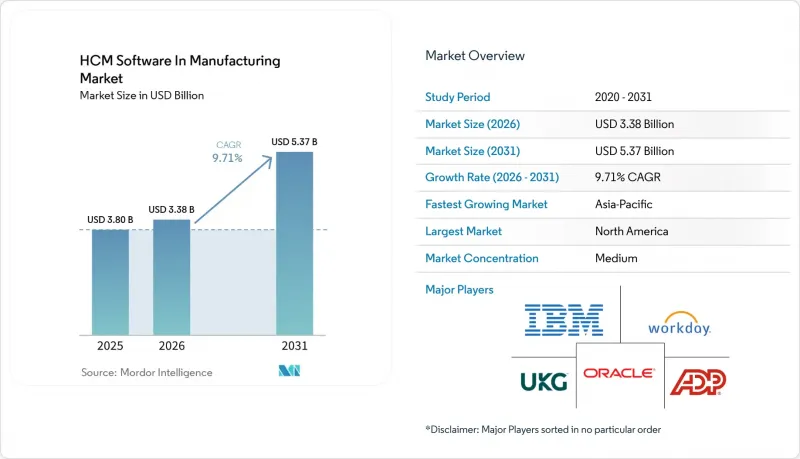
Mordor Intelligence에 의하면, 제조 분야 HCM 소프트웨어 시장은 2025년 30억 8,000만 달러로 평가되었습니다. 2026년에는 33억 8,000만 달러로 확대되어 2031년까지 53억 7,000만 달러에 이를 것으로 예측되며, 2026년부터 2031년에 걸쳐 CAGR 9.71%로 성장할 전망입니다.
본 보고서는 배포 방식(클라우드, On-Premise, 하이브리드), 조직 규모(중소기업, 대기업), 소프트웨어 모듈(핵심 HR, 인력 관리 등), 제조업의 하위 산업(자동차, 항공우주 및 방위, 전자·하이테크 등) 및 지역별로 분류되어 있습니다. 시장 전망은 금액(달러) 기준으로 제시되어 있습니다.
세계의 제조 분야 HCM 소프트웨어 시장 동향 및 인사이트
클라우드 퍼스트를 통한 제조업의 인사 혁신
2025년 신규 계약에서 클라우드 도입이 52%를 차지하여, 2년 전의 38%에서 증가했습니다. 제조업체들은 규제 업데이트와 머신러닝 기능 강화를 반영한 분기별 기능 업데이트를 주요 성장 동인으로 꼽고 있습니다. 하이브리드 모델은 급여 계산 데이터를 On-Premise에 보관하면서, 인사 관리 및 분석 워크로드를 벤더가 관리하는 클라우드로 이전할 수 있기 때문에 지지를 얻었습니다. 자동차 업계의 1차 공급업체들은 가장 신속하게 대응하여 SaaS 제품군을 활용해 전 세계 공장 간의 인력 수요를 조율했습니다. 유럽 공장의 경우, 공급업체가 GDPR(EU 개인정보보호규정) 규정을 준수하기 위해 지역 데이터센터를 개설하면서 추가적인 지연이 발생했으나, 규정 준수를 유지하기 위한 타협책으로서 이를 수용했습니다.
AI를 활용한 예측적 인재 분석 도입
2025년에는 주요 제조업체의 38%로 예측 이직 분석 시스템이 본격적으로 가동되어, 퇴사 90일 전에 이직 위험이 있는 직원을 파악할 수 있게 되었습니다. 입력 신호는 교대 근무 출석 현황부터 협업 지표에 이르기까지 다양하며, 이를 조합함으로써 여러 전자기기 공장에서 계획 외 이직률을 5분의 1 이상 줄였습니다. 항공우주 기업에서는 적층 가공 기술의 보급에 따라, 이와 유사한 모델을 활용해 기술의 노후화를 감지하고, 외부 채용 대신 재교육의 방향을 제시하고 있습니다. 보고된 성과로는 채용까지 소요되는 기간이 최대 28% 단축된 점과 첫해의 이직률이 현저히 개선된 점 등이 있습니다.
레거시 시스템 통합의 과제
2025년에는 예정되어 있던 시스템 가동 일정의 약 3분의 1이 지연되었습니다. 그 원인은 커스텀 미들웨어 비용이 예산을 최대 60%나 초과했기 때문입니다. SAP ECC를 도입한 자동차 공장에서는 S/4HANA로의 업그레이드와 클라우드 기반 HCM의 시범 도입을 연계하는 데 어려움을 겪었고, 이로 인해 급여 계산에 불일치가 발생하여 규정 위반에 따른 과태료 위험에 직면했습니다. 자체 개발한 MES에 얽매여 있던 식품 가공 업체는 생산 부서와 인사 부서의 일정을 수작업으로 대조해야 했기 때문에 효율화 효과가 나타나기까지 2년 가까이 지연되었습니다. 현재, 기성 커넥터를 공급하는 업체는 기존 시스템에 도입하는 프로젝트에서 뚜렷한 우위를 점하고 있습니다.
부문별 분석
2025년, 제조 분야 HCM 소프트웨어 시장 점유율의 48.23%를 On-Premise 구축이 차지했으며, 데이터 주권 요건에 얽매여 있는 공장들에게는 기본적인 선택지가 되었습니다. 그러나 클라우드 계약은 2031년까지 연평균 성장률(CAGR) 10.43%로 증가할 것으로 전망됩니다. 제조업의 HCM 소프트웨어 시장은 조직이 급여 계산 엔진을 방화벽 내부에 유지하면서 분석 기능과 인재 관리 기능을 클라우드로 이전해 지속적인 기능 제공을 실현함으로써 성장하고 있습니다. 자동차 업계에서는 1차 공급업체의 61%가 상호 연결된 조립 라인에 맞추어 인력을 배치하기 위해 이미 클라우드 모듈에 의존하고 있습니다. 항공우주 업계는 멀티테넌트형 호스팅이 수출 관리 규제와 충돌하는 경우가 많아 뒤처지고 있지만, 선택적인 리프트 앤 시프트 방식의 전환이 진행되고 있습니다.
벤더가 미들웨어 비용을 최대 40% 절감하는 커넥터를 도입함에 따라 하이브리드 도입이 가속화되었고, 이전에는 어려웠던 MES(제조 실행 시스템)와의 통합이 가능해졌습니다. 식품 및 음료 제조업체들은 여전히 완전한 On-Premise 환경을 고수하고 있지만, 43%의 기업이 2027년까지 단계적으로 하이브리드 환경으로 전환하는 방안에 대해 이사회 승인을 받았습니다. 대만과 베트남의 전자 산업 분야에서 새로 설립된 공장에서는 기존의 장벽을 완전히 극복했으며, 모바일 온보딩 덕분에 신입 사원의 생산성이 22% 향상되었습니다. 의사결정 기준은 총비용에서 규제 대응 태도, 통합 준비 상황, 그리고 공급업체가 운영하는 인프라에 대한 수용성으로 전환되고 있습니다.
대기업은 2025년 매출의 63.12%를 차지하며, 그 규모를 바탕으로 인사, 급여, 인력 관리, 분석 기능을 통합한 전사적 라이선스 번들 계약을 협상했습니다. 반면, 중소 제조업체들은 종량제 도입으로 진입 장벽이 낮아짐에 따라 2031년까지 연평균 성장률(CAGR) 11.35%를 나타낼 것으로 전망됩니다. 제조업 분야의 HCM 소프트웨어 시장은 공급업체들이 전체 제품군 구매를 필요로 하지 않는 ‘베스트 오브 브리드’ 모듈을 판매하기 시작함에 따라 중소기업을 중심으로 성장하고 있습니다. 직원 1인당 월 5달러 미만의 요금제는 인도와 인도네시아의 중견 전자 기업들로부터 호응을 얻고 있습니다.
대형 자동차 OEM은 20개국 이상에서 5만 명 이상의 직원을 관리하고 있기 때문에 다중 통화 급여 계산 및 다국어 인터페이스를 보장하는 단일 스택 제품군을 중요하게 여깁니다. 그러나 일부 대기업조차도 통합으로 인한 부담을 줄이기 위해 7가지 도구를 1-2개의 핵심 플랫폼으로 통합하고 있습니다. 중소기업의 구매자들은 현지 언어로 된 사용자 인터페이스와, 도입 기간을 9개월에서 6주로 단축해 주는 셀프 서비스형 설정 마법사를 갖춘 공급업체에 관심을 보이고 있습니다. 이러한 보급 확대 추세는 부문 피라미드의 하위 계층에서 두 자릿수 성장이 지속될 것임을 시사합니다.
지역별 분석
북미는 클라우드의 조기 도입과 예측 기반 스케줄링을 경영진 차원의 최우선 과제로 삼은 인력 부족 노동 시장 덕분에 2025년 매출의 34.19%를 차지했습니다. 미국의 구인 건수가 60만 건을 넘어섬에 따라, 직책이 공석이 되기 전에 수평 이동을 제안하는 ‘스킬 인벤토리’의 도입이 촉진되었습니다. 캐나다의 자동차 부품 공급업체는 대륙 내 공장들 간에 급여 계산을 통일했지만, 중서부에 위치한 식품 제조업체는 이미 정착된 ERP 핵심 시스템 때문에 시스템을 On-Premise로 유지했습니다.
아시아태평양은 레거시 시스템의 제약을 피하려는 인도, 베트남, 인도네시아의 신규 스마트 공장 건설에 힘입어 2031년까지 연평균 성장률(CAGR) 11.41%를 나타낼 것으로 전망됩니다. 중국의 전자제품 거점은 PIPL(개인정보보호법)의 제약에 직면함에 따라, 국내 데이터 거주를 요구했습니다. 일본 노동력의 고령화로 인해, 퇴직자가 정점에 달하기 전에 베테랑의 전문 지식을 수집할 수 있는 지식 전수 도구의 도입이 시급해졌습니다.
유럽에서는 도입 규모는 견조했으나, GDPR(EU 개인정보보호규정)의 국경 간 규제 및 플랫폼 노동 지침으로 인해 규정 준수 일정이 장기화되면서 전환 속도가 둔화되었습니다. 독일의 각 OEM 기업들은 HCM(인적 자원 관리) 시스템 업그레이드를 전기차 생산 전환과 연계하고 있는 반면, 프랑스의 식품 공장에서는 근로시간 지침의 휴식 시간 관련 요건을 준수하기 위해 근무 일정을 미세 조정하고 있습니다. 남미는 예산 제약으로 인해 뒤처지고 있지만, 1인당 5달러 미만의 모듈형 SaaS가 중규모 수출 기업들 사이에서 점차 확산되고 있습니다. 중동에서는 사우디아라비아와 아랍에미리트(UAE)를 중심으로 정부 주도의 디지털 산업 프로그램 하에 도입이 가속화되었으나, 아프리카에서는 남아프리카공화국과 나이지리아의 소수 시범 사례를 제외하고는 아직 도입이 초기 단계에 머물러 있습니다.
추가적인 장점 :
- Excel 형식 시장 예측(ME) 시트
- 3개월간의 애널리스트 지원
자주 묻는 질문
목차
제1장 서론
제2장 조사 방법
제3장 주요 요약
제4장 시장 구도
제5장 시장 규모 및 성장 예측
제6장 경쟁 구도
제7장 시장 기회 및 향후 전망
KTH 26.06.26According to Mordor Intelligence, the hCM software in Manufacturing Market is expected to increase from USD 3.08 billion in 2025 to USD 3.38 billion in 2026 and reach USD 5.37 billion by 2031, growing at a CAGR of 9.71% over 2026-2031.
This report is Segmented by Deployment (Cloud, On-Premises, and Hybrid), Organization Size (Small and Medium-Sized Enterprises, and Large Enterprises), Software Module (Core HR, Workforce Management, and More), Manufacturing Sub-Industry (Automotive, Aerospace and Defense, Electronics and High-Tech, and More), and Geography. The Market Forecasts are Provided in Terms of Value (USD).
Global HCM Software In Manufacturing Market Trends and Insights
Cloud-First Manufacturing HR Transformations
Cloud deployments represented 52% of new contracts in 2025, up from 38% two years earlier. Manufacturers cite quarterly feature drops that embed regulatory updates and machine-learning enhancements as the primary driver. Hybrid models gained favor because they keep payroll data on-site while pushing talent and analytics workloads into vendor-managed clouds. Automotive tier-1 suppliers moved fastest, synchronizing labor requirements across global plants with SaaS suites. European plants faced additional latency after providers opened regional data centers to comply with GDPR rules, yet accepted the trade-off to remain compliant.
AI-Driven Predictive Workforce Analytics Adoption
Predictive attrition engines entered production at 38% of large manufacturers in 2025, flagging at-risk employees 90 days before resignation. Input signals now range from shift attendance to collaboration metrics, which together cut unplanned turnover in several electronics factories by more than one-fifth. Aerospace firms run similar models to spot skill obsolescence as additive manufacturing scales, then trigger retraining paths rather than external hiring. Reported gains include up to 28% shorter time-to-fill and noticeable first-year retention improvements.
Legacy System Integration Challenges
Roughly one-third of scheduled go-lives slipped in 2025 because custom middleware costs outstripped budgets by up to 60%. Automotive plants running SAP ECC struggled to align S/4HANA upgrades with cloud HCM pilots, causing payroll mismatches that risked compliance penalties. Food processors tethered to proprietary MES had to manually reconcile schedules between production and HR, delaying efficiency gains for nearly two years. Vendors shipping pre-built connectors now have a clear edge in brownfield engagements.
Other drivers and restraints analyzed in the detailed report include:
- Labor Shortages Accelerating Digital Workforce Planning
- Compliance Complexity in Multisite Manufacturing
- Data Security and Privacy Constraints
For complete list of drivers and restraints, kindly check the Table Of Contents.
Segment Analysis
On-premises deployments held 48.23% of the HCM software market share in manufacturing in 2025, standing as the default option for plants bound by data sovereignty mandates. Cloud contracts, however, are projected to climb at a 10.43% CAGR through 2031. The HCM software market in manufacturing is growing as organizations keep payroll engines behind the firewall while shifting analytics and talent to the cloud for continuous feature delivery. In automotive, 61% of tier-1 suppliers already rely on cloud modules to align staffing with interconnected assembly lines. Aerospace lags because multi-tenant hosting often conflicts with export-control regulations, yet selective lift-and-shift moves are underway.
Hybrid uptake accelerated where vendors introduced connectors that cut middleware spend by up to 40%, making previously rigid MES integrations feasible. Food and beverage producers still cling to full-on-premises estates, but 43% now have board approval for a phased hybrid migration by 2027. Electronics greenfield sites in Taiwan and Vietnam bypassed legacy hurdles altogether, recording 22% faster new-hire productivity thanks to mobile onboarding. Decision criteria have shifted from total cost toward regulatory posture, integration readiness, and appetite for vendor-run infrastructure.
Large enterprises captured 63.12% of 2025 revenue, wielding scale to negotiate enterprise-wide license bundles that stitch together HR, payroll, workforce management, and analytics. In contrast, small and medium-sized manufacturers are set to post an 11.35% CAGR to 2031 as pay-as-you-go pricing lowers entry barriers. The HCM software market in manufacturing is growing among SMEs as vendors now sell best-of-breed modules that eliminate the need to purchase full suites. Sub-USD 5-per-employee monthly plans resonate with mid-tier electronics firms in India and Indonesia.
Large automotive OEMs manage headcounts above 50,000 across 20-plus countries and therefore prize single-stack suites that guarantee multi-currency payroll and multilingual interfaces. Yet even some conglomerates are consolidating from seven-point tools to one or two core platforms to curb integration debt. SME buyers gravitate toward providers with vernacular interfaces and self-service setup wizards that slash deployment time from nine months to six weeks. The resulting democratization suggests sustained double-digit growth at the lower end of the segment pyramid.
Geography Analysis
North America accounted for 34.19% of 2025 revenue courtesy of early cloud acceptance and tight labor markets that made predictive scheduling a board-level priority. U.S. vacancy counts crossing 600,000 spurred the adoption of skills inventories that propose lateral moves before roles open. Canadian automotive suppliers unified payroll across continental plants, while midwestern food producers kept systems on-site due to entrenched ERP cores.
Asia-Pacific is forecast to log an 11.41% CAGR through 2031, powered by greenfield smart factories in India, Vietnam, and Indonesia that sidestep legacy lock-in. Chinese electronics hubs faced PIPL constraints and therefore demanded in-country data residency. Japan's aging workforce triggered urgency around knowledge-transfer tooling that captures veteran expertise before retirements peak.
Europe saw healthy volume but slower migration due to GDPR cross-border rules and the Platform Work Directive, which stretched compliance timelines. German OEMs tie HCM upgrades to electric-vehicle production pivots, while French food plants fine-tune rosters to respect the Working Time Directive's rest-period mandates. South America lags due to budget limits, yet modular SaaS at sub-USD 5 per head is breaking through among mid-sized exporters. The Middle East accelerated adoption in Saudi Arabia and the UAE under state digital-industry programs, whereas Africa remains nascent outside South Africa and a handful of Nigerian pilots.
- Automatic Data Processing Inc.
- Oracle Corporation
- SAP SE
- Workday Inc.
- Ceridian HCM Holding Inc.
- UKG Inc.
- IBM Corporation
- Infor Inc.
- Paycom Software Inc.
- Cornerstone OnDemand Inc.
- BambooHR LLC
- Ramco Systems Limited
- Darwinbox Digital Solutions Private Limited
- Zoho Corporation Pvt. Ltd.
- Sage Group plc
- Atoss Software AG
- WorkForce Software LLC
- Ascentis Corporation
- Namely Inc.
- Rippling Technologies Inc.
- SumTotal Systems LLC
Additional Benefits:
- The market estimate (ME) sheet in Excel format
- 3 months of analyst support
TABLE OF CONTENTS
1 INTRODUCTION
- 1.1 Study Assumptions and Market Definition
- 1.2 Scope of the Study
2 RESEARCH METHODOLOGY
3 EXECUTIVE SUMMARY
4 MARKET LANDSCAPE
- 4.1 Market Overview
- 4.2 Market Drivers
- 4.2.1 Cloud-First Manufacturing HR Transformations
- 4.2.2 AI-Driven Predictive Workforce Analytics Adoption
- 4.2.3 Labor Shortages Accelerating Digital Workforce Planning
- 4.2.4 Compliance Complexity in Multisite Manufacturing
- 4.2.5 Edge Computing and IoT Integration with HCM Platforms
- 4.2.6 Shift-Based Employee Experience Imperatives
- 4.3 Market Restraints
- 4.3.1 Legacy System Integration Challenges
- 4.3.2 Data Security and Privacy Constraints
- 4.3.3 Change Management Resistance on Factory Floors
- 4.3.4 Budgetary Pressures in Mid-Sized Manufacturers
- 4.4 Industry Value -Chain Analysis
- 4.5 Regulatory Landscape
- 4.6 Technological Outlook
- 4.7 Impact of Macroeconomic Factors on the Market
- 4.8 Porter's Five Forces Analysis
- 4.8.1 Threat of New Entrants
- 4.8.2 Bargaining Power of Suppliers
- 4.8.3 Bargaining Power of Buyers
- 4.8.4 Threat of Substitute Products
- 4.8.5 Intensity of Competitive Rivalry
5 MARKET SIZE AND GROWTH FORECASTS (VALUE)
- 5.1 By Deployment
- 5.1.1 Cloud
- 5.1.2 On-Premises
- 5.1.3 Hybrid
- 5.2 By Organization Size
- 5.2.1 Small and Medium-Sized Enterprises
- 5.2.2 Large Enterprises
- 5.3 By Software Module
- 5.3.1 Core HR
- 5.3.2 Workforce Management
- 5.3.3 Talent Management
- 5.3.4 Payroll
- 5.3.5 Analytics
- 5.4 By Manufacturing Sub-Industry
- 5.4.1 Automotive
- 5.4.2 Aerospace and Defense
- 5.4.3 Electronics and High-Tech
- 5.4.4 Food and Beverage
- 5.4.5 Other Manufacturing Sub-Industries
- 5.5 By Geography
- 5.5.1 North America
- 5.5.2 South America
- 5.5.3 Europe
- 5.5.4 Asia Pacific
- 5.5.5 Middle East
- 5.5.6 Africa
6 COMPETITIVE LANDSCAPE
- 6.1 Market Concentration
- 6.2 Strategic Moves
- 6.3 Market Share Analysis
- 6.4 Company Profiles (includes Global Level Overview, Market Level Overview, Core Segments, Financials as available, Strategic Information, Market Rank/Share, Products and Services, Recent Developments)
- 6.4.1 Automatic Data Processing Inc.
- 6.4.2 Oracle Corporation
- 6.4.3 SAP SE
- 6.4.4 Workday Inc.
- 6.4.5 Ceridian HCM Holding Inc.
- 6.4.6 UKG Inc.
- 6.4.7 IBM Corporation
- 6.4.8 Infor Inc.
- 6.4.9 Paycom Software Inc.
- 6.4.10 Cornerstone OnDemand Inc.
- 6.4.11 BambooHR LLC
- 6.4.12 Ramco Systems Limited
- 6.4.13 Darwinbox Digital Solutions Private Limited
- 6.4.14 Zoho Corporation Pvt. Ltd.
- 6.4.15 Sage Group plc
- 6.4.16 Atoss Software AG
- 6.4.17 WorkForce Software LLC
- 6.4.18 Ascentis Corporation
- 6.4.19 Namely Inc.
- 6.4.20 Rippling Technologies Inc.
- 6.4.21 SumTotal Systems LLC
7 MARKET OPPORTUNITIES AND FUTURE OUTLOOK
- 7.1 White-Space and Unmet-Need Assessment


