

|
시장보고서
상품코드
2063973
남미의 HCM 소프트웨어 시장 : 점유율 분석, 업계 동향과 통계, 성장 예측(2026-2031년)South America HCM Software - Market Share Analysis, Industry Trends & Statistics, Growth Forecasts (2026 - 2031) |
||||||
 Mordor Intelligence
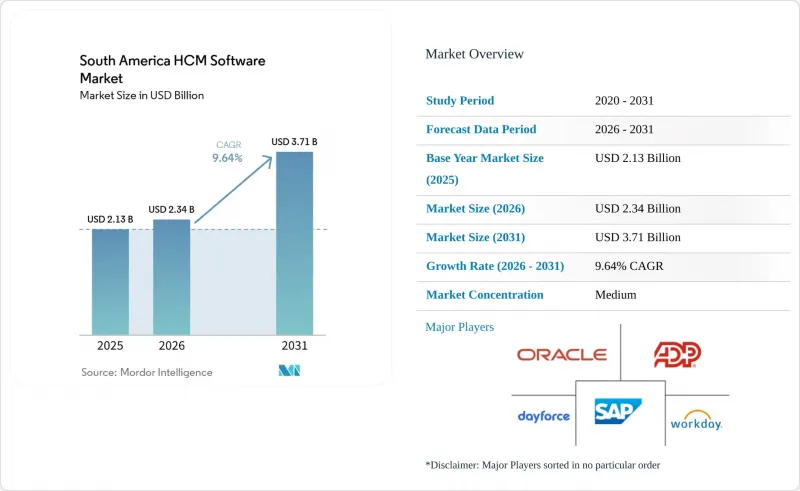
Mordor Intelligence에 의하면, 남미 인사관리(HCM) 소프트웨어 시장 규모는 2025년에 21억 3,000만 달러로 평가되었고 2026년 23억 4,000만 달러에서 2031년까지 37억 1,000만 달러에 이를 것으로 예측되며, 예측 기간(2026-2031년) CAGR은 9.64%를 나타낼 전망입니다.
본 보고서는 구성 요소(소프트웨어 및 서비스), 도입 형태(클라우드, On-Premise, 하이브리드), 조직 규모(대기업 및 중소기업), 용도(핵심 HR, 인재 관리, 인력 관리, 급여 관리 등), 최종 사용자 산업(IT 및 통신, BFSI 등)별로 분류되어 있습니다. 시장 전망은 금액(달러) 기준으로 제시되어 있습니다.
남미 HCM 소프트웨어 시장 동향 및 인사이트
중견 기업에서의 클라우드 기반 HCM 제품군 도입 확대
중견 기업들은 표면적인 비용 절감을 위해서가 아니라, 분기별 규정 준수 대응이 On-Premise 팀에 지나친 부담이 되고 있기 때문에 클라우드로의 전환을 추진하고 있습니다. 2024년 3월에 출시된 Oracle의 ‘HCM Now’ 덕분에, 직원 수 500-2,000명 규모의 기업에서 도입 기간이 6개월로 단축되었습니다. 칠레의 15일 주기 REL 제출 제도에 따라 일괄 급여 계산이 폐지됨에 따라, 실시간 동기화는 단순한 편의성에서 필수 요건으로 바뀌었습니다. 그 결과, 클라우드 시장의 성장률은 남미 HCM 소프트웨어 시장 전체보다 166 베이시스 포인트 높습니다. 각 벤더사는 과거에는 현지 시스템 통합사업자로 흘러가던 지속적인 수익을 확보할 수 있게 되었습니다. 이러한 추세는 가격 결정력을 강화하고 있으며, 2028년까지 중견 기업 대상 시장의 협상 구조를 완전히 바꿀 것으로 예측됩니다.
노동법 규제에 대한 준법 요건의 강화와 디지털화
브라질의 DET 의무화로 인해 채용 후 24시간 이내에 전자 계약서를 제출해야 하며, 기업들은 자동화된 워크플로우를 갖춘 플랫폼에 의존할 수밖에 없게 되었습니다. 아르헨티나의 법률 제27.802호는 2026년 3월부터 급여 계산을 ARCA 체제 하에서 일원화하도록 규정하고 있으며, 분산형 시스템으로는 대응할 수 없는 엔진의 전면적인 개편을 요구하고 있습니다. 칠레의 REL법에 따른 제출 지연에 대한 제재로 인해, 클라우드 네이티브 아키텍처가 유일한 현실적인 선택지가 됩니다. 또한, 브라질 법률 14.611/2023에 따른 병행적 동일임금 분석에는 기존 데이터베이스에서는 지원되지 않는 대시보드가 필요합니다. 이러한 법규들이 맞물리면서, 컴플라이언스는 정기적인 감사에서 상시 모니터링으로 전환되고, On-Premise 환경의 폐지가 가속화될 것입니다.
레거시 ERP 환경에서의 높은 초기 통합 비용
1990년대부터 SAP나 Oracle의 ERP를 운영해 온 제조업체들은 18-24개월에 달하는 통합 작업에 직면해 있으며, 그 예산은 라이선스 비용보다 최대 300%나 더 많이 소요됩니다. 미들웨어는 기술적인 매핑 문제를 해결해 주지만, 수십년전의 워크플로를 재구축하는 것은 프로젝트 범위를 과도하게 확대시킵니다. CFO들은 클라우드 HCM의 ROI에 회의적인 태도를 보이고 있으며, 이로 인해 기존 ERP 공급업체들이 할인된 가격으로 네이티브 HCM을 교차 판매할 기회가 생기고 있습니다. 독립형 벤더들이 기성 커넥터에 투자하지 않는 한, 남미 HCM 소프트웨어 시장에서 그들이 확보할 수 있는 점유율은 대기업들 사이에서 정체될 가능성이 있습니다.
부문별 분석
기업들이 통합, 맞춤화 및 변경 관리에 비용을 투자함에 따라, 서비스 매출은 2031년까지 연평균 성장률(CAGR) 10.82%로 증가할 것으로 전망됩니다. 2025년 기준으로 소프트웨어는 남미 HCM 소프트웨어 시장의 71.32%를 차지했으나, 도입 시 발생하는 마찰이 증가함에 따라 총소유비용(TCO)은 서비스 계약 쪽으로 점차 이동하고 있습니다. 따라서 사내에 전문 서비스 부서를 보유한 벤더는 이익률의 안정성을 확보할 수 있는 반면, 파트너에 의존하는 순수 소프트웨어 기업은 거래의 주도권을 내줄 수밖에 없을 가능성이 있습니다.
중견 기업들이 급변하는 급여 계산 규제에 대응하기 위한 설정 지원 수요가 증가함에 따라, 남미 HCM 소프트웨어 시장의 서비스 부문이 확대되고 있습니다. 한편, 대기업에서는 분석 모듈이 성숙해짐에 따라 가동 후 최적화를 위한 추가 예산이 배정되고 있습니다. 남미 HCM 소프트웨어 시장에서 이러한 지출 추이의 변화가 서비스 분야의 성장률과 시장 전체의 평균 성장률 사이에 지속적인 격차가 발생하는 배경이 되고 있습니다.
2025년 기준으로 클라우드는 남미 HCM 소프트웨어 시장의 64.18%를 차지하고 있으며, 연평균 성장률(CAGR) 11.24%로 성장할 것으로 전망됩니다. 이는 On-Premise 및 하이브리드 솔루션보다 200 베이시스 포인트 이상 높은 성장세입니다. 브라질의 DET와 아르헨티나의 ARCA는 실시간 제출을 의무화하고 있어, On-Premise형 도구에서 흔히 사용되는 일괄 업로드는 더 이상 통용되지 않습니다. 하이브리드 방식은 급여 데이터에 대한 주권 확보를 위한 과도기적인 대안으로 남아 있지만, 관리 체제가 성숙해지면 기업은 결국 시스템 전체를 이전하게 되므로 그 확대는 더딘 임베디드니다.
남미의 인사 관리(HCM) 소프트웨어 시장에서 클라우드의 점유율은 2031년보다 훨씬 이전에 크게 확대될 것으로 예측됩니다. 이는 각 지역의 관할 구역에서 빈번하게 발생하는 급여, 세무, 노동 규정 준수 관련 변경 사항에 조직이 신속하게 대응할 수 있도록 지원하는 공급업체 관리형 업데이트를 기반으로 합니다. 또한 초기 인프라 요구 사항이 낮고, 도입 주기가 짧으며, 사업 확장에 따른 확장도 용이하기 때문에 이 모델은 많은 지지를 얻고 있습니다.
기타 혜택:
- 엑셀 형식 시장 예측(ME) 시트
- 3개월간의 애널리스트 지원
자주 묻는 질문
목차
제1장 서론
제2장 조사 방법
제3장 주요 요약
제4장 시장 구도
제5장 시장 규모와 성장 예측
제6장 경쟁 구도
제7장 시장 기회와 향후 전망
JHS 26.06.23According to Mordor Intelligence, the south america hCM software market size was valued at USD 2.13 billion in 2025 and estimated to grow from USD 2.34 billion in 2026 to reach USD 3.71 billion by 2031, at a CAGR of 9.64% during the forecast period (2026-2031).
This report is Segmented by Component (Software, and Services), Deployment Mode (Cloud, On-Premises, and Hybrid), Organization Size (Large Enterprises, and Small and Medium Enterprises), Application (Core HR, Talent Management, Workforce Management, Payroll Management, and More), End-User Industry (IT and Telecommunications, BFSI, and More). The Market Forecasts are Provided in Terms of Value (USD).
South America HCM Software Market Trends and Insights
Rising Adoption of Cloud-Based HCM Suites Among Mid-Sized Firms
Mid-sized companies are shifting to the cloud because quarterly compliance patches overwhelm on-premise teams, not because of headline cost savings. Oracle's HCM Now rollout in March 2024 cut implementation to six months for firms with 500-2,000 workers. Chile's 15-day REL filing cycle eliminated batch payroll, converting real-time synchronization from a convenience to a requirement. As a result, cloud growth outpaces the South America HCM software market by 166 basis points. Vendors now secure recurring revenue that once drifted to local system integrators. The trend consolidates pricing power and is expected to reshape mid-market negotiations by 2028.
Increasing Regulatory Compliance Demands for Labor Laws Digitization
Brazil's DET mandate obliges electronic contract submission within 24 hours of hiring, locking enterprises into platforms with automated workflows. Argentina's Law 27.802 centralizes payroll under ARCA starting March 2026, forcing engine overhauls that decentralized systems cannot meet. Chile's REL fines for late filings make cloud-native architecture the only viable option. Parallel equal-pay analytics under Brazil's Law 14.611/2023 require dashboards that legacy databases do not support. Together, these statutes convert compliance from periodic audits to always-on monitoring and accelerate retirement of on-premise deployments.
High Initial Integration Costs for Legacy ERP Environments
Manufacturers running SAP or Oracle ERP from the 1990s face 18-24-month integrations with budgets that exceed license spend by up to 300%. Middleware solves technical mapping issues, yet re-engineering decades-old workflows strains the project's scope. CFOs view cloud HCM ROI skeptically, opening doors for incumbent ERP vendors to cross-sell native HCM at a discount. Unless standalone vendors invest in ready connectors, their addressable share of the South America HCM software market may plateau among large enterprises.
Other drivers and restraints analyzed in the detailed report include:
- Growing Remote and Hybrid Workforces Necessitating Digital HR Tools
- AI-Driven Analytics Enhancing Talent Acquisition Efficiency
- Data Privacy Concerns Amidst Cross-Border Cloud Hosting Regulations
For complete list of drivers and restraints, kindly check the Table Of Contents.
Segment Analysis
Services revenue is projected to rise at a 10.82% CAGR to 2031, as enterprises pay for integration, customization, and change management. In 2025, software contributed 71.32% of the South America HCM software market, yet mounting deployment friction suggests total cost of ownership is shifting toward services contracts. Vendors with in-house professional services thus gain margin resilience, whereas pure-play software firms reliant on partners may concede deal control.
The South America HCM software market for services is expanding as mid-sized buyers require guided configuration to meet rapidly changing payroll regulations. Meanwhile, larger enterprises allocate incremental budgets to post-go-live optimization as analytics modules mature. This spending evolution in the South America HCM software market underpins the sustained gap between services growth and overall market averages.
Cloud held 64.18% of the South America HCM software market in 2025 and is forecast to grow at a 11.24% CAGR, outstripping on-premises and hybrid solutions by more than 200 basis points. Brazil's DET and Argentina's ARCA compel real-time submission, invalidating batch uploads typical of on-premise tools. Hybrid remains a transitional choice for payroll data sovereignty, but its expansion lags because firms eventually migrate entire stacks once controls mature.
Cloud's share of the South America HCM software market is expected to grow substantially well before 2031, supported by vendor-managed updates that help organizations quickly adapt to frequent payroll, tax, and labor compliance changes across regional jurisdictions. The model is also gaining traction due to lower upfront infrastructure requirements, faster deployment cycles, and easier scalability for expanding enterprises.
List of Companies Covered in this Report:
- Workday, Inc.
- Dayforce, Inc.
- Automatic Data Processing, Inc.
- Oracle Corporation
- SAP SE
- Cornerstone OnDemand, Inc.
- Ultimate Kronos Group Inc.
- Paycom Software, Inc.
- YourPeople Inc.
- The Sage Group plc
- Rippling People Center Inc.
- Darwinbox Digital Solutions Private Limited
- Odoo SA
- Ramco Systems Limited
- Meta4 Spain S.A.U.
- Cegid Group SA
- Neeyamo Enterprise Solutions Private Limited
- Deel Inc.
- HiBob Ltd.
- Factorial HR, S.L.
- Visma AS
Additional Benefits:
- The market estimate (ME) sheet in Excel format
- 3 months of analyst support
TABLE OF CONTENTS
1 INTRODUCTION
- 1.1 Study Assumptions and Market Definition
- 1.2 Scope of the Study
2 RESEARCH METHODOLOGY
3 EXECUTIVE SUMMARY
4 MARKET LANDSCAPE
- 4.1 Market Overview
- 4.2 Market Drivers
- 4.2.1 Rising Adoption of Cloud-Based HCM Suites Among Mid-Sized Firms
- 4.2.2 Increasing Regulatory Compliance Demands for Labor Laws Digitization
- 4.2.3 Growing Remote and Hybrid Workforces Necessitating Digital HR Tools
- 4.2.4 Expansion of Gig Economy Accelerating Demand for Flexible Workforce Management Platforms
- 4.2.5 AI-Driven Analytics Enhancing Talent Acquisition Efficiency
- 4.2.6 Localization of Payroll and Tax Modules for South American Jurisdictions Attracting SMEs
- 4.3 Market Restraints
- 4.3.1 High Initial Integration Costs for Legacy ERP Environments
- 4.3.2 Data Privacy Concerns Amidst Cross-Border Cloud Hosting Regulations
- 4.3.3 Shortage of HR Tech Implementation Expertise in Secondary Cities
- 4.3.4 Economic Volatility Reducing IT Budgets for Non-Core Projects
- 4.4 Industry Value Chain Analysis
- 4.5 Regulatory Landscape
- 4.6 Technological Outlook
- 4.7 Impact of Macroeconomic Factors on the Market
- 4.8 Porter's Five Forces Analysis
- 4.8.1 Threat of New Entrants
- 4.8.2 Bargaining Power of Suppliers
- 4.8.3 Bargaining Power of Buyers
- 4.8.4 Threat of Substitutes
- 4.8.5 Intensity of Competitive Rivalry
5 MARKET SIZE AND GROWTH FORECASTS (VALUE)
- 5.1 By Component
- 5.1.1 Software
- 5.1.2 Services
- 5.2 By Deployment Mode
- 5.2.1 Cloud
- 5.2.2 On-Premises
- 5.2.3 Hybrid
- 5.3 By Organization Size
- 5.3.1 Large Enterprises
- 5.3.2 Small and Medium Enterprises
- 5.4 By Application
- 5.4.1 Core HR
- 5.4.2 Talent Management
- 5.4.3 Workforce Management
- 5.4.4 Payroll Management
- 5.4.5 Learning and Development
- 5.5 By End-User Industry
- 5.5.1 IT and Telecommunications
- 5.5.2 BFSI
- 5.5.3 Industrial Manufacturing
- 5.5.4 Healthcare and Lifesciences
- 5.5.5 Retail and E-commerce
- 5.5.6 Government and Public Sector
- 5.5.7 Other End-User Industries
- 5.6 By Geogrpahy
- 5.6.1 Brazil
- 5.6.2 Argentina
- 5.6.3 Colombia
- 5.6.4 Chile
- 5.6.5 Peru
- 5.6.6 Rest of South America
6 COMPETITIVE LANDSCAPE
- 6.1 Market Concentration
- 6.2 Strategic Moves
- 6.3 Market Share Analysis
- 6.4 Company Profiles (includes Global Level Overview, Market Level Overview, Core Segments, Financials as available, Strategic Information, Market Rank/Share, Products and Services, Recent Developments)
- 6.4.1 Workday, Inc.
- 6.4.2 Dayforce, Inc.
- 6.4.3 Automatic Data Processing, Inc.
- 6.4.4 Oracle Corporation
- 6.4.5 SAP SE
- 6.4.6 Cornerstone OnDemand, Inc.
- 6.4.7 Ultimate Kronos Group Inc.
- 6.4.8 Paycom Software, Inc.
- 6.4.9 YourPeople Inc.
- 6.4.10 The Sage Group plc
- 6.4.11 Rippling People Center Inc.
- 6.4.12 Darwinbox Digital Solutions Private Limited
- 6.4.13 Odoo SA
- 6.4.14 Ramco Systems Limited
- 6.4.15 Meta4 Spain S.A.U.
- 6.4.16 Cegid Group SA
- 6.4.17 Neeyamo Enterprise Solutions Private Limited
- 6.4.18 Deel Inc.
- 6.4.19 HiBob Ltd.
- 6.4.20 Factorial HR, S.L.
- 6.4.21 Visma AS
7 MARKET OPPORTUNITIES AND FUTURE OUTLOOK
- 7.1 White-Space and Unmet-Need Assessment


