

|
시장보고서
상품코드
2064512
HCM용 에이전트 AI 시장 : 시장 점유율 분석, 산업 동향 및 통계 데이터, 성장 예측(2026-2031년)Agentic AI In HCM - Market Share Analysis, Industry Trends & Statistics, Growth Forecasts (2026 - 2031) |
||||||
 Mordor Intelligence
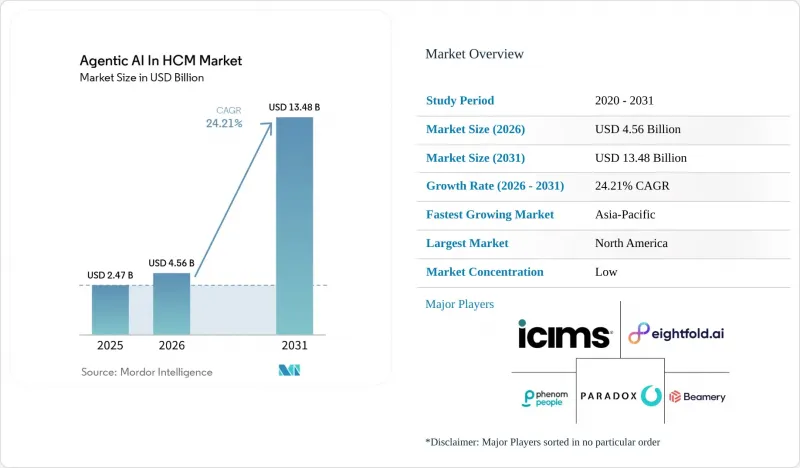
Mordor Intelligence에 의하면, HCM(인적 자본 관리)용 에이전트 AI 시장 규모는 2025년 24억 7,000만 달러로 평가되었고, 2026년에는 45억 6,000만 달러로 추정되고, 2026-2031년 CAGR 24.21%로 성장을 지속할 전망이며, 2031년에는 134억 8,000만 달러에 이를 것으로 예측됩니다.
본 보고서는 구성 요소별(에이전틱 AI 플랫폼, 오케스트레이션 엔진 등), 기능별(채용, 후보자 발굴 등), 도입 모델별(클라우드 기반 등), 기업 규모별(대기업, 중소기업), 최종 사용자 산업 분야별(은행, 금융서비스 및 보험(BFSI), 의료 및 생명과학 등) 및 지역별로 분류되어 있습니다. 시장 전망은 금액(달러) 기준으로 제시되어 있습니다.
세계의 HCM용 에이전트 AI 시장 동향 및 인사이트
고숙련직 및 현장 업무 담당자 채용에 있어 노동력 부족의 심화
노동력 부족이 지속됨에 따라, HCM용 에이전트 AI 시장에서는 도입이 가속화되고 있습니다. 이는 현장 업무나 전문직 분야에서 현재 요구되는 채용 규모와 속도에 대해, 수작업에 의존하는 채용 팀만으로는 감당할 수 없기 때문입니다. 미국의 JOLTS 데이터에 따르면, 2025년 12월 구인 건수는 740만 건에 달했으며, 의료, 제조, 물류 분야의 구인 대 채용 비율은 여전히 팬데믹 이전 수준을 상회하고 있어, 이는 단기적인 혼란이 아닌 지속적인 채용 압력을 시사하고 있습니다. 또한, 기업들의 보고에 따르면 2025년 2월 기준 미국의 미충족 구인 건수는 총 노동 수요의 4.5%를 차지한 반면, 채용률은 2025년 12월에 지난 10년 동안 최저치인 3.3%까지 하락했으며, 이는 노동 공급 측면에서 구조적인 불일치를 시사하고 있습니다. 이러한 압박이 중요하게 여겨지는 이유는 현장 근로자가 전 세계 노동력의 상당 부분을 차지하고 있으며, 생산성 저하를 고려하기 전 단계에서도 근로자 1인당 대체 비용이 여전히 3,000-5,000달러에 달하기 때문입니다. iCIMS는 2026년 3월, Frontline AI를 도입한 고객사를 대상으로 채용까지 소요되는 기간이 최대 75% 단축되었으며, 채용 담당자 1인당 채용 건수가 최대 10배 증가했다고 보고했습니다. 이는 대량 채용이 필요한 직종에서 대화형 소싱 에이전트의 비즈니스적 유효성을 입증하는 것입니다. HCM용 에이전트 AI 시장의 장기적인 수요는 성숙한 경제권 전반에 걸친 노동 연령 인구 감소로 인해 더욱 강화되고 있습니다. 이에 따라 노동력의 지속성을 확보하기 위해서는 보다 신속한 채용 능력이 중요해지고 있습니다.
인원을 늘리지 않으면서 채용 담당자나 관리직의 생산성을 높이도록 요구하는 기업의 압박
HCM용 에이전트 AI 시장은 비용 관리의 강화에 힘입어 성장하고 있습니다. 인사 부서에는 인원을 늘리지 않고 성과를 향상시켜야 한다는 요구가 있기 때문입니다. BCG는 2026년 2월, 특정 인사 워크플로우에 AI를 도입한 조직에서 20-30%의 효율성 향상이 기록되었다고 보고했습니다. 또한, GPT 기반의 관리자용 평가 도구는 평가문 작성 시간을 45% 단축하고, 평가의 질을 22% 향상시켰으며, 사용자 만족도는 90%에 달했습니다. 급여 계산 업무 역시 재무 측면에 부담을 주고 있습니다. 조사에 따르면, 고용주는 총 인건비의 2-4%를 급여 누락으로 인해 손실하고 있으며, 대기업의 경우 단 1%의 손실만으로도 연간 1,500만 달러에 달할 가능성이 있습니다. IBM의 ‘AskHR’ 프로그램은 표준화된 워크플로우에 기반한 상담원 지원을 도입함으로써, 인사 팀이 단일 창구를 통해 서비스를 집중화할 수 있음을 보여주었습니다. 이를 통해 94%의 사건 해결률을 달성하고, 4년 동안 인사 운영 비용을 40% 절감할 수 있었습니다. 이 모델이 중요하게 여겨지는 이유는 맥킨지가 2025년 기준으로 직원 1,000명 이상의 조직 중 전문적인 HR 공유 서비스 센터를 이용하고 있는 곳이 고작 18%에 불과하며, 소프트웨어 주도의 생산성 향상 측면에서 여전히 큰 프로세스상의 격차가 존재한다는 사실을 밝혀냈기 때문입니다. 그 결과, HCM용 에이전트 AI 시장은 더 이상 실험적인 자동화 예산이 아닌, 측정 가능한 업무 효율성과 연계되어 가고 있습니다.
데이터 개인정보 보호, 국경 간 데이터 전송, AI 거버넌스의 부담
인사(HR) 분야의 의사결정은 극히 민감한 데이터와 관련되어 있으며, 대부분의 경우 위험이 높은 규제 범주에 해당하기 때문에 규정 준수는 여전히 HCM용 에이전트 AI 시장의 가장 큰 걸림돌로 남아 있습니다. EU AI법(규정(EU) 2024/1689)은 2024년 8월 1일에 발효되었으며, 부속서 III에서 채용 심사, 후보자 순위 매기기, 성과 모니터링 및 업무 배정 시스템을 고위험 범주로 분류했습니다. 이 체계에서는 적합성 평가, 이용 로그 보관, 영향 평가 및 근로자 대표와의 협의가 의무화되어 있으며, 이러한 요인들이 비용을 증가시켜 HCM용 에이전트 AI의 도입을 지연시키고 있습니다. 영국에서는 정보위원회 사무국이 2026년 3월, 실제 인간에 의한 심사를 거치지 않은 AI 채용 도구는 법적 기준을 위반할 가능성이 있다며, 단순한 형식적인 승인만으로는 의미 있는 감독으로 간주될 수 없습니다고 경고했습니다. 2026년 1월 조사에 따르면, 미국 경영진의 77%가 2025년 4분기 기업의 최대 위험 요인으로 데이터 프라이버시를 꼽았으며, 이는 연초의 53%에서 증가한 수치입니다. 이는 거버넌스에 대한 우려가 기능성과 마찬가지로 구매 기준을 좌우하게 되었음을 보여줍니다. 이는 HCM 시장에서 자율형 AI가 앞으로도 계속 확대될 것임을 의미하지만, 벤더들은 수요를 실제 수익으로 연결하기 위해 더욱 강력한 현지화 기능, 감사 가능성 및 감독 기능을 갖추어야 합니다.
부문별 분석
2025년, 에이전틱 AI 플랫폼 오케스트레이션 엔진은 구성 요소 부문의 36.47%를 차지했으며, HCM용 에이전트 AI 시장에서 가장 큰 구성 요소 카테고리가 되었습니다. 이러한 선도적인 위상은 기업들이 가동 중인 에이전트 수를 확대하기 전에 거버넌스, 라우팅, 정책 제어 및 에스컬레이션 로직을 확보하는 것을 우선시하고 있음을 반영합니다. 이러한 플랫폼을 통해 구매자는 채용, 인사 서비스, 급여 계산, 인사 이동 등 각 워크플로우에서 업무 분할, 인적 점검 단계 및 ID 관리를 수행할 수 있는 수단을 확보하게 되었습니다. 2025년과 2026년의 많은 도입 사례에서 에이전트 수를 극대화하는 것보다 실행 위험을 줄이는 것이 우선시되었기 때문에 이 기반은 중요했습니다. 따라서, HCM용 에이전트 AI 시장에서 구성 요소의 비중은 이용 사례가 광범위하게 확대되기 전에 인프라에 대한 신뢰가 확립되었음을 보여줍니다.
AI 에이전트 워크플로우 용도 시장은 2026-2031년 연평균 성장률(CAGR) 27.39%를 기록하며 성장할 것으로 예상되며, 가장 빠르게 성장하는 구성 요소 부문이 될 전망입니다. 이 단계는 HCM용 에이전트형 AI 시장의 다음 단계를 여는 것으로, 2024년과 2025년에 오케스트레이션 역량을 구축한 기업들은 현재 면접, 정책 안내, 급여 계산 예외 처리, 사내 이동과 같은 업무에 특화된 에이전트를 통해 해당 역량을 강화해 나가고 있습니다. 2026년 2월 조사에 따르면, AI를 활용하는 인재 파견 회사는 동종 업계 타사보다 실적이 더 좋을 가능성이 4배 더 높았으며, 응답자의 55%는 AI를 활용한 선별 과정을 통해 KPI가 25% 이상 개선되었다고 답했고, 46%는 선별 시간을 50% 이상 단축할 수 있었습니다고 답했습니다. 대규모 멀티시스템 도입에는 여전히 구현 지원, 워크플로우 재설계, 지속적인 튜닝이 필요하기 때문에 서비스는 여전히 중요한 역할을 하고 있습니다. 또한, HCM 업계에서는 사내에 고도의 AI 운영 팀을 구축하지 않고도 HCM용 에이전트 AI의 이점을 누리고자 하는 수요가 높아짐에 따라, 매니지드 AI 서비스도 점차 보급되고 있습니다. 이를 통해 플랫폼이 제어를 확립하고, 용도이 확장을 주도하며, 서비스가 롱테일의 도입 복잡성을 지원하는 명확한 패턴이 구성 요소 구조에 나타나고 있습니다.
2025년, 인재 계획 및 분석은 시장의 22.83%를 차지했으며, HCM용 에이전트 AI 시장에서 가장 큰 기능 부문이 되었습니다. 이 직책은 치열한 채용 환경과 변화하는 기술 수요 속에서 실시간 인력 배분, 예산 가시화 및 시나리오 계획 수립에 대한 요구를 반영한 것입니다. 이 기능에 적용된 HCM용 에이전트 AI는 인재 관련 의사결정을 재무 성과와 보다 직접적으로 연결해 줄 도구를 원하는 경영진 수요 덕분에 혜택을 보았습니다. 미국 인사 담당자 중 3년 이상의 장기적인 관점에서 인재 계획을 수립하고 있는 비율은 고작 12%에 불과했으며, 73%는 여전히 운영 계획에만 주력하고 있었습니다. 2026년에 시작된 AI 기반 인력 계획은 인력 배치 및 노동 관련 의사결정을 ERP 및 비정규직 직원 데이터와 연계함으로써, 분석 중심의 자동화에 대한 수요 증가를 뒷받침했습니다. 실제로 이 기능은 단순한 보고서 작성의 부가 기능이 아니라, HCM용 에이전트 AI의 중추적인 역할을 수행하게 되었습니다.
인력 관리 및 사내 이동 시장은 2026-2031년 연평균 성장률(CAGR) 25.41%로 확대될 것으로 예측되며, 가장 빠르게 성장하는 분야가 될 전망입니다. 이러한 상승세는 HCM용 에이전트 AI가 단순한 외부 채용의 효율화에만 그치지 않고, 인재 재배치 및 정착이라는 목표에 점점 더 가까워지고 있음을 보여줍니다. 채용 활동과 후보자 발굴은 여전히 채용 규모에서 큰 비중을 차지하고 있으며, 특히 속도와 지원 완료율이 중요한 현장직에서 그 경향이 두드러집니다. 2025년 시점에서 대화형 ATS 도입을 통해 평균 지원 완료율은 72%, 평균 채용 소요 기간은 3.5일, 후보자 만족도는 95%를 달성했습니다. 직원 서비스 및 인사 업무도 사례 처리율 향상을 통해 개선이 진행되고 있지만, 급여 계산 및 근태 관리의 경우 오류에 대한 허용 범위가 좁기 때문에 여전히 엄격한 관리가 유지되고 있습니다. HCM용 에이전트 AI 업계 전반을 살펴보면, 기능 구성 측면에서 구매자들이 효율성을 중시하던 워크플로우에서 벗어나, 인력의 가치 창출로 지출 범위를 넓혀가고 있음을 알 수 있습니다.
지역별 분석
2025년, 북미는 전 세계 HCM용 에이전트 AI 시장의 39.73%를 차지했으며, 주요 지역 클러스터로 부상했습니다. 미국은 성숙한 HCM 소프트웨어 생태계, 기업 내 클라우드의 광범위한 도입, 그리고 대규모 AI 프로그램에 대한 자금 투입에 대한 강한 의지를 통해 이러한 위상을 확립했습니다. 2025년 2월 기준 미국의 미충족 구인율은 총 노동 수요의 4.5%에 달했으며, 이는 채용 효율에 대한 압박을 지속시켜 AI 주도의 채용 후보자 발굴 및 선발에 대한 수요를 뒷받침했습니다. 2026년 1월 기준으로 미국 기업의 64%가 AI 에이전트의 영향을 받아 신입사원 채용 방식을 변경했으며, 이는 전 분기의 18%에서 증가한 수치로, AI를 활용한 채용 관행이 빠르게 정착되고 있음을 보여줍니다. 또한, 해당 지역에서는 조달 기준의 확립이 진행되고 있는데, 이는 구매자가 컴플라이언스를 후속 단계의 문제로 취급하는 것이 아니라, 거버넌스, 설명 가능성, ROI를 하나의 통합된 요소로 평가하게 되었기 때문입니다.
기업들의 명확한 노력이 북미의 주도적 입지를 뒷받침하고 있습니다. 2026년 3월, 아데코 그룹은 세일즈포스와 무제한 다년 계약인 ‘Agentforce 360’을 체결하고, 2026년 말까지 60개국 이상, 2만 7,000명의 채용 담당자 중 50% 이상에게 에이전틱 AI를 활용하고, 매출의 50% 이상을 AI로 뒷받침하는 것을 목표로 하고 있습니다. 영국에서 진행된 초기 시범 운영에서는 이미 15%의 시간 단축 효과가 확인되었습니다. 동시에, 미국에서는 주 차원의 AI 고용 규제가 확대되고 있어, 북미에서 확보한 HCM용 에이전트 AI 시장 점유율은 통지, 영향 평가 및 차별 방지 대책에 대한 공급업체의 준비 상황에 점점 더 좌우될 것입니다. 캐나다는 규모는 작지만, 중소기업에서의 채용 도입이 확대됨에 따라 꾸준히 발전하고 있습니다. 멕시코도 광범위한 지역적 기회의 일부이지만, 기업 내 도입 수준은 미국보다 여전히 낮은 상태입니다.
유럽은 HCM용 에이전트 AI 시장에서 여전히 2위의 규모를 자랑하지만, 가장 엄격한 거버넌스 조건 하에서 운영되고 있습니다. EU AI법에 따라 채용, 성과 평가 및 인사 배치 시스템 전반에 걸친 규정 준수 최소 기준이 상향 조정됨에 따라, 도입 속도는 종종 느려지지만 거버넌스의 질은 높아지고 있습니다. 영국은 독자적인 길을 걷고 있으며, 2026년 3월 정보위원회(ICO)는 AI를 활용한 채용 결정에 있어서는 개입 권한이 없는 형식적인 승인이 아니라, 여전히 인간에 의한 실질적인 감독이 필요하다고 밝혔습니다. 또한 유럽에서는 심각한 기술 격차가 나타나고 있으며, 생성형 AI 교육을 받은 유럽 근로자는 고작 21%에 그치는 반면, 미국에서는 45%에 달하고, 생산성 향상을 위한 HR AI 도구에 대한 지속적인 투자의 필요성이 부각되고 있습니다. 아시아태평양은 2026-2031년 연평균 성장률(CAGR) 29.11%를 나타낼 것으로 예측되며, HCM용 에이전트 AI 시장의 지역별 부문 중 가장 빠른 성장세를 보일 전망입니다. 동남아시아에서는 HR AI의 활용도와 예산 계획이 증가함에 따라 시장이 확대되고 있는 반면, 인도, 일본, 중국에서는 각각 노동력 부족, 기술 투자, 기업의 현대화라는 요인들이 각기 다른 방식으로 결합되어 수요를 끌어올리고 있습니다. 남미, 중동 및 아프리카는 여전히 초기 단계 시장이지만, 대규모 기업 기반, 클라우드 HCM의 현대화, 그리고 국가 차원의 디지털화 프로그램 덕분에 HCM용 에이전트 AI의 잠재적 시장 규모는 점차 확대되고 있습니다.
기타 혜택 :
- Excel 형식 시장 예측(ME) 시트
- 3개월간의 애널리스트 지원
자주 묻는 질문
목차
제1장 서론
제2장 분석 방법
제3장 주요 요약
제4장 시장 구도
제5장 시장 규모 및 성장률 예측
제6장 경쟁 구도
제7장 시장 기회 및 향후 전망
AJY 26.06.26According to Mordor Intelligence, the agentic AI in the HCM market size is expected to grow from USD 2.47 billion in 2025 to USD 4.56 billion in 2026 and is forecast to reach USD 13.48 billion by 2031 at 24.21% CAGR over 2026-2031.
This report is Segmented by Component (Agentic AI Platforms and Orchestration Engines, and More), Function (Recruiting and Candidate Sourcing, More), Deployment Model (Cloud-Based, and More), Enterprise Size (Large Enterprises, and Small and Medium-Sized Enterprises), End-User Industry (BFSI, Healthcare and Life Sciences, and More), and Geography. The Market Forecasts are Provided in Terms of Value (USD).
Global Agentic AI In HCM Market Trends and Insights
Rising Labor Scarcity in High-Skill and Frontline Hiring
Persistent labor scarcity is pushing the agentic AI in the HCM market toward faster adoption because manual recruiting teams cannot keep pace with the volume and speed now required across frontline and specialized roles. U.S. JOLTS data showed 7.4 million job openings in December 2025, with openings-to-hire ratios in healthcare, manufacturing, and logistics still above pre-pandemic norms, signaling sustained hiring pressure rather than a short-term disruption. Companies also reported that unfilled U.S. vacancies stood at 4.5% of total labor demand in February 2025, while the hiring rate fell to a decade-low of 3.3% in December 2025, pointing to a structural mismatch in labor supply. This pressure matters because frontline employees account for a large share of the global workforce, and replacement costs per worker still range from USD 3,000 to USD 5,000 before productivity losses are counted. iCIMS reported in March 2026 that customers using Frontline AI achieved up to 75% lower time-to-fill and up to 10 times more hires per recruiter, which strengthens the business case for conversational sourcing agents in high-volume roles. The longer-term pull on the agentic AI in the HCM market is reinforced by demographic decline in working-age populations across mature economies, which makes faster hiring capacity more important to workforce continuity.
Enterprise Pressure to Lift Recruiter and Manager Productivity Without Adding Headcount
The agentic AI in the HCM market is also being driven by tighter cost discipline, since HR teams are being asked to improve output without expanding headcount. BCG reported in February 2026 that organizations applying AI in targeted HR workflows recorded 20-30% efficiency gains, and a GPT-based manager review tool cut review-writing time by 45% while improving review quality by 22% with 90% user satisfaction. Payroll administration places the same pressure on finances, with research indicating that employers lose 2-4% of total labor spend to payroll leakage, and that even a 1% loss can equal USD 15 million annually for a large employer. IBM's AskHR program showed that when agentic support is built on standardized workflows, HR teams can centralize service through a single entry point while reaching a 94% containment rate and cutting HR operating costs by 40% over 4 years. That model matters because McKinsey found in 2025 that only 18% of organizations with more than 1,000 employees used specialized HR shared services centers, leaving a significant process gap for software-led productivity gains. As a result, the agentic AI in the HCM market is increasingly tied to measurable labor efficiency rather than experimental automation budgets.
Data Privacy, Cross-Border Data Transfer, And AI Governance Burden
Compliance remains the clearest drag on the agentic AI in the HCM market because HR decisions touch highly sensitive data and often fall into higher-risk regulatory categories. The EU AI Act, Regulation (EU) 2024/1689, entered into force on August 1, 2024, and classified recruitment screening, candidate ranking, performance monitoring, and task allocation systems as high risk under Annex III. The framework requires conformity assessments, use-log retention, impact reviews, and worker-representative consultation, which increase costs and slow deployment of agentic AI in the HCM market. In the United Kingdom, the Information Commissioner's Office said in March 2026 that AI hiring tools without genuine human review can breach legal standards, and it warned that simple rubber-stamping does not qualify as meaningful oversight. Research in January 2026 showed that 77% of U.S. leaders cited data privacy as a top enterprise risk in the fourth quarter of 2025, up from 53% at the start of the year, which shows how governance concerns now shape buying criteria as much as functionality. This means the agentic AI in the HCM market will continue to expand, but vendors will need stronger localization, auditability, and oversight features to convert demand into deployed revenue.
Other drivers and restraints analyzed in the detailed report include:
- Demand for Always-on Employee Self-service and HR Case Deflection
- Shift Toward Skills-Based Talent Decisions and Internal Mobility
- Integration Complexity Across Legacy HCM, Payroll, And Identity Systems
For complete list of drivers and restraints, kindly check the Table Of Contents.
Segment Analysis
Agentic AI platforms and orchestration engines accounted for 36.47% of the component segment in 2025, making them the largest component category in the agentic AI in HCM market. This leadership reflected the enterprise's preference to secure governance, routing, policy control, and escalation logic before expanding the number of live agents. These platforms gave buyers a way to manage task decomposition, human checkpoints, and identity control across recruiting, HR service, payroll, and mobility workflows. That foundation mattered because many deployments in 2025 and 2026 focused first on reducing execution risk rather than maximizing agent volume. The component mix, therefore, showed that infrastructure confidence came before broader expansion of use cases in the agentic AI market in the HCM market.
AI agents and workflow applications are projected to grow at a 27.39% CAGR from 2026 to 2031, making them the fastest-growing component segment. This phase marks the next step for agentic AI in the HCM market, where enterprises that built orchestration capacity in 2024 and 2025 are now filling it with task-specific agents for interviewing, policy navigation, payroll exception review, and internal mobility. Research in February 2026 showed that staffing firms using AI were 4 times more likely to outperform peers, while 55% said AI screening improved KPIs by more than 25%, and 46% achieved a 50% or greater reduction in screening time. Services remain relevant because large, multi-system deployments still require implementation support, workflow redesign, and ongoing tuning. Managed AI services are also gaining traction, as buyers want the benefits of agentic AI in the HCM industry without building deep internal AI operations teams. This leaves the component structure with a clear pattern where platforms establish control, applications drive scaling, and services support long-tail deployment complexity.
Workforce planning and analytics accounted for 22.83% of the market in 2025, making it the largest functional segment in the agentic AI HCM market. That position reflected the need for real-time labor allocation, budget visibility, and scenario planning amid tight hiring conditions and changing skill demand. The agentic AI in the HCM market size in this function benefited from executive demand for tools that connect workforce decisions more directly to financial outcomes. Only 12% of U.S. HR leaders engaged in workforce planning with a 3-year or longer horizon, while 73% remained focused solely on operational planning. AI-driven workforce planning launched in 2026 to link headcount and labor decisions to ERP and contingent workforce data, supporting stronger demand for analytics-centered automation. In practice, this function became the control room for the agentic AI in the HCM market rather than a reporting add-on.
Talent management and internal mobility are projected to expand at 25.41% CAGR from 2026 to 2031, making it the fastest-growing function. This rise shows that the agentic AI in the HCM market is moving closer to workforce redeployment and retention goals, rather than just external hiring efficiency. Recruiting and candidate sourcing still account for a large share of the deployment volume, especially in frontline roles where speed and application completion matter. Conversational ATS deployments delivered a 72% average application completion rate, 3.5-day average time-to-hire, and 95% candidate satisfaction rating in 2025. Employee service and HR operations are also improving through higher case containment, while payroll and time administration remain more tightly controlled due to a low tolerance for error. Across the agentic AI in the HCM industry, the function mix shows that buyers are broadening spend from efficiency-led workflows toward workforce value creation.
Geography Analysis
North America held a 39.73% share of the global agentic AI market in the HCM market in 2025, making it the leading regional cluster. The United States anchored this position through a mature HCM software ecosystem, deep enterprise cloud adoption, and a stronger willingness to fund AI programs at scale. Unfilled U.S. job vacancies stood at 4.5% of total labor demand in February 2025, which continued to put pressure on hiring efficiency and supported demand for AI-led sourcing and screening. In January 2026, 64% of U.S. organizations had changed their approach to entry-level hiring due to AI agent influence, up from 18% in the prior quarter, signaling rapid normalization of AI-assisted recruiting practices. The region is also defining procurement standards because buyers now evaluate governance, explainability, and ROI together rather than treating compliance as a later-stage issue.
Visible enterprise commitments support the North American lead. In March 2026, Adecco Group signed an unlimited, multi-year Agentforce 360 agreement with Salesforce to power more than 50% of revenues with agentic AI across 27,000 recruiters in more than 60 countries by the end of 2026. Early United Kingdom pilots had already produced 15% time savings. At the same time, state-level employment AI rules in the United States are expanding, which means the agentic AI in the HCM market share gained in North America will increasingly depend on vendor readiness for notification, impact review, and anti-discrimination controls. Canada remains smaller in scale, but it is moving steadily as SME hiring adoption improves. Mexico is also part of the broader regional opportunity, though enterprise depth remains lower than in the United States.
Europe remained the second-largest region in the agentic AI in the HCM market, but it operates under the most demanding governance conditions. The EU AI Act has raised the compliance floor across recruitment, performance, and workforce allocation systems, meaning deployment speed is often slower, but governance quality is higher. The United Kingdom is moving on its own track, and in March 2026, the Information Commissioner's Office said that AI-supported hiring decisions still require genuine human oversight rather than formal approval without the authority to intervene. Europe also shows a significant skills gap, with only 21% of European employees having received generative AI training, compared with 45% in the United States, underscoring the need for continued investment in productivity-oriented HR AI tools. Asia-Pacific is projected to grow at a 29.11% CAGR from 2026 to 2031, making it the fastest-growing regional segment of the agentic AI in the HCM market. Southeast Asia is strengthening through higher HR AI usage and budget intent, while India, Japan, and China each add demand through different combinations of labor pressure, technology investment, and enterprise modernization. South America, the Middle East, and Africa remain early-stage opportunities, but large enterprise bases, cloud HCM modernization, and national digital programs are gradually expanding the addressable base for agentic AI in the HCM market.
- Phenom People, Inc.
- Eightfold AI Inc.
- iCIMS, Inc.
- Paradox, Inc.
- Beamery Inc.
- Gloat Ltd.
- HireVue, Inc.
- Findem, Inc.
- Harver B.V.
- Personio SE & Co. KG
- Degree, Inc. d/b/a Lattice
- Darwinbox Digital Solutions Private Limited
- Textio, Inc.
- Peoplebox Inc.
- Peoplelogic, Inc.
- Humaans Software UK LTD
- Wisq Inc.
- Visier, Inc.
- VIVAHR, LLC d/b/a AvaHR
- Jobs and Talent, S.L.
Additional Benefits:
- The market estimate (ME) sheet in Excel format
- 3 months of analyst support
TABLE OF CONTENTS
1 INTRODUCTION
- 1.1 Study Assumptions and Market Definition
- 1.2 Scope of the Study
2 RESEARCH METHODOLOGY
3 EXECUTIVE SUMMARY
4 MARKET LANDSCAPE
- 4.1 Market Overview
- 4.2 Market Drivers
- 4.2.1 Rising Labor Scarcity in High-skill and Frontline Hiring
- 4.2.2 Demand for Always-on Employee Self-service and HR Case Deflection
- 4.2.3 Shift Toward Skills-Based Talent Decisions and Internal Mobility
- 4.2.4 Enterprise Pressure to Lift Recruiter and Manager Productivity Without Adding Headcount
- 4.2.5 Need to Orchestrate Work Across Fragmented ATS, HRIS, Helpdesk, and Collaboration Stacks
- 4.2.6 Emergence of Agent Governance Layers That Make Multi-agent HR Automation Auditable
- 4.3 Market Restraints
- 4.3.1 Data Privacy, Cross-border Data Transfer, and AI Governance Burden
- 4.3.2 Integration Complexity Across Legacy HCM, Payroll, and Identity Systems
- 4.3.3 Works Council and Employee Relations Pushback Against Autonomous HR Decisions
- 4.3.4 Weak Process Standardization That Limits Agent Reliability in Mid-market Deployments
- 4.4 Industry Value Chain Analysis
- 4.5 Regulatory Landscape
- 4.6 Technological Outlook
- 4.7 Porter's Five Forces Analysis
- 4.7.1 Bargaining Power of Suppliers
- 4.7.2 Bargaining Power of Buyers
- 4.7.3 Threat of New Entrants
- 4.7.4 Threat of Substitutes
- 4.7.5 Intensity of Competitive Rivalry
- 4.8 Impact of Macroeconomic Factors on the Market
5 MARKET SIZE AND GROWTH FORECASTS (VALUE)
- 5.1 By Component
- 5.1.1 Agentic AI Platforms and Orchestration Engines
- 5.1.2 AI Agents and Workflow Applications
- 5.1.3 Professional Services
- 5.1.4 Managed AI Services
- 5.2 By Function
- 5.2.1 Recruiting and Candidate Sourcing
- 5.2.2 Employee Service and HR Operations
- 5.2.3 Talent Management and Internal Mobility
- 5.2.4 Learning and Development
- 5.2.5 Workforce Planning and Analytics
- 5.2.6 Payroll and Time Administration
- 5.3 By Deployment Model
- 5.3.1 Cloud-Based
- 5.3.2 On-Premises
- 5.3.3 Hybrid
- 5.4 By End User Enterprise Size
- 5.4.1 Large Enterprises
- 5.4.2 Small and Medium-sized Enterprises
- 5.5 By End User Industry
- 5.5.1 BFSI
- 5.5.2 Healthcare and Life Sciences
- 5.5.3 Information Technology and Telecom
- 5.5.4 Retail and E-commerce
- 5.5.5 Industrial Manufacturing
- 5.5.6 Government and Public Sector
- 5.6 By Geography
- 5.6.1 North America
- 5.6.1.1 United States
- 5.6.1.2 Canada
- 5.6.1.3 Mexico
- 5.6.2 South America
- 5.6.2.1 Brazil
- 5.6.2.2 Argentina
- 5.6.2.3 Rest of South America
- 5.6.3 Europe
- 5.6.3.1 Germany
- 5.6.3.2 United Kingdom
- 5.6.3.3 France
- 5.6.3.4 Italy
- 5.6.3.5 Spain
- 5.6.3.6 Russia
- 5.6.3.7 Netherlands
- 5.6.3.8 Rest of Europe
- 5.6.4 Asia-Pacific
- 5.6.4.1 China
- 5.6.4.2 Japan
- 5.6.4.3 India
- 5.6.4.4 South Korea
- 5.6.4.5 Australia and New Zealand
- 5.6.4.6 Rest of Asia-Pacific
- 5.6.5 Middle East
- 5.6.5.1 Saudi Arabia
- 5.6.5.2 United Arab Emirates
- 5.6.5.3 Rest of Middle East
- 5.6.6 Africa
- 5.6.6.1 South Africa
- 5.6.6.2 Nigeria
- 5.6.6.3 Rest of Africa
- 5.6.1 North America
6 COMPETITIVE LANDSCAPE
- 6.1 Market Concentration
- 6.2 Strategic Moves
- 6.3 Market Share Analysis
- 6.4 Company Profiles (includes Global Level Overview, Market Level Overview, Core Segments, Financials as available, Strategic Information, Market Rank/Share, Products and Services, Recent Developments).
- 6.4.1 Phenom People, Inc.
- 6.4.2 Eightfold AI Inc.
- 6.4.3 iCIMS, Inc.
- 6.4.4 Paradox, Inc.
- 6.4.5 Beamery Inc.
- 6.4.6 Gloat Ltd.
- 6.4.7 HireVue, Inc.
- 6.4.8 Findem, Inc.
- 6.4.9 Harver B.V.
- 6.4.10 Personio SE & Co. KG
- 6.4.11 Degree, Inc. d/b/a Lattice
- 6.4.12 Darwinbox Digital Solutions Private Limited
- 6.4.13 Textio, Inc.
- 6.4.14 Peoplebox Inc.
- 6.4.15 Peoplelogic, Inc.
- 6.4.16 Humaans Software UK LTD
- 6.4.17 Wisq Inc.
- 6.4.18 Visier, Inc.
- 6.4.19 VIVAHR, LLC d/b/a AvaHR
- 6.4.20 Jobs and Talent, S.L.
7 MARKET OPPORTUNITIES AND FUTURE OUTLOOK
- 7.1 White-space and Unmet-need Assessment


