

|
시장보고서
상품코드
2063856
정부 및 공공 부문용 HCM 소프트웨어 : 시장 점유율 분석, 업계 동향 및 통계, 성장 예측(2026-2031년)HCM Software In Government And Public Sector - Market Share Analysis, Industry Trends & Statistics, Growth Forecasts (2026 - 2031) |
||||||
 Mordor Intelligence
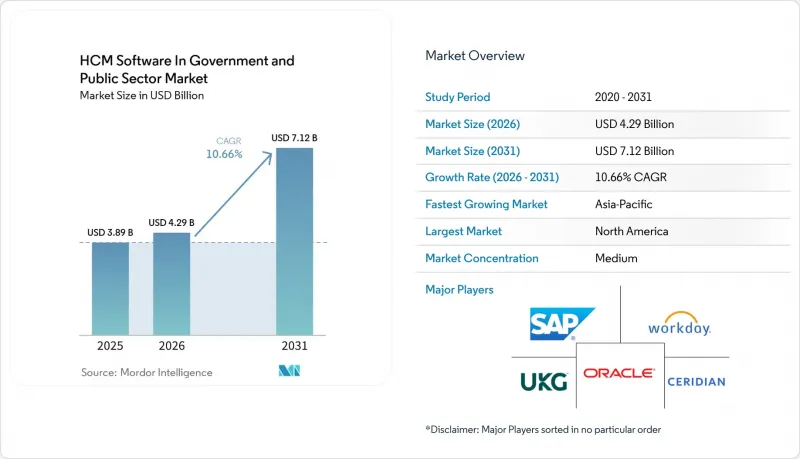
Mordor Intelligence에 의하면, 정부 및 공공 부문용 HCM 소프트웨어 시장 규모는 2025년 38억 9,000만 달러로 평가되었습니다. 2026년에는 42억 9,000만 달러로 확대되어 2031년까지 71억 2,000만 달러에 이를 것으로 예측됩니다.
2026년부터 2031년까지의 연평균 성장률(CAGR)은 10.66%가 될 것으로 전망됩니다.
본 보고서는 구성 요소(핵심 HR 소프트웨어, 급여·보상 관리, 인재 관리, 인력 관리 등), 배포 방식(On-Premise, 클라우드, 하이브리드), 정부 기관 규모(대, 중, 소), 최종 사용자 유형(연방 정부, 주·지방 자치단체, 국방·정보 기관 등) 및 지역별로 분류되어 있습니다. 시장 전망은 금액(달러) 기준으로 제시되어 있습니다.
정부 및 공공 부문용 HCM 소프트웨어 시장 동향 및 인사이트
공공 부문 인사 현대화에서 ‘클라우드 우선’ 방침의 가속화
미국, 영국, 호주, 인도의 각국 최고정보책임자(CIO)들은 현재 클라우드 전환을 단순한 비용 절감 수단이 아닌, 예산상의 의무로 인식하고 있습니다. 미국 연방 정부의 ‘HR 2.0’ 지침에 따르면, 각 기관은 2030년까지 190개의 기존 인사 시스템을 공유 클라우드 서비스로 통합해야 하며, 이를 준수하지 않을 경우 예산 삭감의 위험이 있습니다. 영국의 ‘Matrix’, ‘Synergy’, ‘Unity’ 프로그램에 포함된 유사한 현대화 목표에 따르면, 각 부처는 2028년까지 인사 업무의 70%를 클라우드로 이전해야 합니다. 호주는 2030년까지 1만 5,000명의 직원을 대상으로 클라우드 분석 역량을 강화하기 위해 1억 8,000만 호주 달러(1억 2,000만 달러)를 예산으로 편성하고, 자금 지원을 도입 단계별 목표와 연계하고 있습니다. 인도의 e-HRMS 2.0은 3년 이내에 500만 명의 직원 규모로 확대되었으며, 연방형 설계가 중앙의 기준을 적용하면서도 주 정부의 자치를 존중할 수 있음을 입증했습니다. 이러한 움직임에 따라 평가 주기가 12개월로 단축되었고, 사전 승인을 받은 벤더가 우대받는 한편, 정부 및 공공 부문용 HCM 소프트웨어 시장의 도입 속도가 가속화되고 있습니다.
FedRAMP, GDPR(EU 개인정보보호규정) 및 제로 트러스트 보안 프레임워크에 대한 필수 준수
보안 프레임워크는 결정적인 관문 역할을 하고 있습니다. 12-18개월이 소요되고 200만 달러의 비용이 드는 FedRAMP 인증을 취득한 HCM 벤더는 고작 6%에 불과하며, 조기에 인증을 취득한 기업들은 미국 연방 정부 수요에 주력하고 있습니다. 유럽의 AI법은 HR 소프트웨어를 고위험 분야로 분류하고, 프로젝트 리드타임을 최대 1년까지 연장할 가능성이 있는 필수 적합성 평가를 추가하고 있습니다. 미국 국방부의 제로 트러스트 로드맵은 지속적인 인증을 추진하고 있으며, 세션 기반 아키텍처는 이에 부합하지 않습니다. 조기에 인가를 획득한 벤더(2019년 Workday, 2024년 SAP SuccessFactors, 2025년 Oracle HCM Cloud)는 경쟁사 대비 18-24개월의 리드타임을 확보함으로써, 정부 및 공공 부문용 HCM 소프트웨어 시장의 경쟁 환경을 더욱 치열하게 만들고 있습니다.
장기화되는 공공 조달 주기와 예산 승인 지연
조달 주기의 장기화와 예산 승인 절차의 분산으로 인해, 공공 부문 기관에서의 HCM 도입은 여전히 제약을 받고 있습니다. 미국 국세청(IRS)의 2025년도 인재 관리 시스템 입찰은 여러 부서에 걸친 자금 의존 관계로 인해 14개월이 지났음에도 여전히 해결되지 않은 상태입니다. 또한, 노스캐롤라이나주 전역에 Workday를 도입하는 작업은 재해 복구를 위한 예산 재배정으로 인해 지연되었습니다. NASPO ValuePoint와 같은 공동 조달 프레임워크는 계약 체결을 신속하게 하는 데 기여하고 있지만, 각 기관에서의 도입은 여전히 제한적입니다. 이러한 구조적인 지연은 연간 성장률에 약간의 부담을 주고 있지만, 정부 및 공공 부문용 HCM 소프트웨어 시장의 장기적인 현대화 추세를 바꾸지는 않을 것입니다.
부문별 분석
급여·보수 분야는 2025년 수익의 28.32%를 차지했으며, 이는 재무성의 지급 네트워크와의 긴밀한 통합과 급여 관련 규정 위반 위험을 반영한 것입니다. 주요 기관들은 미국 자동 표준 지급 신청 시스템(USASAP) 등의 시스템에 대한 인증된 인터페이스에 의존하고 있으며, 이로 인해 정부 및 공공 부문용 HCM 소프트웨어 시장에서 급여 모듈이 핵심적인 위치를 차지하고 있습니다. 급여 압류 및 연금 공제에 대한 지속적인 관리는 구체적인 재정적 설명 책임을 수반하며, 이것이 급여 계산 부문의 견고한 시장 점유율을 설명해 줍니다.
한편, 학습·개발 분야는 가장 빠르게 성장하고 있으며, 공공 부문 관리자들이 일시적인 도입 교육이 아닌 지속적인 역량 개발로 초점을 옮기면서 연평균 성장률(CAGR) 13.42%를 기록하며 확대되고 있습니다. 인도의 Karmayogi iGOT 플랫폼은 마이크로 크레덴셜을 성과 평가에 반영함으로써 과정 수료율을 2배 이상 높였습니다. 호주에서는 AI가 추천하는 나노디그리를 인재 계획과 연계하여 기술 격차를 사전에 방지하고 있습니다. 이는 정부 및 공공 부문용 HCM 소프트웨어 시장의 지출 규모를 확대하기 위한 전략적 전환을 시사합니다.
On-Premise 환경은 2025년 지출의 56.19%를 계속 차지했습니다. 이는 국방 및 정보 기관이 기밀 데이터를 다루는 시스템을 격리해야 하기 때문입니다. 국방정보시스템국(DISA)은 최고 기밀(Top Secret) 파일을 정부 소유의 데이터센터로만 제한하고 있으며, 이로 인해 클라우드의 보급이 지연되고 정부가 관리하는 안전한 인프라에 대한 의존도가 높아지고 있습니다. 그럼에도 불구하고, 민간 기관들은 보다 신속한 업그레이드와 유연한 종량제 예산을 확보하기 위해 클라우드 구독 서비스를 꾸준히 도입하고 있는 반면, 하이브리드 모델은 주권과 기동성 간의 균형을 맞추며, 두 가지 도입 형태 모두에서 HCM 소프트웨어의 도입 범위를 확대되고 있습니다.
그렇긴 하지만, 공공 기관들이 보다 신속한 업그레이드와 종량제 예산 편성을 추구하는 가운데, 클라우드 구독 시장은 연평균 성장률(CAGR) 12.81%를 기록하며 성장하고 있습니다. 핵심 기록을 On-Premise에 보관하면서 분석 처리를 클라우드로 이전하는 하이브리드형 모델은 기동성을 희생하지 않고도 주권 요건을 충족시키며, 정부 및 공공 부문용 HCM 소프트웨어 시장을 양 진영에 걸쳐 확대되고 있습니다.
지역별 분석
북미는 정부 및 공공 부문용 HCM 소프트웨어 시장을 독점하고 있으며, 2025년에는 45.12%를 차지했지만, 처리하기 쉬운 워크로드가 먼저 이전됨에 따라 시장의 성숙도가 뚜렷해지고 있습니다. 연방 정부의 HR 2.0만 해도 12억 달러 규모 시장을 자랑하지만, 레거시 용도의 40%는 기밀 취급 제한으로 인해 전환이 지연되고 있습니다. 애리조나주, 조지아주, 버몬트주, 유타주 전역에 걸친 Workday 도입 사례는 공유 계약이 워싱턴 D.C. 이외의 지역에서 도입을 어떻게 가속화하는지를 보여주고 있으며, 캐나다의 각 주도 현재 도입 단계에서 분석 기능의 정교화로 초점을 옮기고 있습니다. 사이버보안 및 인프라 보안국(CISA)의 제로 트러스트 도입 기한은 규정을 준수하지 않는 제품군의 업데이트 주기를 확실히 보장하고 있습니다.
유럽에서의 성장은 영국의 8억 파운드(10억 1,000만 달러) 규모의 ‘Matrix’ 프레임워크, 독일의 디지털 온보딩 법, 그리고 프랑스의 전국적인 SIRH(인사 정보 시스템) 개편에 기인합니다. 스페인의 GEISER 플랫폼은 챗봇을 도입한 결과, 헬프데스크 문의 건수를 35% 줄임으로써 핵심 디지털화 완료 후의 부가가치를 입증했습니다. 유럽연합(EU)의 AI 법안은 리드타임을 연장시키는 한편, 자본력이 약한 신규 시장 진출기업을 가로막는 규정 준수상의 장벽을 조성함으로써, 정부 및 공공 부문용 HCM 소프트웨어 시장에서 기존 공급업체들 시장 점유율을 강화하고 있습니다.
아시아태평양은 가장 빠르게 성장하는 지역으로, 2031년까지의 연평균 성장률(CAGR)은 10.11%에 달할 전망입니다. 인도의 국가 e-HRMS 2.0 및 주 차원의 Maha-AASTHA 이니셔티브 덕분에 매년 수백만 명의 사용자가 추가되고 있습니다. 호주는 인력 분석 역량 강화에 1억 8,000만 호주 달러(1억 2,000만 달러)를 투자했으며, 뉴질랜드에서는 공유 서비스 도입을 통해 35개 기관에 걸친 급여 계산이 표준화되었습니다. 베트남과 인도네시아의 사이버 주권 관련 법규는 국경을 넘는 호스팅을 지연시키는 한편, 국내 데이터센터에 대한 새로운 수요를 창출하여 정부 및 공공 부문용 HCM 소프트웨어 시장의 지역적 전망을 뒷받침하고 있습니다.
기타 혜택 :
- 엑셀 형식 시장 예측(ME) 시트
- 3개월간의 애널리스트 지원
자주 묻는 질문
목차
제1장 서론
제2장 조사 방법
제3장 주요 요약
제4장 시장 구도
제5장 시장 규모 및 성장 예측
제6장 경쟁 구도
제7장 시장 기회 및 향후 전망
KTH 26.06.24According to Mordor Intelligence, the HCM software in the Government and Public Sector Market is expected to increase from USD 3.89 billion in 2025 to USD 4.29 billion in 2026, and reach USD 7.12 billion by 2031, growing at a CAGR of 10.66% over 2026-2031.
This report is Segmented by Component (Core HR Software, Payroll and Compensation, Talent Management, Workforce Management, and More), Deployment Mode (On-Premises, Cloud, and Hybrid), Agency Size Tier (Large, Medium, and Small), End-User Type (Federal, State and Local, Defense and Intelligence, and More), and Geography. The Market Forecasts are Provided in Terms of Value (USD).
Global HCM Software In Government And Public Sector Market Trends and Insights
Accelerating Cloud-First Mandates In Public Sector HR Modernization
Chief information officers across the United States, the United Kingdom, Australia, and India now treat cloud migration as a budget-binding obligation rather than a cost-saving option. The United States Federal HR 2.0 directive requires agencies to rationalize 190 legacy personnel systems onto shared cloud services by 2030, and failure to comply risks appropriation cuts. Similar modernization quotas embedded in the United Kingdom's Matrix, Synergy, and Unity programs require departments to move 70% of HR transactions to the cloud by 2028. Australia budgeted AUD 180 million (USD 120 million) to upskill 15,000 workers in cloud analytics by 2030, linking funding to adoption milestones. India's e-HRMS 2.0 scaled to five million employees within three years, proving that federated designs can respect state autonomy while enforcing central standards. These moves compress evaluation cycles to 12 months, favoring vendors with pre-authorized environments and accelerating the HCM software in the government and public sector market adoption curve.
Mandatory Compliance With FedRAMP, GDPR And Zero-Trust Security Frameworks
Security frameworks have become decisive gatekeepers. Only 6% of HCM vendors have cleared the 12- to 18-month, USD 2 million FedRAMP authorization, concentrating on the United States federal demand among early certifiers. Europe's AI Act labels HR software as high risk, adding mandatory conformity assessments that can stretch project lead times by up to 1 year. The United States Department of Defense zero-trust roadmap pushes continuous authentication, disqualifying session-based architectures. Vendors that secured early clearances, Workday in 2019, SAP SuccessFactors in 2024, Oracle HCM Cloud in 2025, trace 18- to 24-month lead windows over challengers, tightening the HCM software in the government and public sector market competitive field.
Lengthy Public Procurement Cycles And Budget Release Delays
Lengthy procurement cycles and fragmented budget approvals continue to restrain HCM deployment across public-sector agencies. The United States Internal Revenue Service's 2025 human capital solicitation remained unresolved after 14 months due to multi-division funding dependencies, while North Carolina's statewide Workday rollout was delayed following budget reallocations toward disaster recovery. Although cooperative procurement frameworks such as NASPO ValuePoint help accelerate contracting, adoption remains limited across agencies. These structural delays modestly pressure annual growth rates but have not altered the long-term modernization trajectory of the HCM software in the government and public sector market.
Other drivers and restraints analyzed in the detailed report include:
- AI-Driven Workforce Analytics Improving Mission Readiness And Budget Efficiency
- Generative AI Copilots Automating Personnel Action Requests
- Heightened Cyber-Sovereignty Rules Limiting Cross-Border Data Flows
For complete list of drivers and restraints, kindly check the Table Of Contents.
Segment Analysis
Payroll and Compensation generated 28.32% of 2025 revenue, reflecting its deep integration with treasury disbursement networks and the risk of salary-related compliance breaches. Leading agencies rely on certified interfaces to systems such as the United States Automated Standard Application for Payments, positioning payroll as the anchoring module within HCM software in the government and public sector markets. Continuous controls over wage garnishments and pension deductions deliver tangible fiscal accountability, explaining payroll's durable share.
Learning and Development, however, is the fastest climber, advancing at a 13.42% CAGR as public managers pivot toward continuous capability building rather than episodic induction. India's Karmayogi iGOT platform more than doubled course-completion rates by embedding micro-credentials into performance reviews. Australia links AI-recommended nanodegrees with workforce planning, pre-empting skill gaps and signaling a strategic shift that widens the addressable spend for HCM software in the government and public sector markets.
On-Premises environments retained 56.19% of 2025 outlays because defense and intelligence units must isolate systems handling classified data. The Defense Information Systems Agency confines Top Secret files to government-owned data centers, which slows cloud penetration and reinforces reliance on secure, government-controlled infrastructure. Despite this, civilian agencies are steadily adopting cloud subscriptions to gain faster upgrades and flexible consumption-based budgets, while hybrid models balance sovereignty with mobility, expanding the HCM software footprint across both deployment camps.
Nonetheless, cloud subscriptions grow at a 12.81% CAGR as public bodies pursue faster upgrades and consumption-based budgets. Hybrid blueprints, where core records stay on-premises while analytics travel to the cloud, satisfy sovereignty requirements without sacrificing mobility, expanding the HCM software market in the government and public sectors across both camps.
Geography Analysis
North America dominates the HCM Software in the Government and Public Sector Market, accounting for 45.12% in 2025, but maturation is evident as easy workloads migrate first. Federal HR 2.0 alone represents a USD 1.2 billion pool, yet 40% of legacy apps hold classified constraints that slow conversions. Statewide Workday implementations in Arizona, Georgia, Vermont, and Utah illustrate how shared contracts accelerate adoption outside Washington, and Canadian provinces now pivot from deployment to analytics refinement. The Cybersecurity and Infrastructure Security Agency's zero-trust deadlines guarantee a replacement cycle for non-compliant suites.
European growth springs from the United Kingdom's GBP 800 million (USD 1.01 billion) Matrix framework, Germany's digital onboarding law, and France's nationwide SIRH overhaul. Spain's GEISER platform reduced help-desk traffic by 35% after deploying a chatbot, demonstrating follow-on value once core digitization is complete. While the European Union AI Act elongates lead times, it simultaneously creates a compliance moat that discourages under-capitalized entrants, reinforcing the market share of established suppliers in the HCM software market for government and the public sector.
Asia-Pacific is the fastest-growing region, with a 10.11% CAGR to 2031. India's national e-HRMS 2.0 and state-level Maha-AASTHA initiatives add millions of users annually. Australia commits AUD 180 million (USD 120 million) to workforce analytics upskilling, and New Zealand's shared-service roll-out standardizes payroll across 35 agencies. Cyber-sovereignty edicts in Vietnam and Indonesia slow cross-border hosting but simultaneously create greenfield demand for domestic data centers, bolstering the regional outlook for HCM software in the government and public sector markets.
- Workday, Inc.
- Oracle Corporation
- SAP SE
- UKG Inc.
- Ceridian HCM Holding Inc.
- Automatic Data Processing, Inc.
- Paycom Software, Inc.
- Paylocity Holding Corporation
- Cornerstone OnDemand, Inc.
- Infor, Inc.
- Tyler Technologies, Inc.
- NEOGOV, Inc.
- Unit4 N.V.
- BambooHR LLC
- PeopleFluent (Learning Technologies Group plc)
- Ramco Systems Limited
- Paycor HCM, Inc.
- Gusto, Inc.
- The Sage Group plc
- SumTotal Systems, LLC
Additional Benefits:
- The market estimate (ME) sheet in Excel format
- 3 months of analyst support
TABLE OF CONTENTS
1 INTRODUCTION
- 1.1 Study Assumptions & Market Definition
- 1.2 Scope of the Study
2 RESEARCH METHODOLOGY
3 EXECUTIVE SUMMARY
4 MARKET LANDSCAPE
- 4.1 Market Overview
- 4.2 Market Drivers
- 4.2.1 Accelerating Cloud-First Mandates in Public Sector HR Modernization
- 4.2.2 Mandatory Compliance with FedRAMP, GDPR and Zero-Trust Security Frameworks
- 4.2.3 AI-Driven Workforce Analytics Improving Mission Readiness & Budget Efficiency
- 4.2.4 Generative AI Copilots Automating Personnel Action Requests (PAR)
- 4.2.5 Integration of Unified Payroll with Treasury Payment Systems
- 4.2.6 Migration Incentives from Legacy Mainframe HRIS Decommissioning Grants
- 4.3 Market Restraints
- 4.3.1 Heightened Cyber-Sovereignty Rules Limiting Cross-Border Data Flows
- 4.3.2 Lengthy Public Procurement Cycles and Budget Release Delays
- 4.3.3 Skills Gap in Government IT to Execute Large-Scale HCM Transformations
- 4.3.4 Algorithmic Bias Scrutiny under Emerging AI Regulations
- 4.4 Industry Value-Chain Analysis
- 4.5 Regulatory Landscape
- 4.6 Technological Outlook
- 4.7 Impact of Macroeconomic Factors on the Market
- 4.8 Porter's Five Forces Analysis
- 4.8.1 Threat of New Entrants
- 4.8.2 Bargaining Power of Suppliers
- 4.8.3 Bargaining Power of Buyers
- 4.8.4 Threat of Substitute Products
- 4.8.5 Intensity of Competitive Rivalry
5 MARKET SIZE AND GROWTH FORECASTS (VALUE)
- 5.1 By Component
- 5.1.1 Core HR Software
- 5.1.2 Payroll & Compensation
- 5.1.3 Talent Management
- 5.1.4 Workforce Management
- 5.1.5 Learning & Development
- 5.2 By Deployment Mode
- 5.2.1 On-Premises
- 5.2.2 Cloud
- 5.2.3 Hybrid
- 5.3 By Agency Size Tier
- 5.3.1 Large Government Agencies (10 000 employees+)
- 5.3.2 Medium Agencies (1 000-10 000 employees)
- 5.3.3 Small Agencies (1 000 employees)
- 5.4 By End-User Type
- 5.4.1 Federal / Central Government Agencies
- 5.4.2 State & Local Government
- 5.4.3 Defense & Intelligence Agencies
- 5.4.4 Public Education & Universities
- 5.4.5 Public Safety & Justice Departments
- 5.4.6 Healthcare & Social Services Agencies
- 5.5 By Geography
- 5.5.1 North America
- 5.5.1.1 United States
- 5.5.1.2 Canada
- 5.5.1.3 Rest of North America
- 5.5.2 South America
- 5.5.2.1 Brazil
- 5.5.2.2 Argentina
- 5.5.2.3 Rest of South America
- 5.5.3 Europe
- 5.5.3.1 Germany
- 5.5.3.2 United Kingdom
- 5.5.3.3 France
- 5.5.3.4 Italy
- 5.5.3.5 Spain
- 5.5.3.6 Rest of Europe
- 5.5.4 Asia-Pacific
- 5.5.4.1 China
- 5.5.4.2 Japan
- 5.5.4.3 India
- 5.5.4.4 South Korea
- 5.5.4.5 Australia & New Zealand
- 5.5.4.6 Rest of Asia-Pacific
- 5.5.5 Middle East
- 5.5.5.1 Saudi Arabia
- 5.5.5.2 United Arab Emirates
- 5.5.5.3 Turkey
- 5.5.5.4 Rest of Middle East
- 5.5.6 Africa
- 5.5.6.1 South Africa
- 5.5.6.2 Nigeria
- 5.5.6.3 Egypt
- 5.5.6.4 Rest of Africa
- 5.5.1 North America
6 COMPETITIVE LANDSCAPE
- 6.1 Market Concentration
- 6.2 Strategic Moves
- 6.3 Market Share Analysis
- 6.4 Company Profiles (Includes Global Level Overview, Market Level Overview, Core Segments, Financials as available, Strategic Information, Market Rank/Share, Products and Services, Recent Developments)
- 6.4.1 Workday, Inc.
- 6.4.2 Oracle Corporation
- 6.4.3 SAP SE
- 6.4.4 UKG Inc.
- 6.4.5 Ceridian HCM Holding Inc.
- 6.4.6 Automatic Data Processing, Inc.
- 6.4.7 Paycom Software, Inc.
- 6.4.8 Paylocity Holding Corporation
- 6.4.9 Cornerstone OnDemand, Inc.
- 6.4.10 Infor, Inc.
- 6.4.11 Tyler Technologies, Inc.
- 6.4.12 NEOGOV, Inc.
- 6.4.13 Unit4 N.V.
- 6.4.14 BambooHR LLC
- 6.4.15 PeopleFluent (Learning Technologies Group plc)
- 6.4.16 Ramco Systems Limited
- 6.4.17 Paycor HCM, Inc.
- 6.4.18 Gusto, Inc.
- 6.4.19 The Sage Group plc
- 6.4.20 SumTotal Systems, LLC
7 MARKET OPPORTUNITIES AND FUTURE OUTLOOK
- 7.1 White-Space & Unmet-Need Assessment


