|
시장보고서
상품코드
2064460
미국의 GPU 시장 : 시장 점유율 분석, 업계 동향 및 통계, 성장 예측(2026-2031년)United States GPU - Market Share Analysis, Industry Trends & Statistics, Growth Forecasts (2026 - 2031) |
||||||
 Mordor Intelligence
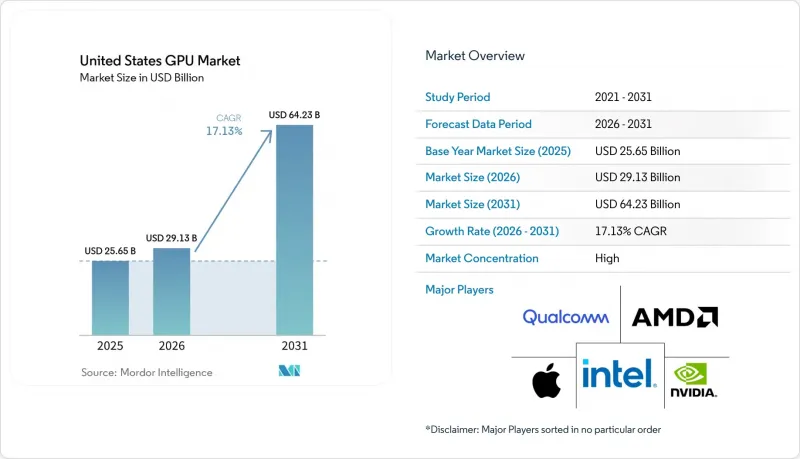
Mordor Intelligence에 의하면, 미국의 GPU 시장 규모는 2025년 256억 5,000만 달러로 평가되었고, 2026년 291억 3,000만 달러로 추정되고, 2031년까지 642억 3,000만 달러로 확대될 전망이며, 2026-2031년 CAGR은 17.13%를 나타낼 것으로 예측됩니다.
본 보고서는 통합형별(통합형 GPU, 디스크리트 GPU)과 기기 용도별(모바일 기기 및 태블릿, PC 및 워크스테이션, 서버 및 데이터센터 가속기, 게임기 및 휴대용 게임기, 자동차/ADAS, 기타 임베디드 및 엣지 기기)로 분류되어 있습니다. 시장 전망은 금액(달러) 기준으로 제시되어 있습니다.
미국의 GPU 시장 동향 및 인사이트
AI 및 데이터센터 가속화 기술의 도입 확대
하이퍼스케일 사업자들은 2025년에 국내에서 100만 대 이상의 가속기를 도입했으며, 그 출하 대수의 5분의 4에 가까운 비중을 Microsoft Azure, AWS, Google Cloud가 차지했습니다. 현재는 일회성 구매 대신 다년 계약을 통한 공급이 이루어지고 있으며, 테이프아웃보다 훨씬 앞서 웨이퍼와 패키징의 생산 능력을 확보하고 있습니다. 이러한 계약은 생산 우선순위를 보호하는 한편, 지역 클라우드 제공업체 및 연구 기관에 대한 공급량을 감소시켜 간접적으로 GPU-as-a-Service(GPUaaS) 모델을 촉진하고 있습니다. 최첨단 훈련을 단 한 번만 수행해도 수만 장의 GPU 카드를 수개월 동안 점유하게 되며, 300-1,000메가와트 규모의 부하를 관리하기 위해서는 현장 발전이나 베이스로드 전원에 가까운 장소에서의 코로케이션이 필요합니다.
고성능 게이밍 PC에 대한 수요 증가
미국 내 디스크리트 게이밍 카드 출하량은 2024년 4분기에 840만 대에 달했습니다. 이는 전용 연산 능력이 필요한 레이 트레이싱 지원 타이틀과 AI 기반 업스케일링에 힘입은 결과입니다. 그러나 300-500달러 가격대의 중급형 보드가 1,000달러 이상의 플래그십 모델로부터 시장 점유율을 빼앗아 평균 판매 가격을 끌어내렸습니다. 엔트리 레벨 시장은 클라우드 게임에 의해 잠식되고 있지만, e스포츠 애호가들은 여전히 240fps를 구현하는 하드웨어에 비싼 가격을 지불하고 있습니다.
선진 노드공급망 제약
첨단 패키징 기술은 웨이퍼 생산보다 약 18개월 뒤처져 있어, 3nm 웨이퍼를 충분히 확보한 경우에도 출하를 제한하고 있습니다. 대역폭이 높은 메모리공급도 부족하여, 소규모 구매자들은 현물 가격으로 40%의 할증료를 감수하거나 프로젝트를 연기할 수밖에 없는 상황입니다. 국내 기가팹 건설을 통해 이 격차가 해소되는 것은 2028년 이후가 될 것이므로, 공급 부족으로 인해 가격은 높은 수준을 유지하게 되며, 장기 계약을 체결한 하이퍼스케일러에게 우선적으로 배정될 것입니다.
부문별 분석
2025년 미국 GPU 시장에서 디스크리트 가속기는 66.29%를 차지했습니다. 이는 전용 메모리 스톡, 독립형 전원 레일, 첨단 열 관리 솔루션에 대한 수요를 반영한 것입니다. 이 하이엔드 데이터센터용 보드는 700와트의 소비 전력, 192GB의 HBM3E, 20페타플롭스를 넘는 FP8 처리량을 자랑하며, 1조 파라미터 규모의 모델 훈련을 가능하게 합니다. 하이퍼스케일러들이 수백만 대 규모의 가속기를 통해 클러스터를 확장함에 따라, 미국의 디스크리트 GPU 시장 규모는 연평균 성장률(CAGR) 17.53%로 확대될 것으로 전망됩니다. 통합형 설계는 33.71%의 시장 점유율을 차지하고 있으며, 15와트의 전력 소비가 최우선으로 고려되는 노트북, 태블릿, 씬 클라이언트의 워크로드를 대상으로 합니다. 퀄컴, 애플, 인텔은 성능 격차를 점차 좁혀가고 있으며, 배터리 구동 기기에서 15-30 테라플롭스의 성능을 제공함으로써 보급형 디스크리트 GPU에 대한 수요를 압박하고 있습니다.
통합형 GPU는 과거 300달러 미만의 그래픽 카드가 담당하던 중저가 소비자 시장을 휩쓸고 있습니다. 인텔의 차세대 ‘팬서 레이크’ 플랫폼은 레이 트레이싱과 행렬 연산 엔진을 통합한 반면, 퀄컴의 ‘스냅드래곤 X2 엘리트’는 15와트 이하의 전력 소비로 80 TOPS의 신경망 처리량을 실현합니다. 따라서 디스크리트 보드 제조업체들은 수익성이 높은 데이터센터, 워크스테이션, 매니아용 부문에 주력하고 있습니다. 이러한 부문에서는 고객들이 노드당 최고 성능을 중시하며, 성능 향상을 위해 수냉식 인프라에 투자하고 있습니다. 이러한 전략적 전환 덕분에, 소비자 채널에서의 판매 대수가 정체되거나 감소하고 있음에도 불구하고 60% 이상의 매출 총이익률을 유지할 수 있게 되었습니다.
기타 혜택
- 엑셀 형식 시장 예측(ME) 시트
- 3개월간의 애널리스트 지원
자주 묻는 질문
목차
제1장 서론
제2장 조사 방법
제3장 주요 요약
제4장 시장 구도
제5장 시장 규모 및 성장 예측
제6장 경쟁 구도
제7장 시장 기회 및 향후 전망
AJY 26.06.26According to Mordor Intelligence, the united states gPU market size is projected to expand from USD 25.65 billion in 2025 and USD 29.13 billion in 2026 to USD 64.23 billion by 2031, registering a CAGR of 17.13% between 2026 and 2031.
This report is Segmented by Integration Type (Integrated GPUs, Discrete GPUs) and Device Application (Mobile Devices and Tablets, Pcs and Workstations, Servers and Datacenter Accelerators, Gaming Consoles and Handhelds, Automotive/ADAS, Other Embedded and Edge Devices). The Market Forecasts are Provided in Terms of Value (USD).
United States GPU Market Trends and Insights
Growth In AI And Data Center Acceleration Adoption
Hyperscale operators deployed more than one million accelerators domestically in 2025, with Microsoft Azure, AWS, and Google Cloud representing nearly four-fifths of shipments. Multi-year supply contracts now replace spot buys, locking in wafer and packaging capacity well before tape-out. Such commitments protect production priority but reduce availability for regional cloud providers and research labs, indirectly propelling the GPU-as-a-Service model. A single state-of-the-art training run can occupy tens of thousands of cards for months, requiring on-site generation or co-location near baseload power to manage 300- to 1,000-megawatt loads.
Expanding Demand For High-Performance Gaming PCs
U.S. shipments of discrete gaming cards climbed to 8.4 million units in Q4 2024, buoyed by ray-tracing titles and AI-driven upscaling that demand dedicated compute. Yet mid-range boards priced from USD 300 to USD 500 grabbed share from USD 1,000-plus flagships, trimming blended average prices. The entry-level market is being eroded by cloud gaming, while eSports enthusiasts still pay premiums for 240 fps hardware.
Supply Chain Constraints Of Advanced Nodes
Advanced packaging lags wafer output by roughly 18 months, restricting shipments even when plenty of 3 nm wafers are available. The supply of high-bandwidth memory is also tight, forcing smaller buyers to accept 40% spot-price premiums or defer projects. Domestic gigafab construction will close the gap only after 2028, so scarcity will keep prices elevated and allocate priority to hyperscalers with long-term contracts.
Other drivers and restraints analyzed in the detailed report include:
- Government Incentives For Domestic Semiconductor Manufacturing
- Rising Popularity Of Cloud Gaming Services
- High Power Consumption And Cooling Challenges
For complete list of drivers and restraints, kindly check the Table Of Contents.
Segment Analysis
Discrete accelerators accounted for 66.29% of the United States GPU market in 2025, reflecting demand for dedicated memory stacks, independent power rails, and aggressive thermal solutions. Premium datacenter boards showcase 700-watt envelopes, 192 GB of HBM3E, and FP8 throughput exceeding 20 petaflops, enabling trillion-parameter model training. The United States GPU market size for discrete products is projected to grow at 17.53% CAGR as hyperscalers scale clusters by the million-accelerator level. Integrated designs hold 33.71% share and target laptop, tablet, and thin-client workloads where 15-watt budgets are paramount. Qualcomm, Apple, and Intel are closing the capability gap, offering 15-30 teraflops in battery-powered devices, which compresses entry-level discrete demand.
Integrated GPUs are capturing mid-tier consumer spend once served by cards below USD 300. Intel's forthcoming Panther Lake platform integrates ray tracing and matrix engines, while Qualcomm's Snapdragon X2 Elite delivers 80 TOPS neural throughput at sub-15-watt draw. Vendors of discrete boards, therefore, concentrate on high-margin datacenter, workstation, and enthusiast segments, where customers value peak performance per node and invest in liquid cooling infrastructure to unlock gains. This strategic pivot supports gross margins above 60% despite flat to declining unit volume in the consumer channel.
List of Companies Covered in this Report:
- Nvidia Corporation
- Advanced Micro Devices, Inc.
- Intel Corporation
- Qualcomm Incorporated
- Apple Inc.
- Samsung Electronics Co., Ltd.
- Arm Holdings plc
- Imagination Technologies Limited
- MediaTek Inc.
- Broadcom Inc.
- Matrox Electronic Systems Ltd.
- Texas Instruments Incorporated
- NXP Semiconductors N.V.
- Renesas Electronics Corporation
- Graphcore Ltd.
- VIA Technologies, Inc.
- Rockchip Electronics Co., Ltd.
- Allwinner Technology Co., Ltd.
- Zhaoxin Semiconductor Co., Ltd.
Additional Benefits:
- The market estimate (ME) sheet in Excel format
- 3 months of analyst support
TABLE OF CONTENTS
1 INTRODUCTION
- 1.1 Study Assumptions and Market Definition
- 1.2 Scope of the Study
2 RESEARCH METHODOLOGY
3 EXECUTIVE SUMMARY
4 MARKET LANDSCAPE
- 4.1 Market Overview
- 4.2 Market Drivers
- 4.2.1 Expanding Demand for High-Performance Gaming PCs
- 4.2.2 Growth in AI and Data Center Acceleration Adoption
- 4.2.3 Rising Popularity of Cloud Gaming Services
- 4.2.4 Increasing Content Creation Workloads Among Prosumers
- 4.2.5 Government Incentives for Domestic Semiconductor Manufacturing
- 4.2.6 Emergence of GPU Virtualization for Enterprise Desktops
- 4.3 Market Restraints
- 4.3.1 Supply Chain Constraints of Advanced Nodes
- 4.3.2 High Power Consumption and Cooling Challenges
- 4.3.3 Market Cannibalization by Integrated GPUs in Mid-Range Segments
- 4.3.4 Rising Scrutiny Over GPU Energy Emissions in Data Centers
- 4.4 Impact of Macroeconomic Factors on the Market
- 4.5 Industry Value / Supply-Chain Analysis
- 4.6 Regulatory Landscape
- 4.7 Technological Outlook
- 4.8 Porter's Five Forces Analysis
- 4.8.1 Bargaining Power of Suppliers
- 4.8.2 Bargaining Power of Buyers
- 4.8.3 Threat of New Entrants
- 4.8.4 Threat of Substitutes
- 4.8.5 Competitive Rivalry
5 MARKET SIZE AND GROWTH FORECASTS
- 5.1 By Integration Type
- 5.1.1 Integrated GPUs (iGPU)
- 5.1.2 Discrete GPUs (dGPU)
- 5.2 By Device Application
- 5.2.1 Mobile Devices and Tablets
- 5.2.2 PCs and Workstations
- 5.2.3 Servers and Datacenter Accelerators
- 5.2.4 Gaming Consoles and Handhelds
- 5.2.5 Automotive / ADAS
- 5.2.6 Other Embedded and Edge Devices
6 COMPETITIVE LANDSCAPE
- 6.1 Market Concentration
- 6.2 Strategic Moves
- 6.3 Market Share Analysis
- 6.4 Company Profiles (includes Global Level Overview, Market Level Overview, Core Segments, Financials as available, Strategic Information, Market Rank/Share, Products and Services, Recent Developments)
- 6.4.1 Nvidia Corporation
- 6.4.2 Advanced Micro Devices, Inc.
- 6.4.3 Intel Corporation
- 6.4.4 Qualcomm Incorporated
- 6.4.5 Apple Inc.
- 6.4.6 Samsung Electronics Co., Ltd.
- 6.4.7 Arm Holdings plc
- 6.4.8 Imagination Technologies Limited
- 6.4.9 MediaTek Inc.
- 6.4.10 Broadcom Inc.
- 6.4.11 Matrox Electronic Systems Ltd.
- 6.4.12 Texas Instruments Incorporated
- 6.4.13 NXP Semiconductors N.V.
- 6.4.14 Renesas Electronics Corporation
- 6.4.15 Graphcore Ltd.
- 6.4.16 VIA Technologies, Inc.
- 6.4.17 Rockchip Electronics Co., Ltd.
- 6.4.18 Allwinner Technology Co., Ltd.
- 6.4.19 Zhaoxin Semiconductor Co., Ltd.
7 MARKET OPPORTUNITIES AND FUTURE OUTLOOK
- 7.1 White-Space and Unmet-Need Assessment