|
시장보고서
상품코드
2065617
아시아태평양의 통합 GPU 시장 : 시장 점유율 분석, 업계 동향 및 통계, 성장 예측(2026-2031년)Asia-Pacific Integrated GPU - Market Share Analysis, Industry Trends & Statistics, Growth Forecasts (2026 - 2031) |
||||||
 Mordor Intelligence
Mordor Intelligence에 의하면, 아시아태평양의 통합 GPU 시장 규모는 2025년 246억 7,000만 달러로 평가되었고, 2026년에는 282억 5,000만 달러로 추정되고, 2026-2031년 CAGR 17.97%로 성장을 지속할 전망이며, 2031년에는 645억 4,000만 달러에 이를 것으로 예측됩니다.
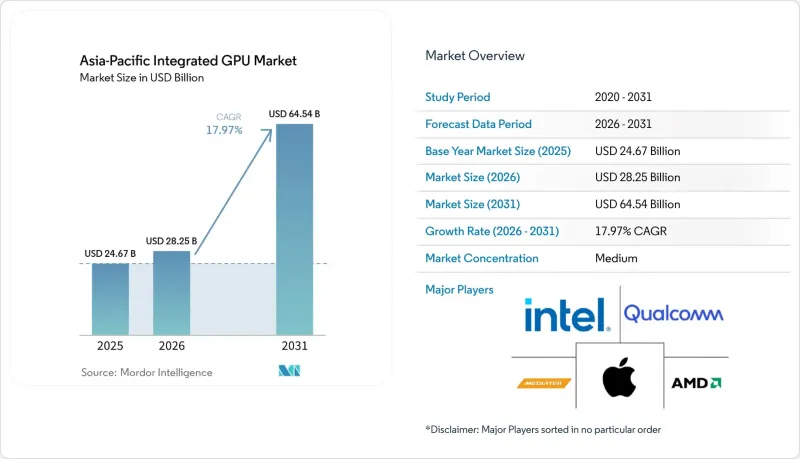
본 보고서는 디바이스 카테고리별(데스크톱 및 노트북용 프로세서, 모바일 SoC(스마트폰 및 태블릿), 임베디드 및 산업용 SoC) 등), 성능 등급별(엔트리 레벨(50달러 미만), 메인스트림(50-150달러), 퍼포먼스(150-300달러), 하이 퍼포먼스(300달러 이상)), 그리고 지역별로 분류되어 있습니다. 시장 전망은 금액(달러) 기준으로 제시되어 있습니다.
아시아태평양의 통합 GPU 시장 동향 및 인사이트
Windows 11 및 상용 노트북의 AI PC 교체 주기
Windows 10의 지원 종료 시한은 아시아태평양의 상용 PC용 통합 GPU 시장에서 가장 명확한 단기적 요인으로 작용했습니다. 기업의 구매 담당자들은 운영 체제 전환을 AI 지원 신규 하드웨어 사양과 조율해야 했기 때문에 노트북 교체는 기존 업그레이드 주기보다 더 빠른 속도로 진행되었습니다. HP에 따르면, AI PC의 출하 비중은 35%에서 44%로 증가했으며, APJ 지역의 Windows 11 교체 주기는 기업용 수요를 2-3% 앞당기는 요인이 되었습니다. 이는 본격적인 전환의 물결이 끝나기도 전부터 구매 담당자들이 이미 고사양 시스템으로 전환해 가고 있었음을 보여줍니다. 그 후, 인텔은 2026년 1월, 플랫폼 전체의 AI 연산 성능이 180 TOPS에 달하는 ‘Core Ultra Series 3’를 출시하며 이러한 변화를 더욱 가속화했습니다. 이로써 통합 그래픽스 블록은 단순한 기본 디스플레이 구성 요소에서 벗어나, 실용적인 AI 워크로드를 구현하는 요소로 변모했습니다. 그 결과, 아시아태평양 지역의 통합 GPU 시장은 특히 일본, 중국, 한국, 인도, 호주에서 상용 노트북의 사양 하한선이 상향 조정된 데 따른 혜택을 누리고 있습니다.
5G 스마트폰의 프리미엄화와 온디바이스 AI 그래픽스에 대한 수요
아시아태평양의 통합 GPU 시장에서 스마트폰 그래픽은 더 이상 렌더링이나 미디어 재생만을 목적으로 설계된 것이 아닙니다. MediaTek에 따르면, Dimensity 9500은 Arm G1-Ultra GPU를 탑재하여 이전 세대에 비해 최대 성능이 33% 향상되고 전력 효율도 42% 개선되었으며, 120fps 레이 트레이싱 지원 게임도 지원합니다. 또한, 미디어텍은 생성형 AI 작업을 GPU 셰이더 리소스와 전용 신경망 가속 장치에 분산시키는 ‘에이전트형 AI 프레임워크’에 대해서도 설명했으며, 이를 통해 플래그십 모델 이외의 기종에서도 로컬 AI 기능이 확장되었습니다. 이로 인해 그래픽 성능이 게임, AI 반응 속도, 전력 효율을 동시에 지원할 수 있게 됨에 따라, 휴대폰 제조업체들이 프리미엄 및 상위 중급형 단말기를 포지셔닝하는 방식에 변화가 생길 것입니다. 따라서 아시아태평양 지역의 통합 GPU 시장은 중국, 인도, 한국, 동남아시아에서 5G를 중심으로 한 프리미엄화 추세의 혜택을 받고 있으며, 이들 지역에서는 더욱 강력한 단말기 내 AI 기능이 일반 소비자의 기기 교체 시 주요 판매 포인트로 자리 잡고 있습니다.
프리미엄 SoC에서 첨단 노드의 파운드리 병목 현상
최첨단 노드 공급은 아시아태평양의 통합 GPU 시장에 여전히 실질적인 제약 요인으로 작용하고 있습니다. 이는 최고 수준의 스마트폰, PC, AI 컴퓨팅 프로그램이 모두 동일한 최첨단 웨이퍼를 필요로 하기 때문입니다. 따라서 프리미엄 SoC 공급업체들은 특히 최대 고객사가 조기 접근권을 확보하고 소규모 신생 기업들이 더 짧은 계획 기간에 의존하는 경우, 더욱 까다로운 할당 환경에 직면하고 있습니다. 이로 인해 웨이퍼 및 패키징 비용이 상승하여, 이는 디바이스 가격에 전가될 뿐만 아니라, 새로운 성능 계층의 설계를 확대하려는 벤더의 유연성이 제한됩니다. 또한, 프리미엄 부문에서는 파운드리 접근성이 아키텍처의 품질과 거의 동등한 중요성을 갖기 시작했기 때문에 경쟁 제품의 교체 주기도 길어집니다. 이러한 상황 속에서도 아시아태평양의 통합 GPU 시장은 성장을 이어갈 가능성이 있지만, 현재의 계획 주기를 통해 볼 때 공급 측면의 제약으로 인해 프리미엄급 제품 공급이 기초 수요를 상회하는 공급 부족 상태가 지속될 전망입니다.
부문별 분석
2025년, 모바일 SoC는 아시아태평양 통합 GPU 시장 점유율의 49.32%를 차지했으며, 이 지역의 수익 기반은 여전히 스마트폰 및 태블릿을 중심으로 이루어졌습니다. 이러한 주도적 지위는 스마트폰 제조와 소비 양면에서 해당 지역이 수행하는 구조적 역할을 반영하고 있으며, 중국과 한국의 OEM 생태계가 그래픽, AI, 연결 기능을 하나의 패키지에 통합한 SoC에 대한 지속적인 수요를 견인하고 있습니다. 데스크톱 및 노트북용 프로세서는 업무용 노트북의 교체 주기와 업무용 및 교육용 기기에서 노트북 중심의 구매 경향이 지속됨에 따라, 2위 기기 카테고리를 형성했습니다. 따라서 AI 지원이 더욱 두드러진 구매 요인으로 부상하면서 PC가 전략적 중요성을 되찾았음에도 불구하고, 아시아태평양의 통합 GPU 시장은 여전히 대량 생산되는 소비자용 전자기기에 힘입어 성장세를 이어갔습니다.
그래픽 기능을 통합한 서버 및 데이터센터용 프로세서의 아시아태평양 통합 GPU 시장 규모는 2026-2031년 연평균 성장률(CAGR) 18.11%로 확대될 것으로 예상되며, 이는 가장 빠르게 성장하는 디바이스 카테고리가 될 것입니다. 이러한 성장은 엣지 추론 노드에 대한 관심이 높아지고 있는 것과 관련이 있습니다. 운영자들은 전용으로 설계된 디스크리트 가속기가 항상 제공할 수 있는 것보다 더 낮은 비용, 손쉬운 도입, 그리고 뛰어난 전력 효율을 원하고 있습니다. 인텔에 따르면, Core Ultra Series 3는 NVIDIA Jetson Orin AGX 64GB와 비교했을 때 대규모 언어 모델의 성능이 최대 1.9배, 로봇 워크로드에서 비전·언어·액션 모델의 처리량이 최대 4.5배 향상되었으며, 이는 서버급 통합 그래픽스가 PC 분야를 넘어 주목받고 있는 이유를 여실히 보여주고 있습니다. 중국, 일본, 한국의 클라우드 및 엔터프라이즈 사용자들이 현지화된 AI 처리를 확대함에 따라, 이 부문은 아시아태평양의 통합 GPU 시장을 주로 클라이언트 기기 중심 시장에서 보다 광범위한 컴퓨팅 플랫폼 시장으로 변화시키고 있습니다.
기타 혜택 :
- 엑셀 형식 시장 예측(ME) 시트
- 3개월간의 애널리스트 지원
자주 묻는 질문
목차
제1장 서론
제2장 조사 방법
제3장 주요 요약
제4장 시장 구도
제5장 시장 개요
제6장 시장 규모 및 성장 예측
제7장 경쟁 구도
제8장 시장 기회 및 향후 전망
LSH 26.06.24According to Mordor Intelligence, the asia-Pacific integrated GPU market size is expected to grow from USD 24.67 billion in 2025 to USD 28.25 billion in 2026 and is forecast to reach USD 64.54 billion by 2031 at 17.97% CAGR over 2026-2031.
This report is Segmented by Device Category (Desktop and Laptop Processors, Mobile SoCs (Smartphones and Tablets), Embedded and Industrial SoCs, and More), Performance Tier (Entry-Level (Less Than USD 50), Mainstream (USD 50 - USD 150), Performance (USD 150 - USD 300), and High-Performance (Greater Than USD 300)), and Geography. The Market Forecasts are Provided in Terms of Value (USD).
Asia-Pacific Integrated GPU Market Trends and Insights
Windows 11 and AI PC Refresh Cycle in Commercial Notebooks
The Windows 10 support deadline became the clearest near-term trigger for the Asia-Pacific integrated GPU market in commercial PCs. Notebook replacement moved faster than in prior upgrade cycles because enterprise buyers had to align operating system migration with new AI-ready hardware specifications. HP said AI PC shipment mix increased from 35% to 44%, and the Windows 11 refresh cycle in APJ contributed a 2-3% commercial demand pull-forward, which shows that buyers were already moving toward higher-spec systems before the full migration wave had ended. Intel then reinforced that shift when it launched Core Ultra Series 3 in January 2026 with 180 TOPS of total platform AI compute, which turned the integrated graphics block into a practical AI workload enabler rather than a basic display component. As a result, the Asia-Pacific integrated GPU market is benefiting from a higher specification floor in commercial notebooks, especially in Japan, China, South Korea, India, and Australia.
5G Smartphone Premiumization and On-Device AI Graphics Demand
Smartphone graphics in the Asia-Pacific integrated GPU market are no longer being designed only for rendering and media playback. MediaTek said the Dimensity 9500 integrated the Arm G1-Ultra GPU with 33% higher peak performance and 42% better power efficiency than the prior generation, while also supporting 120fps ray-traced gaming.MediaTek also described an agentic AI framework that distributes generative AI tasks across GPU shader resources and dedicated neural acceleration, which expands local AI capability beyond the flagship tier. This changes how handset makers position premium and upper mid-range devices, because graphics performance now supports gaming, AI responsiveness, and power efficiency at the same time. The Asia-Pacific integrated GPU market therefore gains from 5G-led premiumization in China, India, South Korea, and Southeast Asia, where stronger on-device AI capability is becoming a selling point in mainstream consumer upgrades.
Advanced-Node Foundry Bottlenecks for Premium SoCs
Advanced-node supply remains a real constraint for the Asia-Pacific integrated GPU market because the same leading-edge wafers are needed by top smartphone, PC, and AI compute programs. Premium SoC vendors therefore face a more rigid allocation environment, especially when the largest customers lock in early access and smaller challengers depend on shorter planning windows. This raises wafer and packaging costs, which then feeds into device pricing and narrows the flexibility of vendors trying to scale new performance-tier designs. It also slows competitive rotation, because foundry access starts to matter almost as much as architecture quality in premium segments. The Asia-Pacific integrated GPU market can still grow under these conditions, but supply discipline is likely to keep the premium tier tighter than underlying demand through the current planning cycle.
Other drivers and restraints analyzed in the detailed report include:
- Ray Tracing and Console-Class Mobile Gaming Migration
- Unified Memory Architectures Expand Creator-Class iGPU Workloads
- Slow Monetization of AI PC Use Cases in Price-Sensitive Segments
For complete list of drivers and restraints, kindly check the Table Of Contents.
Segment Analysis
Mobile SoCs held 49.32% of Asia-Pacific integrated GPU market share in 2025, which kept the region's revenue base centered on smartphones and tablets. This leadership reflects the region's structural role in both smartphone manufacturing and consumption, with Chinese and Korean OEM ecosystems driving persistent demand for SoCs that integrate graphics, AI, and connectivity in the same package. Desktop and laptop processors formed the second-largest device category, supported by the commercial notebook refresh cycle and continued notebook-heavy buying patterns in work and education devices. The Asia-Pacific integrated GPU market therefore remained anchored in high-volume consumer electronics, even as PCs regained strategic importance because AI-readiness became a more visible purchase factor.
The Asia-Pacific integrated GPU market size for server and data center processors with integrated graphics is projected to expand at an 18.11% CAGR from 2026 to 2031, making this the fastest-growing device category. That growth is linked to rising interest in edge inference nodes, where operators want lower cost, easier deployment, and better power efficiency than purpose-built discrete accelerators can always provide. Intel said Core Ultra Series 3 delivered up to 1.9x higher large language model performance than NVIDIA Jetson Orin AGX 64GB and up to 4.5x higher vision language action model throughput in robotic workloads, which highlights why integrated server-class graphics are gaining attention beyond the PC space. As cloud and enterprise users across China, Japan, and South Korea expand localized AI processing, this category is reshaping the Asia-Pacific integrated GPU market from a primarily client-device story into a broader compute platform story.
List of Companies Covered in this Report:
- Intel Corporation
- Advanced Micro Devices, Inc.
- Qualcomm Incorporated
- Apple Inc.
- MediaTek Inc.
- Samsung Electronics Co., Ltd.
- HiSilicon (Shanghai) Technologies Co., LTD.
- UNISOC (Shanghai) Technologies Co., Ltd.
- Xiaomi Corporation
- Arm Holdings plc
- Imagination Technologies Group plc
- NXP Semiconductors N.V.
- Renesas Electronics Corporation
- Texas Instruments Incorporated
- Rockchip Electronics Co., Ltd.
- Amlogic Co., Ltd.
- Socionext Inc.
- STMicroelectronics N.V.
- Broadcom Inc.
- Allwinner Technology Co., Ltd.
Additional Benefits:
- The market estimate (ME) sheet in Excel format
- 3 months of analyst support
TABLE OF CONTENTS
1 INTRODUCTION
- 1.1 Study Assumptions and Market Definition
- 1.2 Scope of the Study
2 RESEARCH METHODOLOGY
3 EXECUTIVE SUMMARY
4 MARKET LANDSCAPE
5 Market Overview
- 5.1 Market Drivers
- 5.1.1 Windows 11 and AI PC Refresh Cycle in Commercial Notebooks
- 5.1.2 5G Smartphone Premiumization and On-Device AI Graphics Demand
- 5.1.3 Ray Tracing and Console-Class Mobile Gaming Migration
- 5.1.4 Unified Memory Architectures Expand Creator-Class iGPU Workloads
- 5.1.5 Education Device Procurement in India and Southeast Asia
- 5.1.6 Local Assembly and Semiconductor Incentives Improve SoC Economics
- 5.2 Market Restraints
- 5.2.1 Advanced-Node Foundry Bottlenecks for Premium SoCs
- 5.2.2 Slow Monetization of AI PC Use Cases in Price-Sensitive Segments
- 5.2.3 Advanced Packaging Capacity Prioritizes AI Accelerators Over iGPUs
- 5.2.4 China Export Controls and Localization Friction
- 5.3 Industry Value Chain Analysis
- 5.4 Regulatory Landscape
- 5.5 Technological Outlook
- 5.6 Porter's Five Forces Analysis
- 5.6.1 Threat of New Entrants
- 5.6.2 Bargaining Power of Suppliers
- 5.6.3 Bargaining Power of Buyers
- 5.6.4 Threat of Substitutes
- 5.6.5 Intensity of Competitive Rivalry
- 5.7 Impact of Macroeconomic Factors on the Market
6 MARKET SIZE AND GROWTH FORECASTS (VALUE)
- 6.1 By Device Category
- 6.1.1 Desktop and Laptop Processors
- 6.1.2 Mobile SoCs (Smartphones and Tablets)
- 6.1.3 Embedded and Industrial SoCs
- 6.1.4 Server and Data Center Processors with Integrated Graphics
- 6.2 By Performance Tier
- 6.2.1 Entry-Level (Less than USD 50)
- 6.2.2 Mainstream (USD 50 - USD 150)
- 6.2.3 Performance (USD 150 - USD 300)
- 6.2.4 High-Performance (Greater than USD 300)
- 6.3 By Geography
- 6.3.1 China
- 6.3.2 Japan
- 6.3.3 India
- 6.3.4 South Korea
- 6.3.5 Taiwan
- 6.3.6 Rest of Asia-Pacific
7 COMPETITIVE LANDSCAPE
- 7.1 Market Concentration
- 7.2 Strategic Moves
- 7.3 Market Share Analysis
- 7.4 Company Profiles (includes Global Level Overview, Market Level Overview, Core Segments, Financials as available, Strategic Information, Market Rank/Share, Products and Services, Recent Developments)
- 7.4.1 Intel Corporation
- 7.4.2 Advanced Micro Devices, Inc.
- 7.4.3 Qualcomm Incorporated
- 7.4.4 Apple Inc.
- 7.4.5 MediaTek Inc.
- 7.4.6 Samsung Electronics Co., Ltd.
- 7.4.7 HiSilicon (Shanghai) Technologies Co., LTD.
- 7.4.8 UNISOC (Shanghai) Technologies Co., Ltd.
- 7.4.9 Xiaomi Corporation
- 7.4.10 Arm Holdings plc
- 7.4.11 Imagination Technologies Group plc
- 7.4.12 NXP Semiconductors N.V.
- 7.4.13 Renesas Electronics Corporation
- 7.4.14 Texas Instruments Incorporated
- 7.4.15 Rockchip Electronics Co., Ltd.
- 7.4.16 Amlogic Co., Ltd.
- 7.4.17 Socionext Inc.
- 7.4.18 STMicroelectronics N.V.
- 7.4.19 Broadcom Inc.
- 7.4.20 Allwinner Technology Co., Ltd.
8 MARKET OPPORTUNITIES AND FUTURE OUTLOOK
- 8.1 White-Space and Unmet-Need Assessment