
|
시장보고서
상품코드
2121236
그린 IT 서비스 : 시장 점유율 분석, 업계 동향과 통계, 성장 예측(2026-2031년)Green IT Services - Market Share Analysis, Industry Trends & Statistics, Growth Forecasts (2026 - 2031) |
||||||
 Mordor Intelligence
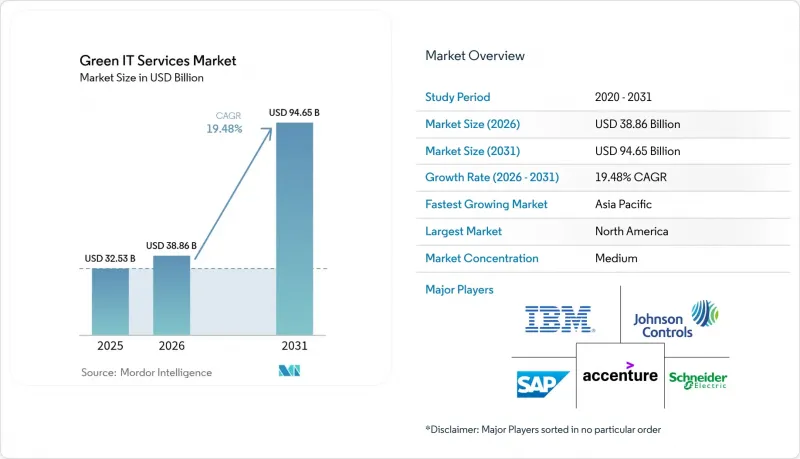
Mordor Intelligence에 의하면, 2026년 그린 IT 서비스 시장 규모는 388억 6,000만 달러로 추정되며, 2025년 325억 3,000만 달러에서 2031년에는 946억 5,000만 달러에 달할 것으로 예측됩니다.
또한 2026-2031년 연평균 성장률(CAGR)은 19.48%를 기록할 전망입니다.
본 보고서는 유형별(소프트웨어 및 서비스), 도입 모델별(On-Premise, 클라우드, 하이브리드), 조직 규모별(대기업 및 중소기업), 서비스 분야별(데이터센터 최적화 등), 최종 사용자 업종별(정부 기관, 은행, 금융서비스 및 보험(BFSI), IT 및 통신, 제조업 등), 그리고 지역별로 분류되어 있습니다. 시장 예측은 금액(달러)으로 표시되어 있습니다.
세계 그린 IT 서비스 시장 동향 및 인사이트
기업의 넷제로 목표 확대
포춘 500대 기업의 70% 이상이 2030년까지 탄소 중립을 달성하겠다고 공언하고 있으며, 이에 따라 CIO(최고정보책임자)들은 IT 조달 기준에 지속가능성 지표를 반영하고 있습니다. 금융 기관들은 이러한 추세를 더욱 강화하고 있으며, JP모건 체이스가 지속가능 금융에 2조 5,000억 달러를 투자하겠다고 약속함에 따라 사내 IT 팀은 탄소 효율이 높은 아키텍처를 우선시하고 있습니다. 경영진의 보상을 배출량 감축과 연계함으로써 측정 가능한 그린 IT 성과에 대한 수요가 높아지고 있으며, 지속가능성 플랫폼은 단순한 선택적 지출이 아닌 전략적 촉진요인으로서의 입지를 강화하고 있습니다. 기업들이 ESG 프레임워크와 디지털 로드맵을 조화시키는 가운데, 기존 시스템 환경에 배출량 분석 기능을 통합하는 서비스 제공업체들은 경쟁 우위를 확보하고 있습니다. 보고 주기가 공식적으로 확립되고 규정 위반에 대한 제재가 강화됨에 따라, 이러한 영향은 향후 3년 동안 정점에 달할 것으로 예측됩니다.
에너지 비용 상승이 ROI 산정을 가속화합니다.
2024년 유럽의 상업용 전력 가격은 2022년 이전 평균에 비해 40% 상승했으며, 그린 IT는 윤리적 노력에서 재무적 필수 사항으로 전환되고 있습니다. 도이치은행 등의 기업은 AI 기반 열 관리 시스템을 도입한 결과, 연간 1,500만 달러의 비용 절감을 실현하고 18개월도 채 되지 않아 투자 비용을 회수했습니다. CO2e 1톤당 80-100달러의 EU 배출권 거래 제도(EU ETS)를 비롯한 병행 탄소 가격 제도로 인해 효율적인 인프라와 기존 인프라 간의 비용 격차는 확대되고 있습니다. 가격 변동이 지속되는 가운데, CFO들은 현재 지속가능성 프로젝트를 순현재가치 관점에서 정량화하고 있으며, 이로 인해 전력 소비량(메가와트시)을 줄이는 워크로드 오케스트레이션 소프트웨어의 신속한 도입이 촉진되고 있습니다. 단기적인 성과에 힘입어 IT 자본 배분의 우선순위가 저탄소 자산으로 재편되고 있습니다.
높은 자본 요건이 도입의 장벽이 되고 있다.
에너지 효율이 높은 서버는 기존 모델보다 20-30% 더 비싸며, 중규모 데이터센터의 개보수에는 500만-1,000만 달러가 소요될 수 있어 중소기업의 예산을 압박할 가능성이 있습니다. 지속가능성 연계형 금융에 대한 접근이 제한적이어서 수익성 기준이 높아지고, 장비 교체 주기가 지연되고 있습니다. 클라우드 기반 구독 서비스를 통해 이러한 부담이 부분적으로 상쇄되기는 하지만, 많은 조직은 여전히 종합적인 현대화를 위한 자본 배분에 어려움을 겪고 있습니다. 금리 환경이 정상화되고 그린본드 시장이 성숙해짐에 따라, 자금 조달 방식의 혁신을 통해 이러한 제약이 완화될 것으로 예측됩니다.
부문 분석
2025년, 그린 IT 서비스 시장에서 서비스 부문은 64.58%의 점유율을 차지했으며, 이는 기업들이 지속가능성 로드맵 수립에 있어 컨설팅 주도의 접근 방식에 의존하고 있는 현실을 여실히 보여줍니다. 서비스 부문에는 On-Premise, 클라우드, 엣지 환경에 걸쳐 있는 복잡한 레거시 환경을 처리하기 위한 자문, 통합, 관리형 운영이 포함됩니다. 액센츄어와 같은 기업들은 탄소 분석을 전문으로 하는 전문 기업을 인수하여 전문 지식을 심화하고 역량의 폭을 넓히고 있습니다. 한편, 소프트웨어 분야는 표준화된 SaaS 플랫폼이 배출량 추적을 자동화하고 신속한 확장을 가능하게 함으로써 연평균 성장률(CAGR) 20.71%라는 기세로 급성장하고 있습니다. 구독 방식은 중소기업의 진입 장벽을 낮추고, 대상 수요를 확대하며, 예측 기간 동안 수익 구성을 정기적인 라이선스 수입으로 점진적으로 전환시키고 있습니다.
소프트웨어의 부상은 DevOps 파이프라인에 탄소 지능형 API를 통합하고, 도입 주기를 몇 달에서 몇 주로 단축하는 하이퍼스케일러 생태계에 의해서도 뒷받침되고 있습니다. 조기 도입 기업들은 감사 가능성의 향상과 IT 용량을 재생에너지 발전 시간대와 일치시키는 예측 분석의 유효성을 강조하고 있습니다. 규제 보고 템플릿이 통일됨에 따라, 규정 준수 양식이 미리 입력된 소프트웨어 모듈이 추가 지출을 창출하여 서비스 부문의 우위를 축소시키겠지만, 완전히 해소되지는 않을 것입니다.
2025년에는 기업들이 하이퍼스케일러의 재생에너지 활용 실적과 규모의 경제에 따른 효율성을 활용한 결과, 클라우드 도입이 매출의 50.15%를 차지했습니다. 클라우드 워크로드를 위한 그린 IT 서비스 시장 규모는 2025년에 163억 2,000만 달러에 달했습니다. 이는 계산 부하가 높은 작업이 탄소 배출 효율이 뛰어난 지역으로 광범위하게 이전되었음을 반영합니다. 그러나 하이브리드 아키텍처는 20.88%라는 가장 높은 연평균 성장률(CAGR)을 기록하며, 데이터 주권 및 지연 시간 요구 사항과 지속가능성 목표 간의 균형을 맞추고 있습니다.
하이브리드 전략에서는 일반적으로 기밀성이 높은 워크로드를 On-Premise 환경에 유지하면서, 분석 및 AI 기능을 그린 클라우드 영역으로 이전합니다. 제약 기업은 이러한 접근 방식의 대표적인 예로, 지적 재산의 보안을 확보하기 위해 로컬 데이터센터를 활용하고, 탄소 배출량 최적화를 위해 클라우드 분석을 활용하고 있습니다. 방위 산업 등 규제가 엄격한 업계에서는 여전히 On-Premise 구축이 이어지고 있습니다. 다만, 에너지 효율이 높은 장비와 마이크로그리드의 통합으로 경제성이 향상됨에 따라 그 점유율은 서서히 감소하고 있습니다.
지역별 분석
북미는 2025년 매출의 38.02%를 차지했습니다. 이는 연방 정부 기관 데이터센터의 배출량을 제한하는 환경보호청(EPA)의 지침과 기업의 자발적인 과학 기반 목표(SBT)에 힘입은 결과입니다. 『인플레이션 억제법』에 따른 세액 공제로 인해 청정 에너지 도입에 드는 자본 비용이 절감되어 중견 기업의 도입이 촉진되고 있습니다. 미국의 다국적 기업들은 확립된 재생에너지 크레딧(REC) 시장을 활용하여 규정 준수를 간소화하는 동시에 수출 경쟁력을 높이고 있습니다.
유럽은 성숙해 가면서도 계속 확대되고 있는 시장이며, 높은 전기 요금이 효율화 개조에 대한 투자 수익률(ROI)을 높이고 있습니다. EU의 ‘디지털 제품 여권’ 및 ‘CSRD(기업 지속가능성 보고 지침)’는 IT 하드웨어의 원산지 및 배출량에 대한 상세한 보고를 의무화하고 있어, 정교한 추적성 솔루션에 대한 수요를 견인하고 있습니다. 벤더 간의 차별화는 EU 택소노미 준수 및 ISO 14064 검증 서비스 제공에 점점 더 의존하고 있습니다. 동유럽 회원국에는 지속 가능한 디지털 인프라에 할당된 ‘결속 기금’이 배분되어 지역 내 도입이 확대되고 있습니다.
아시아태평양은 2031년까지 22.68%라는 가장 높은 연평균 성장률(CAGR)을 나타낼 전망입니다. 중국의 탄소 중립 선언과 에너지 집약도 상한선 설정으로 인해 레거시 데이터센터의 현대화가 가속화되는 한편, 인도의 재생에너지 입찰 및 생산 인센티브는 하이퍼스케일 투자를 유도하고 있습니다. 일본의 1,500억 달러 규모의 ‘그린 트랜스포메이션’ 프로그램은 저탄소 컴퓨팅에 보조금을 지급하고 있으며, 호주의 ‘세이프가드 메커니즘’은 클라우드 시설을 포함한 대규모 배출 사업자에 대한 기준선을 강화하고 있습니다. 남미 및 중동 및 아프리카는 여전히 신흥 시장이며, 스마트 시티 및 핀테크 프로젝트에 대한 외국인 직접 투자가 지역적 수요를 촉진하고 있지만, 정책 체계는 여전히 형성 단계에 있습니다.
기타 혜택:
- 엑셀 형식 시장 예측(ME) 시트
- 3개월간의 애널리스트 지원
자주 묻는 질문
목차
제1장 서론
제2장 조사 방법
제3장 주요 요약
제4장 시장 구도
제5장 시장 규모와 성장 예측
제6장 경쟁 구도
제7장 시장 기회와 향후 전망
LSH 26.09.08According to Mordor Intelligence, green IT services market size in 2026 is estimated at USD 38.86 billion, growing from 2025 value of USD 32.53 billion with 2031 projections showing USD 94.65 billion, growing at 19.48% CAGR over 2026-2031.
This report is Segmented by Type (Software and Services), Deployment Model (On-Premise, Cloud, and Hybrid), Organization Size (Large Enterprises and Small and Medium Enterprises), Service Area (Data Center Optimization, and More), End-User Vertical (Government, BFSI, IT and Telecom, Industrial, and More), and Geography. The Market Forecasts are Provided in Terms of Value (USD).
Global Green IT Services Market Trends and Insights
Growing Corporate Net-Zero Targets
More than 70% of Fortune 500 companies have committed to achieving carbon neutrality by 2030, prompting CIOs to embed sustainability metrics into their IT purchasing criteria. Financial institutions are deepening the trend; JPMorgan Chase has pledged USD 2.5 trillion for sustainable finance, prompting internal IT teams to favor carbon-efficient architectures. Linking executive compensation to emissions reductions intensifies demand for measurable green IT outcomes, positioning sustainability platforms as strategic enablers rather than discretionary spend. As firms harmonize ESG frameworks with digital roadmaps, service providers that integrate emissions analytics into existing stacks gain a competitive edge. The influence is expected to peak over the next three years as reporting cycles formalize and penalties for non-compliance escalate.
Rising Energy Costs Accelerate ROI Calculations
European commercial power prices were 40% higher in 2024 versus pre-2022 averages, converting green IT from an ethical pursuit to a financial imperative. Enterprises such as Deutsche Bank have realized USD 15 million in annual savings after deploying AI-based thermal management, which paid back in under 18 months. Parallel carbon-pricing regimes, including the EU ETS at USD 80-100 per ton CO2e, widen the cost gap between efficient and legacy infrastructure. As volatility persists, CFOs are now quantifying sustainability projects through net-present-value lenses, propelling the rapid adoption of workload orchestration software that reduces megawatt hours consumed. The near-term payoff re-orders IT capital-allocation priorities toward low-carbon assets.
High Capital Requirements Create Adoption Barriers
Energy-efficient servers cost 20-30% more than conventional models, while mid-sized data center retrofits can require USD 5-10 million, which can strain SME budgets. Limited access to sustainability-linked financing elevates hurdle rates, delaying refresh cycles. Cloud-based subscription services partially offset the burden, yet many organizations still struggle to allocate capital for holistic modernization. As interest-rate environments normalize and green-bond markets mature, financing innovations are expected to moderate this constraint.
Other drivers and restraints analyzed in the detailed report include:
- Strengthening Government Regulations Create Compliance-Driven Demand
- Rapid Growth of Hyperscale Data Centers Adopting Renewable PPAs
- Workforce Skills Gap Constrains Implementation Velocity
For complete list of drivers and restraints, kindly check the Table Of Contents.
Segment Analysis
Services commanded a 64.58% share of the Green IT services market in 2025, underscoring enterprises' reliance on consulting-led engagements for sustainability roadmap development. The services category encompasses advisory, integration, and managed operations that tackle complex legacy estates spanning on-premise, cloud, and edge environments. Players like Accenture have deepened their expertise through the acquisition of carbon analytics boutiques, reinforcing their capability breadth. Software, however, is surging at a 20.71% CAGR as standardized SaaS platforms automate emissions tracking and enable rapid scalability. Subscriptions lower entry barriers for SMEs, broaden the addressable demand, and gradually shift the revenue mix toward recurring licenses across the forecast horizon.
Software's ascent is also fueled by hyperscaler ecosystems that embed carbon-intelligent APIs into DevOps pipelines, thereby shrinking deployment cycles from months to weeks. Early adopters highlight improved auditability and predictive analytics that align IT capacity with renewable generation windows. As regulatory reporting templates converge, software modules that offer pre-populated compliance formats will capture incremental spend, narrowing but not erasing the services lead.
Cloud deployments accounted for 50.15% of revenue in 2025 as enterprises leveraged hyperscalers' renewable power footprints and economy-of-scale efficiencies. The Green IT services market size for cloud workloads reached USD 16.32 billion in 2025, reflecting widespread migration of compute-intensive tasks to carbon-optimal regions. Yet hybrid architectures record the fastest 20.88% CAGR, balancing data sovereignty and latency needs with sustainability objectives.
Hybrid strategies typically retain sensitive workloads in on-premise footprints while offloading analytics and AI functions to green cloud zones. Pharmaceutical firms exemplify this approach, leveraging local data centers for intellectual property security and cloud analytics for carbon optimization. On-premise deployments persist in regulated verticals, such as defense, although their share gradually declines as energy-efficient equipment and microgrid integrations improve economics.
Complete Report Scope:
- By Type
- Software
- Services
- By Deployment Model
- On-Premise
- Cloud
- Hybrid
- By Organization Size
- Large Enterprises
- Small and Medium Enterprises (SMEs)
- By Service Area
- Data Center Optimization
- Workplace and End-user Services
- Asset and Infrastructure Management
- Consulting and Integration
- Enterprise Resource Planning
- By End-user Vertical
- Government
- Banking, Financial Services and Insurance (BFSI)
- IT and Telecom
- Industrial
- Healthcare
- Other End-user Verticals
- By Geography
- North America
- United States
- Canada
- Mexico
- South America
- Brazil
- Argentina
- Rest of South America
- Europe
- Germany
- United Kingdom
- France
- Italy
- Spain
- Russia
- Rest of Europe
- Asia-Pacific
- China
- Japan
- India
- South Korea
- Rest of Asia-Pacific
- Middle East and Africa
- Middle East
- Saudi Arabia
- United Arab Emirates
- Turkey
- Rest of Middle East
- Africa
- South Africa
- Nigeria
- Rest of Africa
- Middle East
- North America
Geography Analysis
North America generated 38.02% of 2025 revenue, underpinned by Environmental Protection Agency guidelines that limit federal agency data center emissions and by voluntary corporate science-based targets. Tax credits in the Inflation Reduction Act lower capital costs for clean energy integration, bolstering uptake among medium-sized enterprises. U.S. multinationals leverage established renewable energy certificate markets, simplifying compliance and supporting export competitiveness.
Europe represents a mature yet expanding opportunity, where high electricity tariffs sharpen ROI on efficiency upgrades. The EU Digital Product Passport and CSRD compel detailed reporting on IT hardware provenance and emissions, driving demand for granular traceability solutions. Vendor differentiation increasingly hinges on EU taxonomy alignment and ISO 14064 verification services. Eastern European member states receive Cohesion Fund allocations earmarked for sustainable digital infrastructure, broadening regional adoption.
Asia-Pacific posts the fastest 22.68% CAGR to 2031. China's carbon-neutrality manifesto and energy-intensity caps trigger accelerated modernization of legacy data centers, while India's renewable auctions and production incentives attract hyperscale investments. Japan's USD 150 billion Green Transformation program subsidizes low-carbon computing, and Australia's Safeguard Mechanism tightens baselines for large emitters, including cloud facilities. South America and the Middle East & Africa remain emergent; foreign direct investment in smart-city and fintech projects catalyzes localized demand, though policy frameworks are still coalescing.
- Accenture plc
- Atos SE
- Capgemini SE
- Cognizant Technology Solutions Corporation
- Cisco Systems, Inc.
- Dell Technologies Inc.
- Fujitsu Limited
- Hitachi, Ltd.
- Hewlett Packard Enterprise Company
- IBM Corporation
- Infosys Limited
- Johnson Controls International plc
- NTT DATA Corporation
- SAP SE
- Schneider Electric SE
- Tata Consultancy Services Limited
- Wipro Limited
- Accuvio Sustainability Software Ltd.
- Dakota Software Corporation
- Sphera Solutions, Inc. (Enviance)
Additional Benefits:
- The market estimate (ME) sheet in Excel format
- 3 months of analyst support
TABLE OF CONTENTS
1 INTRODUCTION
- 1.1 Study Assumptions and Market Definition
- 1.2 Scope of the Study
2 RESEARCH METHODOLOGY
3 EXECUTIVE SUMMARY
4 MARKET LANDSCAPE
- 4.1 Market Overview
- 4.2 Market Drivers
- 4.2.1 Growing Corporate Net-Zero Targets
- 4.2.2 Rising Energy Costs Increasing ROI on Green IT
- 4.2.3 Strengthening Government Regulations on IT Emissions
- 4.2.4 Rapid Growth of Hyperscale DCs adopting Renewable PPAs
- 4.2.5 AI-Driven Real-Time Optimization
- 4.2.6 EU Digital Product Passport Mandates
- 4.3 Market Restraints
- 4.3.1 High Up-front Capex for Green IT Infrastructure
- 4.3.2 Lack of Skilled Workforce
- 4.3.3 Embedded-Carbon Accounting Complexity in Multi-cloud
- 4.3.4 Intermittent Renewable Supply vs IT Load Variability
- 4.4 Impact of Macroeconomic Factors
- 4.5 Industry Supply Chain Analysis
- 4.6 Regulatory Landscape
- 4.7 Technological Outlook
- 4.8 Porter's Five Forces Analysis
- 4.8.1 Bargaining Power of Suppliers
- 4.8.2 Bargaining Power of Buyers
- 4.8.3 Threat of New Entrants
- 4.8.4 Threat of Substitutes
- 4.8.5 Intensity of Competitive Rivalry
5 MARKET SIZE AND GROWTH FORECASTS (VALUE)
- 5.1 By Type
- 5.1.1 Software
- 5.1.2 Services
- 5.2 By Deployment Model
- 5.2.1 On-Premise
- 5.2.2 Cloud
- 5.2.3 Hybrid
- 5.3 By Organization Size
- 5.3.1 Large Enterprises
- 5.3.2 Small and Medium Enterprises (SMEs)
- 5.4 By Service Area
- 5.4.1 Data Center Optimization
- 5.4.2 Workplace and End-user Services
- 5.4.3 Asset and Infrastructure Management
- 5.4.4 Consulting and Integration
- 5.4.5 Enterprise Resource Planning
- 5.5 By End-user Vertical
- 5.5.1 Government
- 5.5.2 Banking, Financial Services and Insurance (BFSI)
- 5.5.3 IT and Telecom
- 5.5.4 Industrial
- 5.5.5 Healthcare
- 5.5.6 Other End-user Verticals
- 5.6 By Geography
- 5.6.1 North America
- 5.6.1.1 United States
- 5.6.1.2 Canada
- 5.6.1.3 Mexico
- 5.6.2 South America
- 5.6.2.1 Brazil
- 5.6.2.2 Argentina
- 5.6.2.3 Rest of South America
- 5.6.3 Europe
- 5.6.3.1 Germany
- 5.6.3.2 United Kingdom
- 5.6.3.3 France
- 5.6.3.4 Italy
- 5.6.3.5 Spain
- 5.6.3.6 Russia
- 5.6.3.7 Rest of Europe
- 5.6.4 Asia-Pacific
- 5.6.4.1 China
- 5.6.4.2 Japan
- 5.6.4.3 India
- 5.6.4.4 South Korea
- 5.6.4.5 Rest of Asia-Pacific
- 5.6.5 Middle East and Africa
- 5.6.5.1 Middle East
- 5.6.5.1.1 Saudi Arabia
- 5.6.5.1.2 United Arab Emirates
- 5.6.5.1.3 Turkey
- 5.6.5.1.4 Rest of Middle East
- 5.6.5.2 Africa
- 5.6.5.2.1 South Africa
- 5.6.5.2.2 Nigeria
- 5.6.5.2.3 Rest of Africa
- 5.6.5.1 Middle East
- 5.6.1 North America
6 COMPETITIVE LANDSCAPE
- 6.1 Market Concentration
- 6.2 Strategic Moves
- 6.3 Market Share Analysis
- 6.4 Company Profiles (includes Global level Overview, Market level overview, Core Segments, Financials as available, Strategic Information, Market Rank/Share for key companies, Products and Services, and Recent Developments)
- 6.4.1 Accenture plc
- 6.4.2 Atos SE
- 6.4.3 Capgemini SE
- 6.4.4 Cognizant Technology Solutions Corporation
- 6.4.5 Cisco Systems, Inc.
- 6.4.6 Dell Technologies Inc.
- 6.4.7 Fujitsu Limited
- 6.4.8 Hitachi, Ltd.
- 6.4.9 Hewlett Packard Enterprise Company
- 6.4.10 IBM Corporation
- 6.4.11 Infosys Limited
- 6.4.12 Johnson Controls International plc
- 6.4.13 NTT DATA Corporation
- 6.4.14 SAP SE
- 6.4.15 Schneider Electric SE
- 6.4.16 Tata Consultancy Services Limited
- 6.4.17 Wipro Limited
- 6.4.18 Accuvio Sustainability Software Ltd.
- 6.4.19 Dakota Software Corporation
- 6.4.20 Sphera Solutions, Inc. (Enviance)
7 MARKET OPPORTUNITIES AND FUTURE OUTLOOK
- 7.1 White-space and Unmet-need Assessment