

|
시장보고서
상품코드
2125539
필리핀의 ICT : 시장 점유율 분석, 업계 동향 및 통계, 성장 예측(2026-2031년)Philippines ICT - Market Share Analysis, Industry Trends & Statistics, Growth Forecasts (2026 - 2031) |
||||||
 Mordor Intelligence
Mordor Intelligence에 의하면, 필리핀의 ICT 시장 규모는 2025년에 272억 달러로 평가되었습니다. 2026년 301억 6,000만 달러에서 2031년까지 505억 3,000만 달러에 이를 것으로 예상되며, 예측 기간(2026-2031년) CAGR은 10.88%를 나타낼 전망입니다.
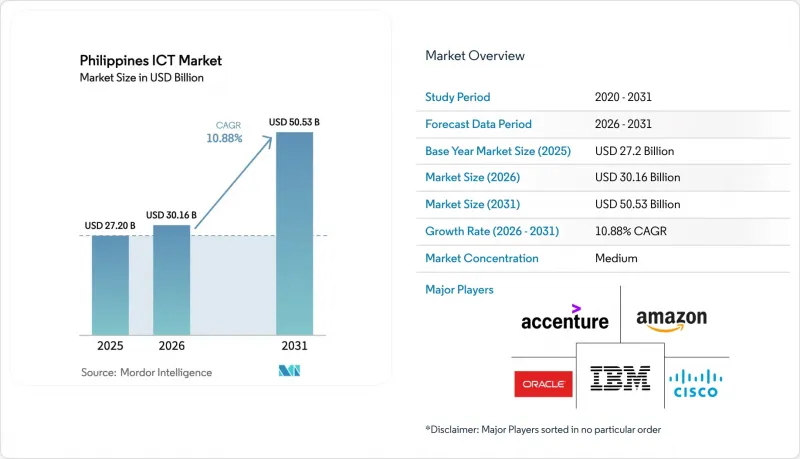
본 보고서는 제품 유형(IT 하드웨어, IT 소프트웨어, IT 서비스, IT 인프라, IT 보안, 통신 서비스), 기업 규모(중소기업, 대기업), 최종 사용자 업종(정부·공공 행정, 은행, 금융서비스 및 보험(BFSI), 에너지 및 유틸리티 등)별로 분류되어 있습니다. 시장 예측은 금액(달러)으로 표시되어 있습니다.
필리핀의 ICT 시장 동향 및 인사이트
급속한 5G 확산이 인프라 현대화를 주도
필리핀의 상용 ICT 시장에서는 Globe와 PLDT가 2025년에 공동으로 지리적으로 고립된 지역 및 소외 지역(GIDA) 내 5G 기지국 수를 100곳 이상 늘린 데 힘입어 네트워크 현대화가 가속화되고 있습니다. 중파 대역의 확대와 새로운 ‘Apricot’ 해저 케이블 덕분에 국제 통신 용량이 33% 증가했으며, 필리핀은 하이퍼스케일 트래픽의 중복화 허브로서의 입지를 확고히 하고 있습니다. 5G 프라이빗 네트워크는 광섬유 도입이 여전히 현실적이지 않은 물류, 광업, 정밀 농업 분야로 확대되고 있는 반면, 새로운 데이터센터 내에 코로케이션된 엣지 노드는 스마트 팩토리 분석에 필수적인 10밀리초 미만의 지연을 실현하고 있습니다. 각 통신 사업자들은 무선 비용 절감과 벤더 다각화를 도모하기 위해 오픈 RAN 도입도 시범적으로 추진하고 있으며, 장기적인 자본 효율 향상을 도모하고 있습니다. 이러한 노력들이 어우러져 국내 통신망에 깊이와 탄력성이 더해져 저지연 용도 구현이 가능해질 뿐만 아니라, 전 세계 클라우드 제공업체들에게 필리핀의 ICT 시장의 매력이 높아지고 있습니다.
정부의 e-Gov 마스터플랜이 공공 부문의 디지털화를 가속화
정보통신기술부는 e-Gov 목표를 달성하기 위해 이미 공공 서비스의 70%를 온라인화하고, 100만 건 이상의 디지털 서명을 발급했으며, 외딴 지역의 바랑가이에 438대의 VSAT 단말기를 도입했습니다. 각 부처가 데이터베이스를 소버린 클라우드로 이전함에 따라, 보안이 강화된 IaaS, SaaS, 통합 서비스에 대한 수요는 꾸준히 증가하고 있습니다. 토지 소유권 등록 및 보조금 지급에 블록체인을 활용한 조달 플랫폼이 시범 도입되고 있어, 전문 시스템 통합사업자에게 미래의 비즈니스 기회를 시사하고 있습니다. 한편, 프랑스, 싱가포르 및 다자간 파트너의 지원을 받는 ‘디지털 바야니한(Digital Bayanihan)’ 프로그램은 지방 공무원에게 기술 연수를 제공함으로써 장기적인 도입을 강화하고 있습니다. 이러한 노력은 필리핀 ICT 시장의 농촌 지역으로의 확산을 촉진하는 동시에, 벤더들에게 신뢰할 수 있는 공공 부문 수익원을 창출하고 있습니다.
만성적인 IT 인력 부족이 시장 성장을 저해
기술 분야 구직자 중 AI, 데이터 분석 또는 사이버 보안 분야의 채용 기준을 충족하는 사람은 10명 중 1명에 불과하며, 약 20만 개의 공석이 채워지지 않고 있습니다. TESDA(필리핀 기술교육 및 기술 개발청)는 2023년 이후 온라인 등록자 수를 3배로 늘렸지만, 주요 대학을 제외하면 인더스트리 4.0 장비를 실제로 다룰 기회는 여전히 제한적입니다. 기업 주도의 견습 제도는 전체 연수의 4% 미만에 그치고 있어, 필리핀의 ICT 시장이 고부가가치 프로젝트를 흡수하는 능력을 저해하고 있습니다. 필리핀 반도체 및 전자산업재단은 지역 내 인재 유출을 막기 위해 우대 조치 패키지와 5억 달러 규모의 기술 육성 기금 설립을 추진하고 있지만, 2027년까지는 그 효과가 나타날 전망이 낮습니다.
부문별 분석
2025년, 기업들이 클라우드 전환, AI 시범 운영, 프로세스 자동화를 위한 성과 기반 관리형 솔루션으로 자본 예산을 전환한 결과, IT 서비스는 필리핀의 ICT 시장 점유율의 27.42%를 차지했습니다. 국제적인 하이퍼스케일러들이 현지 통합 업체들과의 제휴를 심화하고, 통신 사업자들이 5G 지원 엣지 솔루션을 번들로 제공함에 따라, 이 부문의 지출은 2031년까지 하드웨어 지출을 상회할 것으로 예측됩니다. 동시에 랜섬웨어의 빈발과 새로운 데이터 개인정보 보호 지침으로 인해 IT 보안 분야가 가장 빠른 매출 성장률을 보이며 연평균 성장률(CAGR) 11.65%로 확대되고 있습니다.
하드웨어 분야의 성장세는 여전히 둔화되고 있습니다. 이는 반도체 조립 업계가 2023년부터 2024년까지 2년 연속 위축된 후, 2025년에는 매출 성장률이 1-2%에 그쳤기 때문입니다. 그럼에도 불구하고, 중국에서의 니어쇼어링과 전기차(EV) 부품에 대한 우대 조치로 인해 인쇄회로기판(PCB) 및 기판 제조 시설에 대한 투자가 재개되고 있어, 2027년 이후에는 하드웨어 부문의 기여도가 높아질 가능성이 있습니다. 통신 서비스 지출은 견조한 양상을 보이고 있으며, 대역폭 수요에 부응하기 위해 광섬유 및 위성 구축이 가속화되고 있어, 이를 통해 필리핀의 ICT 시장에서 상위 계층의 소프트웨어·플랫폼 수익을 뒷받침하는 기반이 강화되고 있습니다.
기타 혜택 :
- 엑셀 형식 시장 예측(ME) 시트
- 3개월간 애널리스트 지원
자주 묻는 질문
목차
제1장 서론
제2장 조사 방법
제3장 주요 요약
제4장 시장 구도
제5장 시장 규모 및 성장 예측
제6장 경쟁 구도
제7장 시장 기회 및 향후 전망
KTH 26.09.16According to Mordor Intelligence, the Philippines ICT market size was valued at USD 27.2 billion in 2025 and estimated to grow from USD 30.16 billion in 2026 to reach USD 50.53 billion by 2031, at a CAGR of 10.88% during the forecast period (2026-2031).
This report is Segmented by Product Type (IT Hardware, IT Software, IT Services, IT Infrastructure, IT Security, Communication Services), Enterprise Size (Small and Medium Enterprises, Large Enterprises), and End-User Industry Vertical (Government and Public Administration, BFSI, Energy and Utilities, and More). The Market Forecasts are Provided in Terms of Value (USD).
Philippines ICT Market Trends and Insights
Rapid 5G Rollout Drives Infrastructure Modernization
The commercial Philippines ICT market is accelerating network modernization as Globe and PLDT jointly surpassed 100 additional Geo-Isolated and Disadvantaged Area (GIDA) 5G sites in 2025. Expanded mid-band spectrum and the new Apricot subsea cable now lift international capacity 33%, positioning the country as a redundancy hub for hyperscale traffic. 5G private networks are extending to logistics, mining, and precision agriculture where fiber remains impractical, while edge nodes colocated within new data centers deliver sub-10 ms latency critical for smart-factory analytics. Carriers are also experimenting with open-RAN to drive down radio costs and diversify vendors, reinforcing long-run capital efficiency. Collectively, these activities are adding depth and resilience to national connectivity, enabling low-latency applications and boosting the Philippines ICT market's attractiveness to global cloud providers.
Government e-Gov Masterplan Accelerates Public-Sector Digitalization
The Department of Information and Communications Technology has already taken 70% of public services online, issued more than 1 million digital signatures, and deployed 438 VSAT terminals in remote barangays to fulfill e-Gov targets. As ministries migrate databases into sovereign clouds, demand for secure IaaS, SaaS, and integration services grows steadily. Procurement platforms leveraging blockchain for land titling and grant disbursement are being piloted, signaling future opportunities for specialist system integrators. Meanwhile, the Digital Bayanihan program backed by France, Singapore, and multilateral partners supplies skills training for local officials, thus reinforcing long-term adoption. These initiatives deepen the Philippines ICT market penetration into rural regions and produce a reliable public-sector revenue stream for vendors.
Persistent IT-Talent Shortage Constrains Market Growth
Only 1 in 10 technical applicants meets AI, data-analytics, or cybersecurity hiring thresholds, leaving an estimated 200,000 vacancies unfille. Although TESDA has tripled online enrollments since 2023, hands-on exposure to Industry 4.0 equipment remains scarce outside flagship universities. Enterprise-based apprenticeships account for less than 4% of total training, dampening the Philippines ICT market's ability to absorb high-value projects. The Semiconductor and Electronics Industries in the Philippines Foundation is lobbying for incentive packages and a USD 500 million skills fund to stave off regional talent leakage, but any impact is unlikely before 2027.
Other drivers and restraints analyzed in the detailed report include:
- Hyperscale Data-Center Investment Transforms Digital Infrastructure
- Digital-Payments Boom Reshapes Financial-Services ICT
- Rising Electricity Costs Threaten Data-Center Economics
For complete list of drivers and restraints, kindly check the Table Of Contents.
Segment Analysis
IT services controlled 27.42% of Philippines ICT market share in 2025 as enterprises shifted capital budgets toward outcome-based managed solutions for cloud migration, AI pilots, and process automation. The segment is forecast to outpace hardware spending through 2031 as international hyperscalers deepen partnerships with local integrators and telcos bundle 5G-enabled edge solutions. At the same time, IT security contributes the fastest incremental revenue, rising at an 11.65% CAGR thanks to ransomware frequency and new data-privacy directives.
The hardware slice remains subdued because the semiconductor assembly base posted just 1-2% top-line growth in 2025 after back-to-back contractions in 2023-2024. Nonetheless, near-shoring from China and incentives for electric-vehicle components are renewing investment in printed-circuit and substrate facilities that could lift hardware contributions after 2027. Communication-services spend is resilient as fiber and satellite deployments race to meet bandwidth demand, strengthening the Philippines ICT market's foundation for higher-layer software and platform revenues.
Complete Report Scope:
- By Product Type
- IT Hardware
- Computer Hardware
- Networking Equipment
- Peripherals
- IT Software
- IT Services
- IT Consulting and Implementation
- IT Outsourcing (ITO)
- Business Process Outsourcing (BPO)
- Managed Security Services
- Cloud and Platform Services
- IT Infrastructure
- IT Security/Cybersecurity
- Communication Services
- IT Hardware
- By Enterprise Size
- Small and Medium-sized Enterprises
- Large Enterprises
- By End-user Industry Vertical
- Government and Public Administration
- BFSI
- IT and Telecom
- Energy and Utilities
- Retail, E-commerce, and Logistics
- Manufacturing and Industry 4.0
- Healthcare and Life Sciences
- Oil and Gas
- Gaming and Esports
- Other Verticals
List of Companies Covered in this Report:
- Accenture plc
- Amazon.com Inc.
- Alphabet Inc. (Google)
- Cisco Systems Inc.
- Huawei Technologies Co. Ltd.
- International Business Machines Corporation
- Microsoft Corporation
- Oracle Corporation
- Cognizant Technology Solutions Corporation
- PLDT Inc.
- Globe Telecom Inc.
- Total Information Management Corporation
- Doa Alejandra Inc.
- CTO Phils Inc.
- P-Tech People and Technology Inc.
- Trend Micro Inc.
- Hewlett Packard Enterprise Company
- Dell Technologies Inc.
- Lenovo Group Limited
- SAP SE
Additional Benefits:
- The market estimate (ME) sheet in Excel format
- 3 months of analyst support
TABLE OF CONTENTS
1 INTRODUCTION
- 1.1 Study Assumptions and Market Definition
- 1.2 Scope of the Study
2 RESEARCH METHODOLOGY
3 EXECUTIVE SUMMARY
4 MARKET LANDSCAPE
- 4.1 Market Overview
- 4.2 Market Drivers
- 4.2.1 Rapid 5G roll out
- 4.2.2 Accelerated cloud adoption by SMEs
- 4.2.3 Government's e-Gov Masterplan 2022-2028
- 4.2.4 Surge in hyperscale data center investments
- 4.2.5 Digital payments boom via e-wallets
- 4.2.6 Growing tech startup ecosystem outside Metro Manila
- 4.3 Market Restraints
- 4.3.1 Last-mile connectivity gaps in rural provinces
- 4.3.2 Persistent IT talent shortage
- 4.3.3 Rising electricity costs impacting data centers
- 4.3.4 Cyber-extortion and ransomware incidents
- 4.4 Value Chain Analysis
- 4.5 Regulatory Landscape
- 4.6 Technological Outlook
- 4.7 Porter's Five Forces Analysis
- 4.7.1 Bargaining Power of Suppliers
- 4.7.2 Bargaining Power of Buyers
- 4.7.3 Threat of New Entrants
- 4.7.4 Threat of Substitutes
- 4.7.5 Intensity of Competitive Rivalry
- 4.8 Investment Analysis
- 4.9 Impact of Macroeconomic Factors
- 4.10 Industry Stakeholder Analysis
5 MARKET SIZE AND GROWTH FORECASTS (VALUE)
- 5.1 By Product Type
- 5.1.1 IT Hardware
- 5.1.1.1 Computer Hardware
- 5.1.1.2 Networking Equipment
- 5.1.1.3 Peripherals
- 5.1.2 IT Software
- 5.1.3 IT Services
- 5.1.3.1 IT Consulting and Implementation
- 5.1.3.2 IT Outsourcing (ITO)
- 5.1.3.3 Business Process Outsourcing (BPO)
- 5.1.3.4 Managed Security Services
- 5.1.3.5 Cloud and Platform Services
- 5.1.4 IT Infrastructure
- 5.1.5 IT Security/Cybersecurity
- 5.1.6 Communication Services
- 5.1.1 IT Hardware
- 5.2 By Enterprise Size
- 5.2.1 Small and Medium-sized Enterprises
- 5.2.2 Large Enterprises
- 5.3 By End-user Industry Vertical
- 5.3.1 Government and Public Administration
- 5.3.2 BFSI
- 5.3.3 IT and Telecom
- 5.3.4 Energy and Utilities
- 5.3.5 Retail, E-commerce, and Logistics
- 5.3.6 Manufacturing and Industry 4.0
- 5.3.7 Healthcare and Life Sciences
- 5.3.8 Oil and Gas
- 5.3.9 Gaming and Esports
- 5.3.10 Other Verticals
6 COMPETITIVE LANDSCAPE
- 6.1 Market Concentration
- 6.2 Strategic Moves
- 6.3 Market Share Analysis
- 6.4 Company Profiles (includes Global level Overview, Market level overview, Core Segments, Financials as available, Strategic Information, Market Rank/Share for key companies, Products and Services, and Recent Developments)
- 6.4.1 Accenture plc
- 6.4.2 Amazon.com Inc.
- 6.4.3 Alphabet Inc. (Google)
- 6.4.4 Cisco Systems Inc.
- 6.4.5 Huawei Technologies Co. Ltd.
- 6.4.6 International Business Machines Corporation
- 6.4.7 Microsoft Corporation
- 6.4.8 Oracle Corporation
- 6.4.9 Cognizant Technology Solutions Corporation
- 6.4.10 PLDT Inc.
- 6.4.11 Globe Telecom Inc.
- 6.4.12 Total Information Management Corporation
- 6.4.13 Doa Alejandra Inc.
- 6.4.14 CTO Phils Inc.
- 6.4.15 P-Tech People and Technology Inc.
- 6.4.16 Trend Micro Inc.
- 6.4.17 Hewlett Packard Enterprise Company
- 6.4.18 Dell Technologies Inc.
- 6.4.19 Lenovo Group Limited
- 6.4.20 SAP SE
- 6.5 Vendor Positioning Analysis
7 MARKET OPPORTUNITIES AND FUTURE OUTLOOK
- 7.1 White-space and Unmet-need Assessment


