
|
시장보고서
상품코드
2125685
중동의 데이터센터 건설 시장 : 점유율 분석, 업계 동향과 통계, 성장 예측(2026-2032년)Middle East Data Center Construction - Market Share Analysis, Industry Trends & Statistics, Growth Forecasts (2026 - 2032) |
||||||
 Mordor Intelligence
Mordor Intelligence에 의하면, 중동 데이터센터 건설 시장 규모는 2025년에 52억 4,000만 달러로 평가되었고 2026년 65억 1,000만 달러에서 2032년까지 238억 6,000만 달러에 이를 것으로 예측되며, 예측 기간(2026-2032년) CAGR은 24.18%를 나타낼 전망입니다.
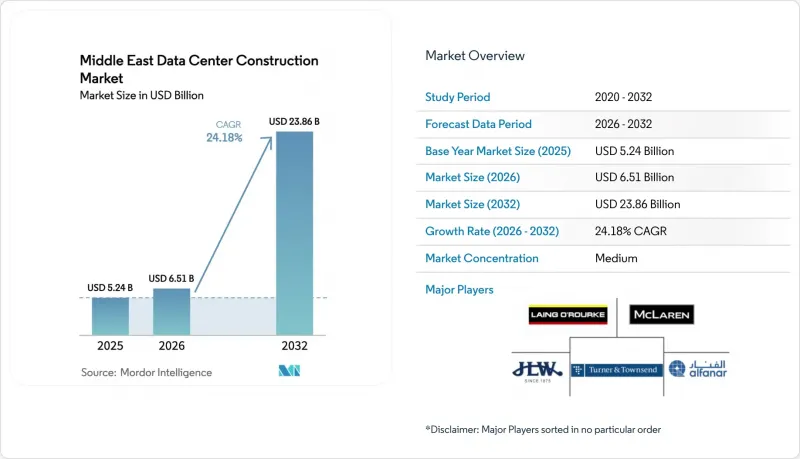
본 보고서는 인프라(전기 인프라, 기계 인프라, IT 인프라 등), 티어 유형(Tier I 및 Tier II, Tier III, Tier IV), 데이터센터 유형(코로케이션, 하이퍼스케일/자체 건설 등), 최종 사용자 산업(은행, 금융서비스 및 보험(BFSI), IT 및 통신, 정부 및 국방 등), 그리고 지역별로 분류되어 있습니다. 시장 예측은 금액(달러) 기준으로 제시되어 있습니다.
중동 데이터센터 건설 시장 동향 및 인사이트
하이퍼스케일 클라우드 및 AI 구축이 지역 인프라 변혁을 가속화하고 있습니다.
OpenAI와 G42의 5GW 규모 ‘Stargate UAE’ 캠퍼스 제휴로 인해 랙당 전력 밀도는 80kW로 높아졌으며, 액체 냉각이 표준 설계로 자리 잡았습니다. 마이크로소프트의 제로워터 기술은 사막 환경에서의 기계적 복잡성을 더욱 가중시키고 있습니다. 이러한 도입으로 인해 전기 서브시스템에 대한 수요가 증가하고 있으며, 중동 데이터센터 건설 시장은 차세대 고밀도 설계의 시험장으로서의 입지를 확고히 하고 있습니다.
정부의 디지털 경제 및 비전 프로그램이 자국 주도의 인프라 개발을 추진
사우디아라비아의 ‘세계 AI 허브 법’ 초안에는 국내 건설을 우선시하는 ‘데이터 대사관’에 관한 규정이 도입되었습니다. UAE와 오만에서도 유사한 움직임이 관찰되며, 조달 규정에 현지 조달 비율 기준이 포함되어 있습니다. 그 결과 발생하는 예측 가능한 수요 흐름이 장기적인 설비 투자를 뒷받침하며, 중동의 데이터센터 건설 시장을 디지털 정부 전략의 핵심 플랫폼으로 확고히 자리매김하고 있습니다.
송전망의 병목 현상과 디젤 설비 투자 비용 상승이 급속한 확장을 제약
송전망 업그레이드가 수요를 따라가지 못해, 사우디아라비아의 성장 회랑에서는 전력 공급 개시가 최대 18개월 지연되고 있습니다. 또한 철강 및 운송 비용의 급등으로 인해 디젤 백업 시스템 비용은 2024년 대비 35-40% 상승했습니다. 이러한 요인들로 인해 중동 데이터센터 건설 시장의 단기 프로젝트 착공이 둔화되고 있습니다.
부문 분석
GPU 클러스터 확대를 배경으로 전기 장비 매출이 증가하고 있으며, 전기 서브시스템의 연평균 성장률(CAGR)은 27.84%로 성장을 지속하고 있습니다. 랙당 40-80kW를 지원하는 개폐 장치, PDU, UPS 유닛은 룸 레이아웃을 전면적으로 개편하고 구조적 부하를 증가시키고 있습니다. 중동 데이터센터 건설 시장의 전기 시스템 시장 규모는 2032년까지 67억 2,000만 달러에 달할 것으로 예측됩니다. 액체 냉각 펌프의 통합으로 시설의 전력 소비량이 15-25% 증가함에 따라 기계 설비와 전기 설비의 경계가 모호해지고 있습니다. 이에 따라 서비스 제공업체들은 설계, 통합, 재생에너지에 관한 컨설팅을 턴키 방식의 제안에 포함시켜 중동 데이터센터 건설 시장에서 전문성을 더욱 강화하고 있습니다.
사막 지역에서는 견고한 냉각 시스템이 요구되기 때문에 여전히 기계 시스템이 최대 지출 비중을 차지하고 있습니다. 리어 도어 방식 열교환기와 직접 투 칩 루프의 급속한 보급으로 인해, 2025년 기계 시스템의 점유율은 37.55%를 유지하고 있습니다. 현재 프로젝트 설계에서는 매니폴드 배관이나 무게가 증가한 칠러에 대응하기 위해 화이트 스페이스의 높이에 여유를 두게 되어, 이로 인해 토목 비용이 증가하고 있습니다. 따라서 전기와 기계의 연계가 프로젝트의 중요 경로를 결정짓고, 중동 데이터센터 건설 시장 전체에서의 경쟁적 위치를 형성하고 있습니다.
Tier III는 99.982%의 가동률과 비용 관리의 균형을 도모함으로써 2025년에는 53.65%의 점유율을 차지했습니다. 그러나 은행 및 공공 부문 고객은 액티브-액티브 아키텍처를 채택하고 있어, 2032년까지 Tier IV 도입률이 연평균 성장률(CAGR) 21.72%로 성장할 전망입니다. Tier IV의 높은 기밀성과 듀얼 버스 방식의 전기 배선은 자본 지출(CAPEX)을 25-30% 끌어올리는 한편, 프리미엄 가격 책정을 가능하게 합니다. 규제 관련 및 핀테크 분야의 워크로드가 증가함에 따라, 중동 데이터센터 건설 시장에서 Tier IV의 점유율은 2032년까지 17.45%에 달할 전망입니다.
엣지 구축의 경우, 일반적으로 구축 속도를 높이기 위해 Tier II 셸이 선호됩니다. 모듈식 공급업체는 공장에서 구성 요소 인증을 수행하므로 현장 작업을 절반으로 줄이고 12주 만에 가동을 시작할 수 있게 합니다. 업타임 인스티튜트(Uptime Institute)의 인증은 여전히 조달의 필수 조건이며, 소규모 건설업체들은 전 세계 평가 기관과 협력할 수밖에 없습니다. 그러나 인증 대기 물량은 지역적인 기술 인력 부족을 여실히 드러내며, 중동 데이터센터 건설 시장에서 일부 Tier III 시설의 업그레이드를 지연시키고 있습니다.
기타 혜택:
- 엑셀 형식 시장 예측(ME) 시트
- 3개월간 애널리스트 지원
자주 묻는 질문
목차
제1장 서론
제2장 조사 방법
제3장 주요 요약
제4장 시장 구도
제5장 시장 규모와 성장 예측
제6장 경쟁 구도
제7장 시장 기회와 향후 전망
JHS 26.09.11According to Mordor Intelligence, the Middle East data center construction market size was valued at USD 5.24 billion in 2025 and estimated to grow from USD 6.51 billion in 2026 to reach USD 23.86 billion by 2032, at a CAGR of 24.18% during the forecast period (2026-2032).
This report is Segmented by Infrastructure (Electrical Infrastructure, Mechanical Infrastructure, IT Infrastructure, and More), Tier Type (Tier I and Tier II, Tier III, Tier IV), Data Center Type (Colocation, Hyperscale/Self-built, and More), End-User Industry (BFSI, IT and Telecommunications, Government and Defense, and More), and Geography. The Market Forecasts are Provided in Terms of Value (USD).
Middle East Data Center Construction Market Trends and Insights
Hyperscale Cloud and AI Build-outs Accelerate Regional Infrastructure Transformation
OpenAI's partnership with G42 on the 5 GW "Stargate UAE" campus pushes rack power densities toward 80 kW and makes liquid cooling a baseline design. Microsoft's zero-water technologies further widen mechanical complexity in desert settings . These deployments raise electrical subsystem demand and anchor the Middle East data center construction market as a testbed for next-generation high-density designs.
Government Digital-Economy and Vision Programs Drive Sovereign Infrastructure Development
Saudi Arabia's draft Global AI Hub Law introduces data-embassy provisions favoring in-country build-outs . Parallel moves in the UAE and Oman embed local-content thresholds in procurement rules. The resulting predictable demand stream underwrites long-horizon capital spending and cements the Middle East data center construction market as the core platform for digital-government strategies.
Grid-Power Bottlenecks and Diesel Capex Inflation Constrain Rapid Deployment
Transmission upgrades trail demand, postponing energization by up to 18 months in Saudi growth corridors. Diesel backup systems cost 35-40% more than in 2024 due to steel and transport premiums . These factors slow near-term project starts inside the Middle East data center construction market.
Other drivers and restraints analyzed in the detailed report include:
- 5G-Edge Latency Requirements Spur Distributed Site Development
- Utility-Scale Solar and Nuclear PPAs Transform Energy Economics
- Cooling-Water Scarcity and Wastewater Fees Drive Innovation Requirements
For complete list of drivers and restraints, kindly check the Table Of Contents.
Segment Analysis
Electrical equipment revenue rose behind growing GPU clusters, and electrical subsystems are on pace for a 27.84% CAGR. Switchgear, PDUs, and UPS units capable of 40-80 kW per rack reshape room layouts and lift structural loads. The Middle East data center construction market size for electrical systems is projected to reach USD 6.72 billion by 2032. Integration of liquid cooling pumps raises facility electrical consumption by 15-25%, blurring boundaries between mechanical and electrical trades. Service providers therefore bundle design, integration, and renewable-energy consulting into turnkey offers, deepening specialization inside the Middle East data center construction market.
Mechanical systems still absorb the largest spend because desert locations demand robust cooling. Rapid adoption of rear-door heat exchangers and direct-to-chip loops keeps mechanical share at 37.55% in 2025. Project designs now allocate extra white-space height for manifold routing and heavier chillers, increasing civil costs. Electrical and mechanical coordination thus defines project critical path and shapes competitive positioning throughout the Middle East data center construction market.
Tier III accounted for a 53.65% stake in 2025 by balancing 99.982% uptime with cost control. Banking and public-sector clients, however, push Tier IV uptake to a 21.72% CAGR to 2032 as they adopt active-active architectures. Tier IV's higher sealing and dual-bus electrical schemes uplift capex by 25-30% yet unlock premium pricing. The Middle East data center construction market share for Tier IV is poised to hit 17.45% by 2032 as regulatory and fintech workloads climb.
Edge deployments generally favor Tier II shells to speed roll-out. Modular vendors certify components in-factory, cutting site work by half and enabling 12-week go-live cycles. Uptime Institute certificates remain a procurement prerequisite, compelling smaller builders to partner with global assessors. Certification backlogs, however, accentuate the regional skills deficit and slow some Tier III upgrades inside the Middle East data center construction market.
Complete Report Scope:
- By Infrastructure
- Electrical Infrastructure
- Power Distribution Solutions
- Power Distribution Units
- Switchgears
- Others
- Power Backup Solutions
- UPS
- Generators
- Power Distribution Solutions
- Mechanical Infrastructure
- Cooling Systems
- Liquid-based Cooling
- Air-based Cooling
- Racks and Cabinets
- Other Mechanical Infrastructure
- Cooling Systems
- IT Infrastructure
- Servers
- Storage
- Other IT Infrastructure
- General Construction
- Services (Design and Consulting, Integration, Support and Maintenance)
- Electrical Infrastructure
- By Tier Type
- Tier I and Tier II
- Tier III
- Tier IV
- By Data Center Type
- Colocation
- Hyperscale / Self-built
- Enterprise / Edge / Modular
- By End-User Industry
- Banking, Financial Services and Insurance
- IT and Telecommunications
- Government and Defense
- Healthcare
- Other End Users
- By Geography
- United Arab Emirates
- Saudi Arabia
- Qatar
- Kuwait
- Rest of Middle East
List of Companies Covered in this Report:
- Khazna Data Centers
- Center3 (stc)
- e& (formerly Etisalat)
- Gulf Data Hub
- DataVolt
- Agility Data Centers
- Equinix Inc.
- Digital Realty
- Moro Hub (DEWA)
- Oman Data Park
- Al Ghazala Data Center (Mobily)
- SAPTCO / Quantum Switch Tamasuk
- Huawei Digital Power
- Schneider Electric
- ABB Ltd.
- ALEC Engineering & Contracting
- Nesma & Partners
- Orascom Construction
- Larsen & Toubro ME
- China State Construction ME
- Trojan Group
- AtkinsRealis (SNC-Lavalin)
- Turner Construction International
- AECOM Middle East
Additional Benefits:
- The market estimate (ME) sheet in Excel format
- 3 months of analyst support
TABLE OF CONTENTS
1 INTRODUCTION
- 1.1 Study Assumptions and Market Definition
- 1.2 Scope of the Study
2 RESEARCH METHODOLOGY
3 EXECUTIVE SUMMARY
4 MARKET LANDSCAPE
- 4.1 Market Overview
- 4.2 Market Drivers
- 4.2.1 Hyperscale cloud and AI build-outs accelerate
- 4.2.2 Government digital-economy and Vision programmes
- 4.2.3 5G-edge latency requirements spur local sites
- 4.2.4 Utility-scale solar and nuclear PPAs cut OPEX
- 4.2.5 Sovereign-wealth capital enabling build-to-suit funding
- 4.2.6 Red Sea/Gulf cable landings slash inter-continental latency
- 4.3 Market Restraints
- 4.3.1 Grid-power bottlenecks and diesel capex inflation
- 4.3.2 Cooling-water scarcity and wastewater fees
- 4.3.3 Shortfall of Tier III/IV certified technicians
- 4.3.4 Local-content and data-sovereignty procurement hurdles
- 4.4 Value / Supply-Chain Analysis
- 4.5 Regulatory Landscape
- 4.6 Technological Outlook
5 MARKET SIZE and GROWTH FORECASTS (VALUE)
- 5.1 By Infrastructure
- 5.1.1 Electrical Infrastructure
- 5.1.1.1 Power Distribution Solutions
- 5.1.1.1.1 Power Distribution Units
- 5.1.1.1.2 Switchgears
- 5.1.1.1.3 Others
- 5.1.1.2 Power Backup Solutions
- 5.1.1.2.1 UPS
- 5.1.1.2.2 Generators
- 5.1.1.1 Power Distribution Solutions
- 5.1.2 Mechanical Infrastructure
- 5.1.2.1 Cooling Systems
- 5.1.2.1.1 Liquid-based Cooling
- 5.1.2.1.2 Air-based Cooling
- 5.1.2.2 Racks and Cabinets
- 5.1.2.3 Other Mechanical Infrastructure
- 5.1.2.1 Cooling Systems
- 5.1.3 IT Infrastructure
- 5.1.3.1 Servers
- 5.1.3.2 Storage
- 5.1.3.3 Other IT Infrastructure
- 5.1.4 General Construction
- 5.1.5 Services (Design and Consulting, Integration, Support and Maintenance)
- 5.1.1 Electrical Infrastructure
- 5.2 By Tier Type
- 5.2.1 Tier I and Tier II
- 5.2.2 Tier III
- 5.2.3 Tier IV
- 5.3 By Data Center Type
- 5.3.1 Colocation
- 5.3.2 Hyperscale / Self-built
- 5.3.3 Enterprise / Edge / Modular
- 5.4 By End-User Industry
- 5.4.1 Banking, Financial Services and Insurance
- 5.4.2 IT and Telecommunications
- 5.4.3 Government and Defense
- 5.4.4 Healthcare
- 5.4.5 Other End Users
- 5.5 By Geography
- 5.5.1 United Arab Emirates
- 5.5.2 Saudi Arabia
- 5.5.3 Qatar
- 5.5.4 Kuwait
- 5.5.5 Rest of Middle East
6 COMPETITIVE LANDSCAPE
- 6.1 Market Share Analysis
- 6.2 Company Profiles (includes Global-level Overview, Market-level Overview, Core Segments, Financials as available, Strategic Information, Market Rank/Share, Products and Services, Recent Developments)
- 6.2.1 Khazna Data Centers
- 6.2.2 Center3 (stc)
- 6.2.3 e& (formerly Etisalat)
- 6.2.4 Gulf Data Hub
- 6.2.5 DataVolt
- 6.2.6 Agility Data Centers
- 6.2.7 Equinix Inc.
- 6.2.8 Digital Realty
- 6.2.9 Moro Hub (DEWA)
- 6.2.10 Oman Data Park
- 6.2.11 Al Ghazala Data Center (Mobily)
- 6.2.12 SAPTCO / Quantum Switch Tamasuk
- 6.2.13 Huawei Digital Power
- 6.2.14 Schneider Electric
- 6.2.15 ABB Ltd.
- 6.2.16 ALEC Engineering & Contracting
- 6.2.17 Nesma & Partners
- 6.2.18 Orascom Construction
- 6.2.19 Larsen & Toubro ME
- 6.2.20 China State Construction ME
- 6.2.21 Trojan Group
- 6.2.22 AtkinsRealis (SNC-Lavalin)
- 6.2.23 Turner Construction International
- 6.2.24 AECOM Middle East
7 MARKET OPPORTUNITIES and FUTURE OUTLOOK
- 7.1 White-space and Unmet-Need Assessment