

|
시장보고서
상품코드
2116370
북미의 자동차 엔진오일 시장 : 점유율 분석, 업계 동향과 통계, 성장 예측(2026-2031년)North America Automotive Engine Oils - Market Share Analysis, Industry Trends & Statistics, Growth Forecasts (2026 - 2031) |
||||||
 Mordor Intelligence
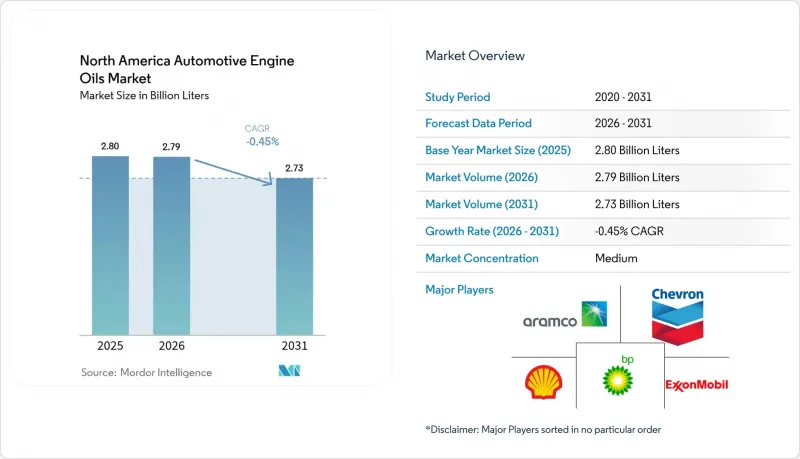
Mordor Intelligence에 의하면, 북미 자동차 엔진오일 시장 규모는 2025년 28억 리터에서 2026년에는 27억 9,000만 리터로 축소해, 2026년부터 2031년까지 CAGR -0.45%로 성장을 지속하여, 2031년에는 27억 3,000만 리터에 이를 것으로 예측됩니다.
본 보고서는 제품 유형(승용차용 엔진오일, 대형차용 엔진오일, 오토바이용 엔진오일), 기유(광유, 합성유, 반합성유, 바이오), 지역(미국, 캐나다, 멕시코)별로 분류되어 있습니다. 시장 예측은 수량(리터) 단위로 표시되어 있습니다.
북미 자동차 엔진오일 시장 동향 및 인사이트
CAFE 및 온실가스 규제 강화가 프리미엄 오일 수요를 견인
미국 환경보호청(EPA)의 온실가스 규제 3단계(Phase 3)에 따라,각 OEM사는 2045년까지 대형 차량의 CO2 배출량을 약 50% 감축해야 할 의무가 있으며, 이에 따라 각 윤활유 제조업체는 2026년에 저점도 PC-12 대형 차량용 오일을 상품화할 예정입니다. 이 오일은 차량군 시험에서 최대 3%의 연비 절감 효과를 발휘하는 것으로 확인되었습니다. 승용차용 ILSAC GF-7 규격의 유사한 효율화 요건에 따라, 고온 전단 안정성이 향상된 0W-16 및 0W-20 합성 오일에 대한 수요가 증가하고 있습니다. CITGARD의 시험을 통한 실측 데이터에 따르면, 차량이 15W-40에서 최적화된 10W-30 배합으로 전환할 경우 2.1%의 연비 개선이 확인되었습니다. 주 및 연방 정부의 탄소 배출 감축 정책이 조화를 이루면서 총 판매량은 감소 추세를 보이고 있지만, 규제 연쇄 효과로 인해 내구성을 중시하는 프리미엄 부문은 견조한 추세를 보이고 있습니다. 미국석유협회(API)의 새로운 내구성 시험에서 성능을 입증할 수 있는 블렌드 제조업체는 시장 점유율을 확보할 수 있는 유리한 입장에 있습니다.
OEM의 공장 충전용 합성유 채택으로 제품 구성이 일신
북미 자동차 제조업체들은 보증 기간 연장 및 터보차저 장착 엔진의 열 부하 요건을 충족하기 위해 공장 충전 오일에 합성유 사양을 도입하고 있습니다. 제너럴 모터스(GM)의 ‘dexos1 Gen3’ 사양에서는 슬러지 및 LSPI(저속 피크 점화)에 관한 제한이 더욱 엄격해졌으며, 신차에 0W-20 또는 5W-30 등급의 완전 합성유 사용이 사실상 표준화되었습니다. 대형차 부문에서는 주요 트럭 OEM 업체들이 현재 10W-30 FA-4 오일을 승인하고 있어, 이에 따라 애프터마켓에서의 보급이 가속화되고 있습니다. 엑슨모빌은 2030년까지 고부가가치 고성능 윤활유가 80% 성장할 것으로 예측하고 있으며, OEM과의 제휴를 지원하기 위해 PAO 생산량을 확대되고 있습니다. 합성 오일은 오일 교환 주기가 길어지는 상황에서도 높은 가격 구조를 유지하고 있어, 첨단 기유 생산 능력을 갖춘 공급업체의 매출 감소를 완화하고 있습니다.
BEV 및 하이브리드 차량의 보급 가속화가 오일 수요를 감소시킬 전망
2024년에는 플러그인 차량 판매 대수가 사상 최고치를 기록했으며, 에너지부는 2032년까지 전기차(EV)가 5,500만 대에 달하고, 석유 소비의 상당 부분을 대체할 것으로 예측했습니다. 하이브리드 차량도 여전히 윤활유가 필요하지만, 엔진이 간헐적으로 그리고 최적화된 부하 상태에서 작동하기 때문에 그 사용량은 줄어듭니다. 주 차원의 제로 배출 규제(캘리포니아주의 ‘Advanced Clean Cars II’가 대표적인 예입니다)로 인해 서비스 대상 시장은 더욱 축소되고 있습니다. e-액슬이나 열 관리용 새로운 작동유가 등장하고 있으며, ‘일생 충전형’ 설계와 오일 팬 용량 축소로 인해 이러한 수요는 기존 수요의 극히 일부에 그치고 있습니다.
부문 분석
승용차용 엔진오일은 현재 총 판매량의 62.75%를 차지하고 있지만, 전기차의 보급으로 인해 이 부문은 감소 추세를 보이고 있습니다. 북미 자동차 엔진오일 시장에서는 2019년부터 2024년까지 승용차용 엔진오일(PCMO)의 소비량이 정점을 기록했으나, 그 후 배터리 전용 차량의 점유율이 확대됨에 따라 판매량은 감소하기 시작했습니다. 이러한 축소 추세에도 불구하고, ILSAC GF-7을 준수하는 합성유는 계속해서 시장 점유율을 확대하고 있으며, 공급업체들은 매출을 유지하고 있습니다. Dexos1 Gen3 및 GF-7에 관한 OEM의 공장 충전 의무로 인해 딜러에서의 판매가 더욱 촉진되는 한편, 퀵루브 체인에서는 1회 서비스당 매출을 유지하기 위해 0W-20 풀 합성 오일을 업셀링하고 있습니다.
헤비 듀티용 엔진오일은 판매량(리터) 기준 2위를 차지하고 있으며, 연비 개선 프로그램으로 인해 판매량이 억제되고 있음에도 불구하고 화물 운송량 증가의 혜택을 받고 있습니다. 플릿을 대상으로 한 시범 테스트에서는 새로운 FA-4 10W-30 오일로 전환함으로써 1-4%의 연비 향상이 가능함이 입증되었으며, 이는 가격 프리미엄을 정당화하는 근거가 되고 있습니다. 예측 기간 동안 전기 오토바이,스쿠터, 전기 자전거의 보급이 확대됨에 따라 오토바이용 엔진오일의 감소 폭은 가장 작을 것이며, 연평균 성장률(CAGR)은 -0.35%에 그칠 것으로 예측됩니다. 배터리 수명, 충전 인프라 및 전반적인 성능의 향상으로 인해 전기 이륜차는 소비자에게 더욱 저렴하고 실용적이며 매력적인 선택지가 되고 있습니다.
기타 혜택:
- 엑셀 형식 시장 예측(ME) 시트
- 3개월간의 애널리스트 지원
자주 묻는 질문
목차
제1장 서론
제2장 조사 방법
제3장 주요 요약
제4장 시장 구도
제5장 시장 규모와 성장 예측
제6장 경쟁 구도
제7장 시장 기회와 향후 전망
제8장 CEO가 직면하는 중요 전략적 과제
JHS 26.08.28According to Mordor Intelligence, the North America automotive engine oils market size is expected to grow from 2.80 Billion Liters in 2025 to 2.79 Billion Liters in 2026 and is forecast to reach 2.73 Billion Liters by 2031 at -0.45% CAGR over 2026-2031.
This report is Segmented by Product Type (Passenger Car Motor Oil, Heavy Duty Motor Oil, and Motorcycle Engine Oil), Base Stock (Mineral, Synthetic, Semi-Synthetic, and Bio-Based), and Geography (United States, Canada, and Mexico). The Market Forecasts are Provided in Terms of Volume (Litres).
North America Automotive Engine Oils Market Trends and Insights
Tightening CAFE and GHG Regulations Drive Premium Oil Demand
The Environmental Protection Agency's Phase 3 greenhouse-gas program compels OEMs to cut heavy-duty CO2 by roughly 50% by 2045, prompting lubricant makers to commercialize lower-viscosity PC-12 heavy-duty oils in 2026 that can unlock up to 3% fuel savings in fleet trials. Similar efficiency imperatives under ILSAC GF-7 for passenger cars are driving demand for 0W-16 and 0W-20 synthetics, which offer improved high-temperature shear stability. Field data from CITGARD tests confirm a 2.1% fuel-economy gain when fleets switch from 15W-40 to optimized 10W-30 formulations. As state and federal carbon-reduction policies converge, the regulatory cascade secures a durable premium segment, even as aggregate volumes decline. Blenders able to validate performance under the American Petroleum Institute's new durability tests are positioned to capture share.
OEM Factory-Fill Synthetic Adoption Reshapes Product Mix
North American vehicle makers are embedding synthetic specifications in factory fill to meet warranty extensions and thermal load demands in turbocharged engines. General Motors' dexos1 Gen3 specification imposes tighter sludge and LSPI limits, effectively standardizing the use of full synthetic 0W-20 or 5W-30 in new cars. In the heavy-duty sector, leading truck OEMs are now approving 10W-30 FA-4 oils, which is accelerating aftermarket acceptance. ExxonMobil forecasts 80% growth in high-value performance lubricants by 2030 and is expanding PAO output to support OEM partnerships. Synthetics command a higher price-mix even as drain intervals lengthen, cushioning revenue decline for suppliers with advanced base-stock capacity.
Accelerating BEV and Hybrid Penetration Reduces Oil Demand
Plug-in sales reached new highs in 2024, and the Department of Energy projects 55 million EVs by 2032, displacing a substantial fraction of oil consumption. Hybrids still require lubricant, but at lower volumes because engines operate intermittently and at optimized loads. State-level zero-emission mandates-California's Advanced Clean Cars II being a notable example-further compress the serviceable market. While new fluids for e-axles and thermal management emerge, fill-for-life designs and smaller sump volumes render these a fraction of traditional demand.
Other drivers and restraints analyzed in the detailed report include:
- Rising Average Vehicle Age Boosts Aftermarket Consumption
- Growing Ride-Hailing and Last-Mile Delivery Miles
- Extended OEM Drain-Interval Recommendations
For complete list of drivers and restraints, kindly check the Table Of Contents.
Segment Analysis
Passenger car motor oil currently accounts for 62.75% of the total volume, yet the adoption of electric vehicles sets the segment on a downward slope. The North America automotive engine oils market recorded its peak PCMO consumption during 2019-2024, after which volumes started to shrink as battery-only cars expanded their share. Despite that contraction, synthetics aligned with ILSAC GF-7 continue to capture market share, allowing suppliers to defend their revenue. OEM factory-fill mandates for Dexos1 Gen3 and GF-7 spark stronger pull-through at dealerships, while quick-lube chains upsell 0W-20 full synthetic oils to maintain ticket size.
Heavy-duty motor oil ranks second by liters and benefits from freight growth, even as efficiency programs temper volume. Fleet pilots have shown that switching to new FA-4 10W-30 oils can unlock fuel-economy gains of 1-4%, supporting price premiums. Over the forecast period, motorcycle engine oil is expected to slip least, with a -0.35% CAGR, owing to the growing popularity of electric motorcycles, scooters, and e-bikes. Improvements in battery life, charging infrastructure, and overall performance have made electric two-wheelers a more affordable, practical, and attractive option for consumers.
Complete Report Scope:
- By Product Type
- Passenger Car Motor Oil (PCMO)
- 0W-XX
- 5W-XX
- 10W-XX
- 15W-XX
- Monogrades
- Other Grades
- Heavy Duty Motor Oil (HDMO)
- 0W-XX
- 5W-XX
- 10W-XX
- 15W-XX
- Monogrades
- Other Grades
- Motorcycle Engine Oil (MCO)
- 0W-XX
- 5W-XX
- 10W-XX
- 15W-XX
- Monogrades
- Other Grades
- Passenger Car Motor Oil (PCMO)
- By Base Stock
- Mineral
- Synthetic
- Semi-Synthetic
- Bio-Based
- By Geography
- United States
- Canada
- Mexico
List of Companies Covered in this Report:
- AMSOIL INC.
- BP plc
- Chevron Corporation
- CITGO Petroleum Lubricants
- Exxon Mobil Corporation
- FUCHS
- HollyFrontier (Petro-Canada Lubricants)
- Idemitsu Lubricants America
- Kendall Motor Oil
- LIQUI MOLY
- Lucas Oil Products, Inc.
- Motul
- Phillips 66 Lubricants
- Shell plc
- TotalEnergies
- Saudi Arabian Oil Co.
Additional Benefits:
- The market estimate (ME) sheet in Excel format
- 3 months of analyst support
TABLE OF CONTENTS
1 Introduction
- 1.1 Study Assumptions and Market Definition
- 1.2 Scope of the Study
2 Research Methodology
3 Executive Summary
4 Market Landscape
- 4.1 Market Overview
- 4.2 Market Drivers
- 4.2.1 Tightening CAFE and GHG regulations driving demand for low-viscosity, high-performance oils
- 4.2.2 OEM factory-fill shift toward synthetics and 0W-XX grades
- 4.2.3 Rising average vehicle age boosting aftermarket oil consumption
- 4.2.4 Growing ride-hailing and last-mile delivery fleet miles
- 4.2.5 ESG-driven uptake of re-refined base-oil blends
- 4.3 Market Restraints
- 4.3.1 Accelerating BEV and hybrid penetration lowering oil demand
- 4.3.2 Extended OEM drain-interval recommendations
- 4.3.3 Supply-chain pressure on API Group III/IV base stocks
- 4.4 Value Chain and Distribution Channel Analysis
- 4.5 Porter's Five Forces
- 4.5.1 Threat of New Entrants
- 4.5.2 Bargaining Power of Suppliers
- 4.5.3 Bargaining Power of Buyers
- 4.5.4 Threat of Substitutes
- 4.5.5 Industry Rivalry
- 4.6 Regulatory Framework
- 4.7 Automotive Industry Trends
5 Market Size and Growth Forecasts (Volume)
- 5.1 By Product Type
- 5.1.1 Passenger Car Motor Oil (PCMO)
- 5.1.1.1 0W-XX
- 5.1.1.2 5W-XX
- 5.1.1.3 10W-XX
- 5.1.1.4 15W-XX
- 5.1.1.5 Monogrades
- 5.1.1.6 Other Grades
- 5.1.2 Heavy Duty Motor Oil (HDMO)
- 5.1.2.1 0W-XX
- 5.1.2.2 5W-XX
- 5.1.2.3 10W-XX
- 5.1.2.4 15W-XX
- 5.1.2.5 Monogrades
- 5.1.2.6 Other Grades
- 5.1.3 Motorcycle Engine Oil (MCO)
- 5.1.3.1 0W-XX
- 5.1.3.2 5W-XX
- 5.1.3.3 10W-XX
- 5.1.3.4 15W-XX
- 5.1.3.5 Monogrades
- 5.1.3.6 Other Grades
- 5.1.1 Passenger Car Motor Oil (PCMO)
- 5.2 By Base Stock
- 5.2.1 Mineral
- 5.2.2 Synthetic
- 5.2.3 Semi-Synthetic
- 5.2.4 Bio-Based
- 5.3 By Geography
- 5.3.1 United States
- 5.3.2 Canada
- 5.3.3 Mexico
6 Competitive Landscape
- 6.1 Market Concentration
- 6.2 Strategic Moves
- 6.3 Market Share (%)**/Ranking Analysis
- 6.4 Company Profiles (includes Global level Overview, Market level overview, Core Segments, Financials as available, Production Capacity, Strategic Information, Market Rank/Share for key companies, Products and Services, and Recent Developments)
- 6.4.1 AMSOIL INC.
- 6.4.2 BP plc
- 6.4.3 Chevron Corporation
- 6.4.4 CITGO Petroleum Lubricants
- 6.4.5 Exxon Mobil Corporation
- 6.4.6 FUCHS
- 6.4.7 HollyFrontier (Petro-Canada Lubricants)
- 6.4.8 Idemitsu Lubricants America
- 6.4.9 Kendall Motor Oil
- 6.4.10 LIQUI MOLY
- 6.4.11 Lucas Oil Products, Inc.
- 6.4.12 Motul
- 6.4.13 Phillips 66 Lubricants
- 6.4.14 Shell plc
- 6.4.15 TotalEnergies
- 6.4.16 Saudi Arabian Oil Co.
7 Market Opportunities and Future Outlook
- 7.1 White-space and Unmet-need Assessment


