

|
시장보고서
상품코드
2116386
인도네시아의 자동차 엔진오일 : 시장 점유율 분석, 업계 동향 및 통계, 성장 예측(2026-2031년)Indonesia Automotive Engine Oils - Market Share Analysis, Industry Trends & Statistics, Growth Forecasts (2026 - 2031) |
||||||
 Mordor Intelligence
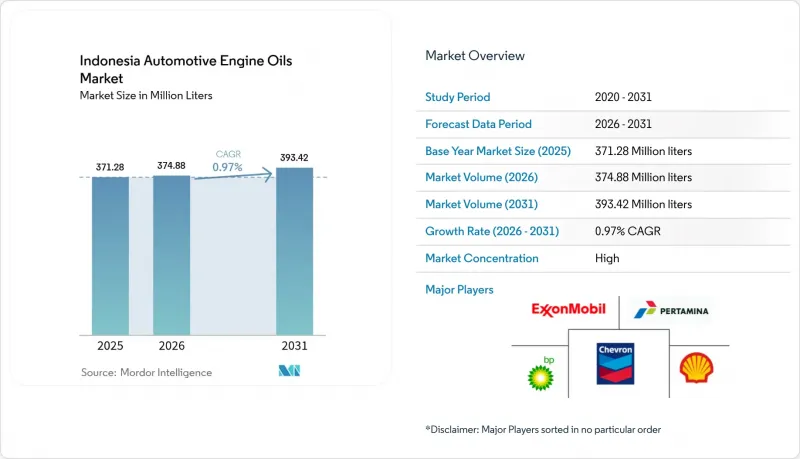
Mordor Intelligence에 의하면, 인도네시아의 자동차 엔진오일 시장 규모는 2025년에 3억 7,128만 리터로 평가되었습니다. 2026년 3억 7,488만 리터에서 2031년까지 3억 9,342만 리터에 이를 것으로 추정되고 예측 기간(2026-2031년) CAGR은 0.97%를 나타낼 전망입니다.
본 보고서는 제품 유형(승용차용 엔진오일, 모노그레이드, 대형차용 엔진오일, 오토바이용 엔진오일(MCO)) 및 베이스 오일(광물유, 합성유, 반합성유, 바이오베이스)별로 세분화되어 있습니다. 시장 예측은 수량(리터) 단위로 표시되어 있습니다.
인도네시아 자동차 엔진오일 시장 동향 및 인사이트
차량 보유 대수의 급증으로 수요 기반 확대
인도네시아의 차량 보유 대수는 1억 3,800만 대(이 중 오토바이가 1억 1,300만 대)에 달하며, 이는 비교할 수 없는 애프터마켓용 윤활유 비즈니스 기회를 창출하고 있습니다. 정부의 세제 혜택에 힘입어 2022년 2월 자동차 판매 대수는 8만 1,230대에 달하여 전년 동월 대비 65%의 급증세를 기록했습니다. 승용차와 이륜차 증가는 윤활유 교환 빈도 증가로 직결되는 한편, 새로운 유료 도로의 개통으로 평균 주행 거리도 늘어나고 있습니다. 이러한 요인으로 인해 인도네시아의 자동차 엔진오일 시장은 단순한 교체 수요에서 신규 차량 증가가 기존 차량의 폐차를 지속적으로 상회하는 상황 하에서 점진적인 판매량 확대 단계로 전환되고 있습니다.
OEM 사양은 고도의 배합으로 전환
세계 및 현지 자동차 제조업체들은 가솔린 엔진용으로 API SP 이상을 표준화하고, 열 관리와 연비를 최적화하기 위해 0W 또는 5W 등급을 권장하고 있습니다. 오토바이 용도의 경우 API SN으로의 전환이 늦어지고 있지만, 2027년까지는 이를 따를 것으로 예측됩니다. 모툴(Motul)을 비롯한 프리미엄 브랜드들은 향후 더욱 엄격해질 배기가스 규제에 대비하기 위해 이미 10W-30 및 10W-40 합성 오일을 권장하고 있습니다. 합성 오일 기술 분야에서 선점 우위를 누리고 있는 공급업체는 점도 변화에 대해 정비소에 대한 계몽 활동을 펼치면서 두 자릿수의 이익률 프리미엄을 달성할 수 있습니다. 소비자들은 더 뛰어난 저온 시동 보호 성능과 교환 주기 연장을 중시하고 있으며, 이로 인해 인도네시아 자동차 엔진오일 시장의 프리미엄화가 가속화되고 있습니다.
오일 교환 주기 연장이 소비 빈도 감소로 이어진다.
합성 오일은 1만킬로미터의 교환 주기를 지원하지만, 기존의 블렌드 오일은 5,000킬로미터에 그칩니다. 최신 저비용 친환경 차량의 경우, 공차가 엄격해지고 오일 팬이 소형화됨에 따라 1회 정비당 사용량이 감소하고 있습니다. 차량 관리자들은 1킬로미터당 수명 주기 비용이 낮아지고 1리터당 수익은 증가하는 반면, 절대적인 소비 리터 수가 감소하기 때문에 고가의 합성 오일을 선호하여 채택하고 있습니다. 오토바이의 경우, 오일 수명을 연장하는 순환 시스템 개선이 도입되었으나, 교통 체증으로 인한 스톱 앤 고(stop-and-go) 주행이 정비 주기 연장 효과를 일부 상쇄하고 있습니다.
부문별 분석
2025년, 인도네시아 자동차 엔진오일 시장에서 승용차용 엔진오일 시장 규모는 총 판매량의 63.62%를 차지했습니다. API SP 규격으로의 업그레이드 및 0W-20 점도 채택이 프리미엄화를 뒷받침하고 있습니다. OEM의 공장 충전 계약은 조기 판매량 확보와 브랜드 충성도를 가져오며, 이는 애프터마켓에도 파급되고 있습니다. 대형차용 엔진오일은 물류 및 농업 분야에서 사용되고 있으며, B40 대응 배합이 필수 조건이 되어가고 있습니다.
오토바이용 엔진오일의 판매량은 2031년까지 연평균 성장률(CAGR) 1.14%로 증가할 것으로 예측됩니다. 도시 지역에서의 지속적인 주행은 윤활유에 가해지는 부하를 높여, 교환 빈도 증가로 이어지고 있습니다. 자동 클러치 설계를 위한 JASO MB 규격은 차별화의 기회를 창출하고 있으며, 2025년 6월에 출시된 ‘쉘 어드밴스 시티 스쿠터’의 완전 합성유가 그 대표적인 예입니다. 가처분 소득 증가에 따라 라이더들은 광물유인 20W-50에서 반합성유인 10W-40으로 전환하고 있으며, 리터당 평균 매출액이 상승하고 있습니다.
기타 혜택 :
- 엑셀 형식 시장 예측(ME) 시트
- 3개월간의 애널리스트 지원
자주 묻는 질문
목차
제1장 서론
제2장 조사 방법
제3장 개요
제4장 시장 구도
제5장 시장 규모 및 성장 예측
제6장 경쟁 구도
제7장 시장 기회 및 향후 전망
제8장 CEO가 직면하는 중요한 전략적 과제
KTH 26.08.31According to Mordor Intelligence, the indonesian automotive engine oils market size was valued at 371.28 million liters in 2025 and estimated to grow from 374.88 million liters in 2026 to reach 393.42 million liters by 2031, at a CAGR of 0.97% during the forecast period (2026-2031).
This report is Segmented by Resin Type (Passenger Car Motor Oil, Monogrades, Heavy Duty Motor Oil, and Motorcycle Engine Oil (MCO)), Base Stock (Mineral, Synthetic, Semi-Synthetic, and Bio-Based). The Market Forecasts are Provided in Terms of Volume (Litres).
Indonesia Automotive Engine Oils Market Trends and Insights
Rapid Growth of Vehicle Parc Drives Base Demand
Indonesia's 138 million-unit vehicle population, including 113 million motorcycles, produces an unmatched aftermarket lubricant opportunity. Government tax incentives propelled car sales to 81,230 units in February 2022, a 65% year-on-year jump. More cars and two-wheelers translate directly into higher lubricant change frequencies, while new toll roads lengthen average kilometers traveled. These factors shift the Indonesian automotive engine oil market from pure replacement to incremental volume expansion as new vehicle additions consistently outrun fleet retirements.
OEM Specifications Shift Toward Advanced Formulations
Global and local automakers are standardizing on API SP or higher for gasoline engines and advocating 0W or 5W grades to optimize thermal management and fuel economy. Motorcycle applications lag at API SN but are expected to follow by 2027. Motul and other premium brands already promote 10W-30 and 10W-40 synthetics for future-proofing against tighter emission norms. Suppliers enjoying early-mover advantage in synthetic technology can achieve double-digit margin premiums while educating workshops on viscosity migration. Consumers gravitate toward better cold-start protection and extended service intervals, accelerating the premiumization of the Indonesia automotive engine oil market.
Lengthening Drain Intervals Reduce Consumption Frequency
Synthetic oils support 10,000-kilometer service intervals versus 5,000 kilometers for conventional blends. Newer low-cost green cars employ tighter tolerances and smaller sumps that cut per-service volumes. Fleet managers favor higher-priced synthetics because lifetime cost per kilometer falls, trimming absolute liters consumed even as revenue per liter rises. Motorcycles adopt improved circulation that extends oil life, yet congestion-induced stop-start driving partly offsets the interval expansion.
Other drivers and restraints analyzed in the detailed report include:
- Rising Motorcycle Ownership Sustains Volume Growth
- Government Incentives Accelerate Technology Adoption
- Electric Two-Wheelers Introduce Long-Term Displacement Risk
For complete list of drivers and restraints, kindly check the Table Of Contents.
Segment Analysis
The Indonesia automotive engine oil market size for passenger car motor oil accounted for 63.62% of the total volume in 2025. API SP upgrades and 0W-20 viscosity adoption underpin premiumization. OEM factory-fill contracts provide early volume security and brand loyalty that extend into the aftermarket. Heavy-duty motor oil serves logistics and agriculture, with B40-ready formulations becoming a prerequisite.
Motorcycle engine oil volume is projected to climb at a 1.14% CAGR through 2031. Continuous city riding elevates lubricant stress, supporting higher change frequencies. JASO MB specifications for automatic clutch designs create differentiation opportunities, illustrated by Shell Advance City Scooter's full-synthetic launch in June 2025. As disposable income rises, riders shift from mineral 20W-50 to semi-synthetic 10W-40, lifting average revenue per liter.
Complete Report Scope:
- By Product Type
- Passenger Car Motor Oil (PCMO)
- 0W-XX
- 5W-XX
- 10W-XX
- 15W-XX
- Monogrades
- Other Grades
- Heavy Duty Motor Oil (HDMO)
- 0W-XX
- 5W-XX
- 10W-XX
- 15W-XX
- Monogrades
- Other Grades
- Motorcycle Engine Oil (MCO)
- 0W-XX
- 5W-XX
- 10W-XX
- 15W-XX
- Monogrades
- Other Grades
- Passenger Car Motor Oil (PCMO)
- By Base Stock
- Mineral
- Synthetic
- Semi-Synthetic
- Bio-Based
List of Companies Covered in this Report:
- BP plc
- Chevron Corporation
- ENEOS Corporation
- Exxon Mobil Corporation
- FUCHS
- Gazpromneft-Lubricants Ltd.
- Idemitsu Kosan Co. Ltd.
- PETRONAS Lubricants International
- PT Pertamina
- PT Surganya Motor
- PT Wiraswasta Gemilang Indonesia
- Repsol
- Shell plc
- Sinopec Lubricant Co. Ltd.
- TOP 1 Oil Products Company
- TotalEnergies
Additional Benefits:
- The market estimate (ME) sheet in Excel format
- 3 months of analyst support
TABLE OF CONTENTS
1 Introduction
- 1.1 Study Assumptions and Market Definition
- 1.2 Scope of the Study
2 Research Methodology
3 Executive Summary
4 Market Landscape
- 4.1 Market Overview
- 4.2 Market Drivers
- 4.2.1 Rapid growth of vehicle parc
- 4.2.2 OEM push toward low-viscosity oils
- 4.2.3 Rising motorcycle ownership
- 4.2.4 Government incentives for cleaner engines
- 4.2.5 Ride-hailing fleet expansion
- 4.3 Market Restraints
- 4.3.1 Lengthening drain intervals
- 4.3.2 Uptake of electric two-wheelers
- 4.3.3 Counterfeit / adulterated lubricants
- 4.4 Value Chain and Distribution Channel Analysis
- 4.5 Porter's Five Forces
- 4.5.1 Threat of New Entrants
- 4.5.2 Bargaining Power of Suppliers
- 4.5.3 Bargaining Power of Buyers
- 4.5.4 Threat of Substitutes
- 4.5.5 Industry Rivalry
- 4.6 Regulatory Framework
- 4.7 Automotive Industry Trends
5 Market Size and Growth Forecasts (Volume)
- 5.1 By Product Type
- 5.1.1 Passenger Car Motor Oil (PCMO)
- 5.1.1.1 0W-XX
- 5.1.1.2 5W-XX
- 5.1.1.3 10W-XX
- 5.1.1.4 15W-XX
- 5.1.1.5 Monogrades
- 5.1.1.6 Other Grades
- 5.1.2 Heavy Duty Motor Oil (HDMO)
- 5.1.2.1 0W-XX
- 5.1.2.2 5W-XX
- 5.1.2.3 10W-XX
- 5.1.2.4 15W-XX
- 5.1.2.5 Monogrades
- 5.1.2.6 Other Grades
- 5.1.3 Motorcycle Engine Oil (MCO)
- 5.1.3.1 0W-XX
- 5.1.3.2 5W-XX
- 5.1.3.3 10W-XX
- 5.1.3.4 15W-XX
- 5.1.3.5 Monogrades
- 5.1.3.6 Other Grades
- 5.1.1 Passenger Car Motor Oil (PCMO)
- 5.2 By Base Stock
- 5.2.1 Mineral
- 5.2.2 Synthetic
- 5.2.3 Semi-Synthetic
- 5.2.4 Bio-Based
6 Competitive Landscape
- 6.1 Market Concentration
- 6.2 Strategic Moves
- 6.3 Market Share (%)/Ranking Analysis
- 6.4 Company Profiles (includes Global level Overview, Market level overview, Core Segments, Financials as available, Production Capacity, Strategic Information, Market Rank/Share for key companies, Products and Services, and Recent Developments)
- 6.4.1 BP plc
- 6.4.2 Chevron Corporation
- 6.4.3 ENEOS Corporation
- 6.4.4 Exxon Mobil Corporation
- 6.4.5 FUCHS
- 6.4.6 Gazpromneft-Lubricants Ltd.
- 6.4.7 Idemitsu Kosan Co. Ltd.
- 6.4.8 PETRONAS Lubricants International
- 6.4.9 PT Pertamina
- 6.4.10 PT Surganya Motor
- 6.4.11 PT Wiraswasta Gemilang Indonesia
- 6.4.12 Repsol
- 6.4.13 Shell plc
- 6.4.14 Sinopec Lubricant Co. Ltd.
- 6.4.15 TOP 1 Oil Products Company
- 6.4.16 TotalEnergies
7 Market Opportunities and Future Outlook
- 7.1 White-space and Unmet-need Assessment


