

|
시장보고서
상품코드
2116373
유럽의 자동차 엔진오일 시장 : 점유율 분석, 업계 동향과 통계, 성장 예측(2026-2031년)Europe Automotive Engine Oils - Market Share Analysis, Industry Trends & Statistics, Growth Forecasts (2026 - 2031) |
||||||
 Mordor Intelligence
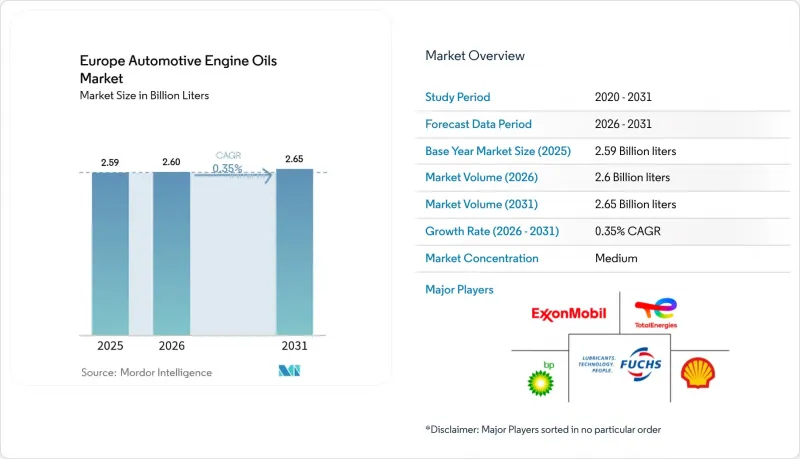
Mordor Intelligence에 의하면, 2026년 유럽 자동차 엔진오일 시장 규모는 26억 리터로 추정되고 있어 2025년 25억 9,000만 리터에서 확대해, 2031년 예측은 26억 5,000만 리터가 될 전망입니다.
2026년부터 2031년까지 연평균 성장률(CAGR) 0.35%로 성장할 것으로 전망됩니다.
본 보고서는 제품 유형(승용차용 엔진오일, 대형차용 엔진오일, 오토바이용 엔진오일), 베이스 오일(광물유, 합성유, 반합성유, 바이오), 지역(독일, 영국, 프랑스, 이탈리아, 스페인, 북유럽 국가, 러시아, 기타 유럽)별로 분류되어 있습니다. 시장 전망은 수량(리터) 기준으로 제시되어 있습니다.
유럽 자동차 엔진오일 시장 동향 및 인사이트
유럽연합(EU)의 CO₂ 배출량 및 연비 목표가 저점도 배합을 촉진
향후 도입될 모든 차종을 대상으로 한 CO2 배출량 상한선으로 인해, 자동차 제조업체들은 측정 가능한 연비 향상을 실현하는 초저점도 0W-20, 나아가 0W-16 등급의 채택을 불가피하게 하고 있습니다. 폭스바겐은 2025년에 TSI 엔진 제품군 전체를 0W-20 초기 충전 오일로 전환할 예정이며, 이에 따라 애프터마켓 정비 공장에서는 그룹 III 및 폴리아알파올레핀 함량이 높은 첨단 합성 오일의 재고 확보가 진행되고 있습니다. 점도가 높은 5W-30이나 10W-40 오일은 점도-온도 특성의 목표를 충족할 수 없기 때문에 저점도 등급에는 20-30%의 가격 프리미엄이 붙습니다. 이러한 규제로 인해 유럽의 자동차 엔진오일 시장에서는 고성능 베이스 오일 및 프리미엄 첨가제 패키지에 대한 수요가 증가하는 반면, 기존 등급은 상품화가 진행되고 있습니다.
노후화된 내연기관 차량(ICE)의 보유 대수가 오일 교환량을 뒷받침하고 있습니다.
2024년, 독일 승용차의 평균 차령은 10.1년에 달했으며, 프랑스, 이탈리아, 스페인에서도 유사한 추세가 관찰됩니다. 오래된 엔진은 오일 교환 빈도가 높고, 기존 또는 반합성 오일 배합으로도 문제가 없기 때문에 전동화로 인한 수요 감소분을 상쇄하고 있습니다. 차량이 보증 기간을 넘기면 독립 정비소가 이 교체 사업의 더 큰 점유율을 확보하게 되므로, 신차의 전동화가 진행되고 있음에도 불구하고 유럽 자동차 엔진오일 시장의 윤활유 기본 수요는 유지되고 있습니다.
BEV의 보급 가속화로 인해 장기적으로는 내연기관 차량의 대수가 감소할 전망
2024년, 유럽의 신차 등록 대수 중 배터리식 전기차(BEV)의 비율은 14.6%를 나타낼 것이며, 2035년까지 운행 중인 차량 총수에서 차지하는 비율이 30%를 넘어설 가능성이 있습니다. 북유럽 시장에서는 이미 윤활유 판매량이 감소하고 있어, 내연기관 수요에 크게 의존하고 있는 공급업체들에게는 향후 압박이 예상됩니다. 전동화 관련 유체로 다각화가 진행되지 않고 있는 유럽 자동차 엔진오일 시장의 참여 기업들에게 이 같은 축소 위험은 가장 심각한 문제가 될 것입니다.
부문 분석
2025년, 유럽 자동차 엔진오일 시장에서 승용차용 엔진오일(PCMO)은 60.72%의 점유율을 차지했습니다. PCMO의 판매량은 2억 5,000만 대에 달하는 승용차 보유 대수의 혜택을 받고 있지만, 주행 거리의 회복이 차량의 전동화로 인해 상쇄되고 있어 성장은 정체 상태를 이어가고 있습니다. 프리미엄 완전 합성유인 0W-20 및 0W-16의 배합으로 오일 교환 주기가 30,000킬로미터까지 연장되어, 각 OEM 업체들은 엔진을 보호하면서도 낮은 소유 비용을 어필할 수 있게 되었습니다. 유통 분야에서는 독립 정비 공장이 주도적인 역할을 하고 있지만, OEM의 승인이 필수적인 고수익률의 공장 충전 사업의 경우, 정식 딜러 채널이 계속해서 주도권을 잡고 있습니다.
오토바이용 엔진오일은 2031년까지 0.92%라는 가장 높은 연평균 성장률(CAGR)을 보일 것으로 예측됩니다. 도시 지역의 교통 정체, 라스트 마일 배송, 레저 목적의 주행이 특히 이탈리아, 스페인, 프랑스에서 이륜차 수요를 끌어올리고 있습니다. 고성능 오토바이에는 전단 안정성, 습식 클러치와의 호환성, 내열성을 갖춘 JASO MA2 규격의 오일이 필요하며, 이것이 프리미엄 가격 책정을 뒷받침하고 있습니다. 유럽 자동차 엔진오일 시장에서 딜러 네트워크를 구축하고 레이싱 이벤트를 후원하는 시장 진출기업들은 리터당 가격이 비싸더라도 이를 기꺼이 수용하는 애호가층으로부터 브랜드 충성도를 확보하고 있습니다.
기타 혜택:
- 엑셀 형식 시장 예측(ME) 시트
- 3개월간의 애널리스트 지원
자주 묻는 질문
목차
제1장 서론
제2장 조사 방법
제3장 주요 요약
제4장 시장 구도
제5장 시장 규모와 성장 예측
제6장 경쟁 구도
제7장 시장 기회와 향후 전망
제8장 CEO가 직면하는 중요 전략적 과제
JHS 26.08.28According to Mordor Intelligence, the european automotive engine oils market size in 2026 is estimated at 2.6 billion liters, growing from 2025 value of 2.59 billion liters with 2031 projections showing 2.65 billion liters, growing at 0.35% CAGR over 2026-2031.
This report is Segmented by Product Type (Passenger Car Motor Oil, Heavy Duty Motor Oil, and Motorcycle Engine Oil), Base Stock (Mineral, Synthetic, Semi-Synthetic, and Bio-Based), and Geography (Germany, United Kingdom, France, Italy, Spain, Nordic Countries, Russia, and Rest of Europe). Market Forecasts are Provided in Terms of Volume (Litres).
Europe Automotive Engine Oils Market Trends and Insights
European Union CO2 and Fuel-Economy Targets Push Low-Viscosity Formulations
Upcoming fleetwide CO2 caps compel automakers to specify ultra-thin 0W-20 and even 0W-16 grades that deliver measurable fuel-efficiency gains. Volkswagen shifted its entire TSI engine family to 0W-20 service fills in 2025, prompting aftermarket workshops to stock advanced synthetics with high Group III and poly-alpha-olefin content. Low-viscosity grades command 20-30% price premiums because heavier 5W-30 and 10W-40 oils cannot meet viscosity-temperature targets. The mandate boosts Europe automotive engine oils market demand for high-performance base stocks and premium additive packages while commoditizing legacy grades.
Aging ICE Vehicle Parc Sustains Oil-Change Volumes
The average German passenger car age climbed to 10.1 years in 2024, and similar trends appear across France, Italy, and Spain. Older engines require more frequent oil changes and tolerate conventional or semi-synthetic formulations, offsetting volume lost to electrification. Independent workshops capture a larger share of this replacement business as vehicles exit warranty coverage, thereby maintaining baseline lubricant demand in the Europe automotive engine oils market even as new-car electrification rises.
Accelerating BEV Penetration Shrinks Long-Term ICE Pool
Battery-electric vehicles captured 14.6% of European new-car registrations in 2024, and the share could exceed 30% of the rolling fleet by 2035. Nordic markets already display lubricant volume contraction, signaling future pressure for suppliers heavily exposed to internal-combustion demand. The contraction risk looms largest for the Europe automotive engine oils market participants lacking diversification into electrification-adjacent fluids.
Other drivers and restraints analyzed in the detailed report include:
- OEM Specification Proliferation Drives Premium Synthetics
- Waste-Oil Regeneration Quotas Spur Re-Refined Base-Oil Demand
- Volatile Crude and Additive Supply Costs Pressure Margins
For complete list of drivers and restraints, kindly check the Table Of Contents.
Segment Analysis
Passenger Car Motor Oil held 60.72% of the European automotive engine oils market in 2025. PCMO volumes benefit from a 250 million-unit passenger car fleet, yet growth remains flat as fleet electrification offsets miles-driven recovery. Premium fully synthetic 0W-20 and 0W-16 formulations extend drain intervals to 30,000 kilometers, allowing OEMs to advertise lower ownership costs while still protecting engines. Independent garages lead distribution, but authorized dealer channels retain high-margin factory-fill business where OEM approvals remain non-negotiable.
Motorcycle Engine Oil is expected to post the fastest 0.92% CAGR through 2031. Urban congestion, last-mile delivery, and recreational riding boost two-wheeler demand, especially in Italy, Spain, and France. High-performance motorcycles require JASO MA2 oils with shear stability, wet-clutch compatibility, and thermal resilience, driving premium pricing. Europe automotive engine oils market participants that cultivate dealer networks and sponsor racing events capture brand loyalty among enthusiasts who accept higher per-liter prices.
Complete Report Scope:
- By Product Type
- Passenger Car Motor Oil (PCMO)
- 0W-XX
- 5W-XX
- 10W-XX
- 15W-XX
- Monogrades
- Other Grades
- Heavy Duty Motor Oil (HDMO)
- 0W-XX
- 5W-XX
- 10W-XX
- 15W-XX
- Monogrades
- Other Grades
- Motorcycle Engine Oil (MCO)
- 0W-XX
- 5W-XX
- 10W-XX
- 15W-XX
- Monogrades
- Other Grades
- Passenger Car Motor Oil (PCMO)
- By Base Stock
- Mineral
- Synthetic
- Semi-Synthetic
- Bio-Based
- By Geography
- Germany
- United Kingdom
- France
- Italy
- Spain
- Nordic Countries
- Russia
- Rest of Europe
List of Companies Covered in this Report:
- ADDINOL
- BP plc
- Chevron Corporation
- Eni S.p.A.
- Exxon Mobil Corporation
- FUCHS
- Gazprom
- Idemitsu Kosan Co., Ltd.
- LIQUI MOLY
- LUKOIL
- Millers Oils LTD
- MOTOREX
- Motul
- Neste
- PETRONAS Lubricants International
- Phillips 66 Company.
- Ravensberger Schmierstoffvertrieb GmbH
- Repsol
- Shell plc
- TotalEnergies
- Valvoline Global Operations
Additional Benefits:
- The market estimate (ME) sheet in Excel format
- 3 months of analyst support
TABLE OF CONTENTS
1 Introduction
- 1.1 Study Assumptions and Market Definition
- 1.2 Scope of the Study
2 Research Methodology
3 Executive Summary
4 Market Landscape
- 4.1 Market Overview
- 4.2 Market Drivers
- 4.2.1 European Union CO2 and fuel-economy targets push low-viscosity formulations
- 4.2.2 Aging ICE vehicle parc sustains oil-change volumes
- 4.2.3 OEM specification proliferation drives premium synthetics
- 4.2.4 Hybrid-vehicle growth needs low-ash, low-viscosity oils
- 4.2.5 Waste-oil regeneration quotas spur re-refined base-oil demand
- 4.3 Market Restraints
- 4.3.1 Accelerating BEV penetration shrinks long-term ICE pool
- 4.3.2 Volatile crude and additive supply costs pressure margins
- 4.3.3 OEM lifetime-fill and sensors extend drain intervals
- 4.4 Value Chain and Distribution Channel Analysis
- 4.5 Porter's Five Forces
- 4.5.1 Threat of New Entrants
- 4.5.2 Bargaining Power of Suppliers
- 4.5.3 Bargaining Power of Buyers
- 4.5.4 Threat of Substitutes
- 4.5.5 Industry Rivalry
- 4.6 Regulatory Framework
- 4.7 Automotive Industry Trends
5 Market Size and Growth Forecasts (Volume)
- 5.1 By Product Type
- 5.1.1 Passenger Car Motor Oil (PCMO)
- 5.1.1.1 0W-XX
- 5.1.1.2 5W-XX
- 5.1.1.3 10W-XX
- 5.1.1.4 15W-XX
- 5.1.1.5 Monogrades
- 5.1.1.6 Other Grades
- 5.1.2 Heavy Duty Motor Oil (HDMO)
- 5.1.2.1 0W-XX
- 5.1.2.2 5W-XX
- 5.1.2.3 10W-XX
- 5.1.2.4 15W-XX
- 5.1.2.5 Monogrades
- 5.1.2.6 Other Grades
- 5.1.3 Motorcycle Engine Oil (MCO)
- 5.1.3.1 0W-XX
- 5.1.3.2 5W-XX
- 5.1.3.3 10W-XX
- 5.1.3.4 15W-XX
- 5.1.3.5 Monogrades
- 5.1.3.6 Other Grades
- 5.1.1 Passenger Car Motor Oil (PCMO)
- 5.2 By Base Stock
- 5.2.1 Mineral
- 5.2.2 Synthetic
- 5.2.3 Semi-Synthetic
- 5.2.4 Bio-Based
- 5.3 By Geography
- 5.3.1 Germany
- 5.3.2 United Kingdom
- 5.3.3 France
- 5.3.4 Italy
- 5.3.5 Spain
- 5.3.6 Nordic Countries
- 5.3.7 Russia
- 5.3.8 Rest of Europe
6 Competitive Landscape
- 6.1 Market Concentration
- 6.2 Strategic Moves
- 6.3 Market Share (%)/Ranking Analysis
- 6.4 Company Profiles (includes Global level Overview, Market level overview, Core Segments, Financials as available, Production Capacity, Strategic Information, Market Rank/Share for key companies, Products and Services, and Recent Developments)
- 6.4.1 ADDINOL
- 6.4.2 BP plc
- 6.4.3 Chevron Corporation
- 6.4.4 Eni S.p.A.
- 6.4.5 Exxon Mobil Corporation
- 6.4.6 FUCHS
- 6.4.7 Gazprom
- 6.4.8 Idemitsu Kosan Co., Ltd.
- 6.4.9 LIQUI MOLY
- 6.4.10 LUKOIL
- 6.4.11 Millers Oils LTD
- 6.4.12 MOTOREX
- 6.4.13 Motul
- 6.4.14 Neste
- 6.4.15 PETRONAS Lubricants International
- 6.4.16 Phillips 66 Company.
- 6.4.17 Ravensberger Schmierstoffvertrieb GmbH
- 6.4.18 Repsol
- 6.4.19 Shell plc
- 6.4.20 TotalEnergies
- 6.4.21 Valvoline Global Operations
7 Market Opportunities and Future Outlook
- 7.1 White-space and Unmet-need Assessment


