

|
시장보고서
상품코드
2116389
베트남의 자동차 엔진오일 시장 : 점유율 분석, 업계 동향과 통계, 성장 예측(2026-2031년)Vietnam Automotive Engine Oils - Market Share Analysis, Industry Trends & Statistics, Growth Forecasts (2026 - 2031) |
||||||
 Mordor Intelligence
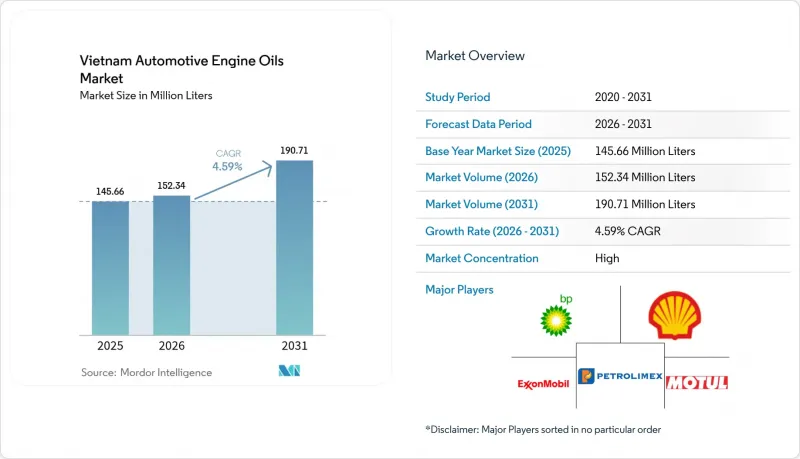
Mordor Intelligence에 의하면, 베트남 자동차 엔진오일 시장 규모는 2025년 1억 4,566만 리터에서 2026년에는 1억 5,234만 리터로 확대되어 2026년부터 2031년까지 CAGR 4.59%로 성장을 지속하여, 2031년에는 1억 9,071만 리터에 이를 것으로 예측됩니다.
본 보고서는 제품 유형(승용차용 엔진오일, 대형차용 엔진오일, 이륜차용 엔진오일) 및 베이스 오일(광물유, 합성유, 반합성유, 바이오)별로 분류되어 있습니다. 시장 전망은 판매량(리터) 단위로 제시되어 있습니다.
베트남 자동차 엔진오일 시장 동향 및 인사이트
급증하는 이륜차 보유 대수와 정비 빈도
7,300만 대를 넘는 가솔린 방식의 이륜차는 3,000-5,000킬로미터마다 오일 교환이 필요한 반면, 자동차의 경우 10,000-15,000킬로미터마다 교환이 필요하기 때문에 신차 판매가 둔화되더라도 윤활유 소비량은 높은 수준을 유지하고 있습니다. 이륜차 판매에서 혼다의 높은 시장 점유율은 표준화된 정비를 촉진하고 있으며, 이는 브랜드 오일의 지속적인 판매량 확보에 기여하고 있습니다. 2024년, 오토바이 부문은 국내 윤활유 수요의 상당 부분을 차지하고 있어 총 소비량에서 그 중요성을 부각시키고 있습니다. 도로 정비와 가처분 소득 증가로 인해 농촌 지역의 오토바이 보유 대수는 계속 증가하고 있으며, 이로 인해 오일 교환 주기가 확대되고 있습니다. 주변 지역의 노후화된 오토바이는 교환 빈도를 더욱 높이고 있어, 주요 도시에서 나타나는 완만한 전기화 추세를 상쇄하고 있습니다.
국내 석유 혼합 능력에 대한 정부의 장려책
당국은 수입 의존도를 억제하기 위해 국내 혼합을 장려하고 있습니다. 그 대표적인 예로 바리아-붕따우성에 건설된 후크스(Hucs)사의 900만 유로(1,020만 달러) 규모 플랜트와, 연간 750만 톤 규모로 확장되는 12억 달러 규모의 둔콰트 정유시설 개보수 공사를 들 수 있습니다. 세제상의 우대 조치, 라이선스 발급 절차 간소화, 토지 이용 지원 등을 통해 블렌딩 업체의 운영 비용이 절감되어, ‘베트남산’ 라벨을 내걸고 주류 가격대를 공략하는 것이 가능해졌습니다. 현재 진행 중인 아람코와 페트로리멕스 간의 협의와 같은 제휴는 아세안(ASEAN)으로의 수출 가능성을 키우는 더 심층적인 하류 부문에서의 협력을 시사합니다. 또한, 국내 생산 능력은 운임 변동이나 환율 변동으로부터 판매업체를 보호하는 완충재 역할도 하여, 독립 소매업체에게 구조적인 이점이 됩니다.
도시 지역의 전기차 보급률 확대
정부가 제시한 2030년까지 35만 대의 전기차 도입 목표와 PVOIL의 369개 충전소 확충에 힘입어, 특히 택시 및 차량 호출 서비스 차량을 중심으로 내연기관용 윤활유 판매량이 감소하고 있습니다. 이미 200만 대의 전기 오토바이가 운행 중이며, 기반은 낮지만 연간 30-35%의 속도로 증가하고 있습니다. 기어박스 및 열 관리용 전기 차량 유체(E-fluids)는 감소한 엔진오일 수요를 일부 보완하고 있지만, 아직 동등한 판매량에는 미치지 못하고 있습니다. 하노이와 호치민시를 제외한 지역에서는 충전 인프라가 제한적이며, 농촌 지역의 사용 현황과 맞물려 인프라가 정비될 때까지는 내연기관 차량이 주류를 이어갈 것입니다. 따라서 역풍은 완만한 수준에 그치겠지만, 전략적인 투자자들은 이미 이러한 변화를 장기적인 생산 능력 계획에 반영하고 있습니다.
부문 분석
2025년 승용차 대수가 51만 대로 증가함에 따라, 승용차용 엔진오일은 베트남 자동차 엔진오일 시장 점유율의 61.45%를 유지했습니다. 한편, 오토바이용 엔진오일은 3,000-5,000킬로미터마다 오일 교환이 필요한 7,300만 대의 운행 중인 오토바이에 힘입어 2031년까지 연평균 성장률(CAGR) 4.78%라는 가장 빠른 성장률을 기록하고 있습니다. 대형차용 엔진오일은 호치민시와 하노이를 수출항과 연결하는 주요 간선 도로를 주행하는 화물 트럭에 공급되어 안정적인 기본 판매량을 뒷받침하고 있습니다.
베트남의 자동차 엔진오일 시장은 2025년 2월까지 오토바이 수입 대수가 1.6% 증가해 46만 4,194대에 달할 것으로 예상에 따라 혜택을 보고 있는 반면, 승용차 수입 대수는 2024년에 17만 2,240대로 증가했습니다. 혼다가 시장을 독점하고 있어 공급업체 입장에서는 적합성 확보가 용이해진 반면, 승용차 OEM의 분산화로 인해 제품 포트폴리오는 확대되고 있습니다. Motul 300V Road Racing이나 야마하의 위조 방지 기능을 갖춘 Yamalube와 같은 고성능 제품 라인은 부문의 세분화를 촉진하며 가격 프리미엄을 확보하고 있습니다.
기타 혜택:
- 엑셀 형식 시장 예측(ME) 시트
- 3개월간의 애널리스트 지원
자주 묻는 질문
목차
제1장 서론
제2장 조사 방법
제3장 주요 요약
제4장 시장 구도
제5장 시장 규모와 성장 예측
제6장 경쟁 구도
제7장 시장 기회와 향후 전망
제8장 CEO을 위한 중요 전략적 과제
JHS 26.08.28According to Mordor Intelligence, the Vietnam automotive engine oils market size is expected to grow from 145.66 million liters in 2025 to 152.34 million liters in 2026 and is forecast to reach 190.71 million liters by 2031 at 4.59% CAGR over 2026-2031.
This report is Segmented by Product Type (Passenger Car Motor Oil, Heavy Duty Motor Oil, and Motorcycle Engine Oil), Base Stock (Mineral, Synthetic, Semi-Synthetic, Bio-Based). The Market Forecasts are Provided in Terms of Volume (Liters).
Vietnam Automotive Engine Oils Market Trends and Insights
Surging Motorcycle Parc and Maintenance Frequency
More than 73 million gasoline two-wheelers require oil changes every 3,000-5,000 kilometers, compared with 10,000-15,000 kilometers for cars, so lubricant throughput remains high even as new bike sales soften. Honda's share across motorcycle sales drives standardized servicing, helping branded oils secure repeat volumes. The motorcycle segment generated a significant percent of national lubricant demand in 2024, underscoring its weight in overall consumption. Rural ownership continues to rise thanks to upgraded roads and higher disposable incomes, expanding the replacement cycle. Ageing bikes in peripheral provinces further elevate change frequency, offsetting modest electrification in core cities.
Government Incentives for Domestic Oil Blending Capacity
Authorities encourage local blending to curb import reliance, exemplified by Fuchs' EUR 9 million (USD 10.2 million) plant in Ba Ria-Vung Tau and the USD 1.2 billion Dung Quat refinery upgrade to 7.5 million tons per year. Fiscal perks, streamlined licensing, and land-use support cut operating costs for blenders, letting them target mainstream price points with made-in-Vietnam labels. Partnerships such as ongoing Aramco-Petrolimex talks hint at deeper downstream collaboration that could seed ASEAN export potential. Domestic capacity also helps cushion distributors against freight volatility and foreign-exchange swings, a structural upside for independent retailers.
Growing EV Penetration in Urban Centres
Government targets of 350,000 EVs by 2030 and PVOIL's rollout of 369 charging points begin to erode combustion-engine lubricant volumes, especially among taxi and ride-hail fleets. Two million electric motorcycles already circulate, advancing 30-35% annually, although from a low base. E-fluids for gearboxes and thermal management partially offset the lost engine oil, but lack a comparable volume density. Outside Hanoi and Ho Chi Minh City, limited charging and rural duty cycles preserve internal-combustion dominance until infrastructure matures. Hence, the headwind remains gradual, yet strategic investors already price this shift into long-range capacity plans.
Other drivers and restraints analyzed in the detailed report include:
- Shift Toward Low-Viscosity Synthetic Grades for Fuel Economy
- E-Commerce Expansion in Lubricant Retailing
- Counterfeit / Grey-Market Engine Oils
For complete list of drivers and restraints, kindly check the Table Of Contents.
Segment Analysis
Passenger Car Motor Oil retained a 61.45% slice of the Vietnam automotive engine oils market share in 2025 as the passenger-vehicle fleet rose to 510,000 units. Motorcycle Engine Oil, however, posts the quickest clip at 4.78% CAGR to 2031, propelled by 73 million active bikes requiring changes every 3,000-5,000 kilometres. Heavy-Duty Motor Oil services freight trucks on arterial corridors linking Ho Chi Minh City and Hanoi to export ports, reinforcing steady baseline volume.
The Vietnam automotive engine oils market benefits from 1.6% growth in motorcycle imports to 464,194 units through February 2025, while passenger car imports grew to 172,240 units in 2024. Honda's dominance simplifies compatibility for suppliers, whereas car OEM fragmentation widens product portfolios. High-performance lines such as Motul 300V Road Racing and Yamaha's anti-counterfeit Yamalube enhance segment segmentation and capture price premium.
Complete Report Scope:
- By Product Type
- Passenger Car Motor Oil (PCMO)
- 0W-XX
- 5W-XX
- 10W-XX
- 15W-XX
- Monogrades
- Other Grades
- Heavy Duty Motor Oil (HDMO)
- 0W-XX
- 5W-XX
- 10W-XX
- 15W-XX
- Monogrades
- Other Grades
- Motorcycle Engine Oil (MCO)
- 0W-XX
- 5W-XX
- 10W-XX
- 15W-XX
- Monogrades
- Other Grades
- Passenger Car Motor Oil (PCMO)
- By Base Stock
- Mineral
- Synthetic
- Semi-Synthetic
List of Companies Covered in this Report:
- AP SAIGON PETRO
- BP p.l.c.
- Chevron Corporation
- Exxon Mobil Corporation
- FUCHS
- GS Caltex Corporation
- Gulf Oil International Ltd.
- Idemitsu Lubricants Vietnam
- Mekong Petrochemical Jsc
- Motul Vietnam (Vilube)
- Petrolimex (PLX)
- PETRONAS Lubricants International
- PVOIL
- Repsol Vietnam
- Shell Plc
- TotalEnergies
- Wolf Oil Corporation
Additional Benefits:
- The market estimate (ME) sheet in Excel format
- 3 months of analyst support
TABLE OF CONTENTS
1 Introduction
- 1.1 Study Assumptions and Market Definition
- 1.2 Scope of the Study
2 Research Methodology
3 Executive Summary
4 Market Landscape
- 4.1 Market Overview
- 4.2 Market Drivers
- 4.2.1 Surging Motorcycle Parc and Maintenance Frequency
- 4.2.2 Government Incentives for Domestic Oil Blending Capacity
- 4.2.3 Shift Toward Low-Viscosity Synthetic Grades for Fuel Economy
- 4.2.4 E-Commerce Expansion in Lubricant Retailing
- 4.2.5 OEM Factory-Fill Localisation Partnerships
- 4.3 Market Restraints
- 4.3.1 Growing EV Penetration in Urban Centres
- 4.3.2 Counterfeit / Grey-Market Engine Oils
- 4.3.3 Crude-Price Volatility Squeezing Blender Margins
- 4.4 Value Chain Analysis
- 4.5 Regulatory Landscape
- 4.6 Porter's Five Forces
- 4.6.1 Threat of New Entrants
- 4.6.2 Bargaining Power of Suppliers
- 4.6.3 Bargaining Power of Buyers
- 4.6.4 Threat of Substitutes
- 4.6.5 Competitive Rivalry
5 Market Size and Growth Forecasts (Volume)
- 5.1 By Product Type
- 5.1.1 Passenger Car Motor Oil (PCMO)
- 5.1.1.1 0W-XX
- 5.1.1.2 5W-XX
- 5.1.1.3 10W-XX
- 5.1.1.4 15W-XX
- 5.1.1.5 Monogrades
- 5.1.1.6 Other Grades
- 5.1.2 Heavy Duty Motor Oil (HDMO)
- 5.1.2.1 0W-XX
- 5.1.2.2 5W-XX
- 5.1.2.3 10W-XX
- 5.1.2.4 15W-XX
- 5.1.2.5 Monogrades
- 5.1.2.6 Other Grades
- 5.1.3 Motorcycle Engine Oil (MCO)
- 5.1.3.1 0W-XX
- 5.1.3.2 5W-XX
- 5.1.3.3 10W-XX
- 5.1.3.4 15W-XX
- 5.1.3.5 Monogrades
- 5.1.3.6 Other Grades
- 5.1.1 Passenger Car Motor Oil (PCMO)
- 5.2 By Base Stock
- 5.2.1 Mineral
- 5.2.2 Synthetic
- 5.2.3 Semi-Synthetic
6 Competitive Landscape
- 6.1 Market Concentration
- 6.2 Strategic Moves
- 6.3 Market Share (%)/Ranking Analysis
- 6.4 Company Profiles (includes Global level Overview, Market level overview, Core Segments, Financials as available, Strategic Information, Market Rank/Share, Products and Services, Recent Developments)
- 6.4.1 AP SAIGON PETRO
- 6.4.2 BP p.l.c.
- 6.4.3 Chevron Corporation
- 6.4.4 Exxon Mobil Corporation
- 6.4.5 FUCHS
- 6.4.6 GS Caltex Corporation
- 6.4.7 Gulf Oil International Ltd.
- 6.4.8 Idemitsu Lubricants Vietnam
- 6.4.9 Mekong Petrochemical Jsc
- 6.4.10 Motul Vietnam (Vilube)
- 6.4.11 Petrolimex (PLX)
- 6.4.12 PETRONAS Lubricants International
- 6.4.13 PVOIL
- 6.4.14 Repsol Vietnam
- 6.4.15 Shell Plc
- 6.4.16 TotalEnergies
- 6.4.17 Wolf Oil Corporation
7 Market Opportunities and Future Outlook
- 7.1 White-space and Unmet-Need Assessment


