

|
시장보고서
상품코드
2116377
독일의 자동차 엔진오일 시장 : 점유율 분석, 업계 동향과 통계, 성장 예측(2026-2031년)Germany Automotive Engine Oils - Market Share Analysis, Industry Trends & Statistics, Growth Forecasts (2026 - 2031) |
||||||
 Mordor Intelligence
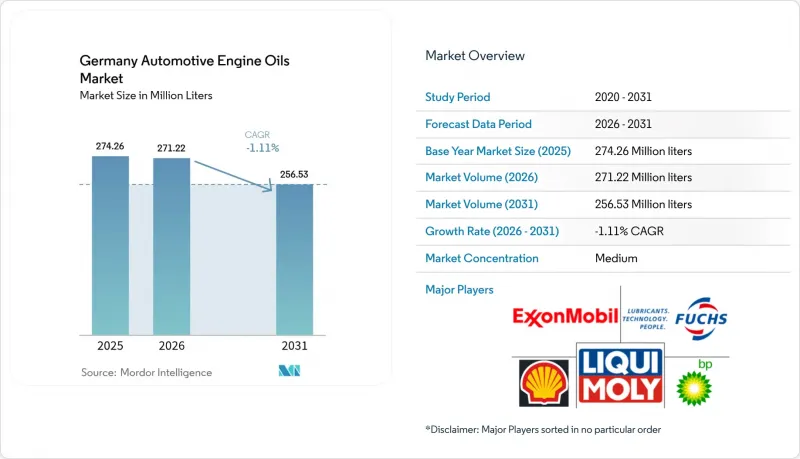
Mordor Intelligence에 의하면, 독일 자동차 엔진오일 시장 규모는 2025년에 2억 7,426만 리터로 평가되어 2026년 2억 7,122만 리터에서 감소로 변해 2031년까지 2억 5,653만 리터에 이를 것으로 추정되고 있어 예측 기간 CAGR은 -1.11%입니다(2026-2031년).
본 보고서는 제품 유형(승용차용 엔진오일(0W-XX, 5W-XX, 10W-XX, 15W-XX, 모노그레이드 및 기타 등급),대형차용 엔진오일(0W-XX, 5W-XX, 10W-XX, 15W-XX, 모노그레이드 및 기타 등급), 오토바이용 엔진오일(0W-XX, 5W-XX, 10W-XX 등)),및 베이스 오일(광물유, 합성유, 반합성유, 바이오베이스)별로 분류되어 있습니다. 시장 전망은 판매량(리터) 기준으로 제시되어 있습니다.
독일 자동차 엔진오일 시장 동향 및 인사이트
Euro-7 연비 개선 노력으로 인해 저점도 합성유의 채택이 가속화되고 있습니다.
Euro-7 배기가스 규제는 미세먼지 및 NOx 배출량을 줄이기 위해, 각 OEM 업체들은 내부 마찰을 최소화하고 일반 도로에서의 배기가스 검증 요건을 충족하는 0W-20, 나아가 0W-16 윤활유를 지정하고 있습니다. 이러한 규제치를 준수하는 새로운 ACEA 규격으로 인해 판매량은 감소하고 있지만, 독일 자동차 엔진오일 시장은 여전히 합성 화학 기술에 의해 지탱되고 있습니다. 2025년 이후의 하이브리드 가솔린 차량 모델에서는 메르세데스-벤츠의 MB 229.71 및 BMW의 Longlife-22FE++가 필수로 지정되어 있으며, 두 규격 모두 매우 높은 안정성을 지닌 저SAPS(황산염 알칼리 성분) 배합이 요구됩니다. 이미 이러한 승인을 획득한 윤활유 블렌딩 제조업체는 시험 프로토콜을 재현하는 데 수백만 유로의 비용과 18개월이 소요되기 때문에 프리미엄 가격을 책정할 수 있습니다. 이처럼 유로 7 규제는 독일 자동차 엔진오일 시장에서 규제를 이익률 향상의 원동력으로 전환시키고, 단순한 ‘리터 단위 판매’에서 ‘라이프사이클 성능 입증’으로의 판매 형태 전환을 뒷받침하고 있습니다. 이러한 긍정적 영향은 딜러 채널에서 가장 두드러지며, 해당 채널에서는 이미 OEM 전용 오일이 합성 PCMO 판매량의 3분의 2 이상을 차지하고 있습니다.
독일 자동차 보유 대수의 고령화가 정비 및 오일 보충 수요를 끌어올리고 있다.
독일 경차의 평균 차령은 2025년에 9.5년에 달하여, 2020년보다 정확히 1년 더 길어졌습니다. 이에 따라 소유 주기가 장기화되면서 애프터마켓 기회가 확대되고 있습니다. 오래된 엔진은 일반적으로 블로우바이나 개스킷을 통한 누출이 증가하기 때문에 정기 점검 사이의 중간 보충 필요성이 높아지며, 구형 유로 5 규격 차량에 적합한 5W-30 등의 점도 등급 사용이 요구됩니다. 정비 공장의 보고에 따르면, 8년 이상 경과한 차량의 경우 정기 점검 사이에 0.4리터의 보충 오일이 필요하며, 이는 배터리식 전기차의 보급으로 인한 판매량 감소를 일부 상쇄하고 있습니다. 상용 밴과 리지드 트럭에서도 유사한 경향이 나타나며, 차량 관리자들은 잔존 가치의 불확실성에 대비하기 위해 교체 주기를 연장하고 있습니다. 이러한 동향이 씰 컨디셔너나 세정력 강화제가 배합된 장거리 주행용 엔진오일에 대한 독일 자동차 엔진오일 시장의 안정적인 수요를 뒷받침하고 있습니다. 필터와 오일을 세트로 구성한 서비스 키트를 제공하는 공급업체들은 이러한 추세를 활용하여 방문 빈도가 안정적인 상황에서도 1회 방문당 수익을 높이고 있습니다.
EU 정유시설 재편이 기유 공급량과 가격에 영향
쉘은 2025년 하반기부터 베셀링 공장을 그룹 III 생산에 특화하기 위해 용도를 변경하고, 그룹 I 생산을 축소함과 동시에 단쇄유 공급이 부족해질 전망입니다. BP는 탄소 강도를 낮추기 위해 게르젠키르헨 공장의 원유 처리량을 줄이고 있으며, 그 결과 기유 수소화 처리 설비에 공급되는 현지 진공 가스오일 생산량이 감소하고 있습니다. 2025년 초, 그룹 III 현물 가격은 하락했으나, 중소 블렌더 업체들은 다년 계약 체결이 어렵다고 보고하고 있어, 이로 인해 공급망 리스크가 높아지고 있습니다. 독일의 기유 수요에서 수입 의존도가 상승하고 있어, 구매자들은 ARA 허브를 경유하는 운임 변동 리스크에 노출되어 있습니다. 대형 종합 석유 회사는 내부 이전 가격을 활용하여 이익률을 유지하고 있는 반면, 독립 윤활유 제조업체들은 비용 전가 지연에 직면하여 EBITDA가 압박받고 있습니다. 따라서 생산 능력의 전환은 예측 기간 동안 독일 자동차 엔진오일 시장에 구조적인 걸림돌이 될 것입니다.
부문 분석
2025년, 독일 자동차 엔진오일 시장에서 승용차용 엔진오일은 62.35%를 차지했습니다. 이는 독일의 역사적으로 자동차 중심의 모빌리티 인프라와 잘 구축된 딜러 정비 네트워크를 반영한 것입니다. 프리미엄 브랜드를 선두로 전기차(EV) 보급이 진행되면서,승용차용 엔진오일(PCMO)의 총 수요를 서서히 잠식하기 시작하고 있지만, 이 하위 부문은 여전히 독일 자동차 엔진오일 시장에서 일정한 점유율을 확보하고 있으며, 특히 저SAPS 0W-20 배합이 필요한 고온·터보차저 장착 가솔린 엔진 분야에서 그 경향이 두드러집니다. 오토바이용 엔진오일은 판매량이 훨씬 적지만,특히 바이에른주와 바덴뷔르템베르크주에서 레저 활동으로서의 라이딩 문화가 2030년대 중반까지 내연기관(ICE)이 탑재된 이륜차 수요를 지탱할 것으로 예상되므로, 연평균 성장률(CAGR)은 -0.95%로 가장 완만한 판매량 감소에 그칠 것으로 전망됩니다. 대형 차량용 엔진오일 수요는 독일 아우토반 네트워크 내 화물 운송 동향과 밀접한 관련이 있으며,해당 네트워크에서는 차량 함대의 텔레매틱스 기술 보급으로 인해 유로 VI 디젤 엔진용으로 HTHS 유지력이 온건하고 장기 교환 주기에 대응하는 10W-30 CK-4 배합이 선호되고 있습니다. 따라서 독일의 자동차 엔진오일 시장은 양극화된 경향을 보이고 있습니다. 구형 세단용 기존 PCMO 등급은 급격히 축소되는 반면, 고급 하이브리드차용 OEM 전용 합성유는 견조한 시장 점유율을 유지하고 있습니다.
플릿 관리자들은 연비 향상과 가동 중단 시간 감소를 최우선으로 하고 있으며, 이에 따라 HDMO 공급업체들은 장거리 운행 시 연료비 절감을 실현하는 FA-4 5W-30 블렌드의 채택을 추진하고 있습니다. 한편, MCO(승용차용 엔진오일) 마케팅 담당자들은 저장 기간이 긴 모노에스테르를 활용하여 소매 평균 판매 가격을 인상하고 있습니다. 메르세데스-벤츠 GLC 400e와 같은 OEM 순정 오일이 주입된 하이브리드 모델에는 LSPI(저속 스파크 점화)를 억제하면서도 촉매 보호 기능을 유지하는 듀얼 퍼포스 배합이 요구되고 있으며, 이를 통해 독일의 통합 제조업체들은 선점 우위를 확보하고 있습니다. 모든 가격대에서 독일 자동차 엔진오일 시장에서는 유로 7 배기가스 후처리 시스템의 내구성 요건을 충족하면서도 고객이 요구하는 프리미엄 브랜드 가치에 부응할 수 있는 화학 기술이 높이 평가받고 있습니다.
기타 혜택:
- 엑셀 형식 시장 예측(ME) 시트
- 3개월간의 애널리스트 지원
자주 묻는 질문
목차
제1장 서론
제2장 조사 방법
제3장 주요 요약
제4장 시장 구도
제5장 시장 규모와 성장 예측
제6장 경쟁 구도
제7장 시장 기회와 향후 전망
제8장 CEO가 직면하는 중요 전략적 과제
JHS 26.08.28According to Mordor Intelligence, the Germany automotive engine oils market size was valued at 274.26 Million liters in 2025 and estimated to decline from 271.22 Million liters in 2026 to reach 256.53 Million liters by 2031, at a CAGR of -1.11% during the forecast period (2026-2031).
This report is Segmented by Product Type (Passenger Car Motor Oil (0W-XX, 5W-XX, 10W-XX, 15W-XX, Monogrades, and Other Grades); Heavy Duty Motor Oil (0W-XX, 5W-XX, 10W-XX, 15W-XX, Monogrades, and Other Grades); Motorcycle Engine Oil (0W-XX, 5W-XX, 10W-XX, and More) )and Base Stock (Mineral, Synthetic, Semi-Synthetic, and Bio-Based). The Market Forecasts are Provided in Terms of Volume (Litres).
Germany Automotive Engine Oils Market Trends and Insights
Euro-7 Fuel-Economy Push Accelerates Low-Viscosity Synthetic Adoption
Euro-7 tailpipe standards reduce particulate and NOx emissions, prompting OEMs to prescribe 0W-20 and even 0W-16 lubricants that minimize internal friction and meet on-road emissions verification requirements. New ACEA sequences aligned with these limits ensure that the German automotive engine oil market remains anchored to synthetic chemistries, despite a decline in unit volume. Mercedes-Benz MB 229.71 and BMW Longlife-22FE++ are now mandatory for post-2025 hybrid gasoline models, each requiring ultra-stable low-SAPS formulations. Lubricant blenders that already hold these approvals can charge a premium because replicating the testing protocol costs several million euros and takes 18 months. Euro-7 thus converts regulation into a margin growth lever inside the Germany automotive engine oils market, reinforcing a shift from selling liters to selling lifecycle performance credentials. The upside is most visible in dealership channels, where OEM-specific oils already account for more than two-thirds of synthetic PCMO throughput.
Ageing German Car Parc Lifts Maintenance and Top-Up Demand
Germany's average light-vehicle age reached 9.5 years in 2025, a full year higher than in 2020, lengthening ownership cycles and expanding aftermarket opportunities. Older engines typically experience higher blow-by and gasket seepage, which raises mid-interval top-up requirements and necessitates the use of viscosity grades such as 5W-30, which are suited to legacy Euro-5 fleets. Workshops report that cars older than eight years require an additional 0.4 liters of make-up oil between scheduled services, which partially compensates for the volume dip induced by the uptake of battery-electric vehicles. Commercial vans and rigid trucks exhibit a similar pattern, with fleet managers extending replacement timelines to hedge against uncertainty in residual value. This demography underpins steady demand in the German automotive engine oils market for high-mileage formulations featuring seal conditioners and detergency boosters. Suppliers with bundled filter-and-oil service kits have leveraged the trend, raising per-visit revenue even as visit frequency stabilizes.
EU Refinery Rationalisation Swings Base-Oil Availability and Price
Shell will repurpose its Wesseling site to focus on Group III production from late 2025, trimming Group I and tightening short-chain supply. BP is reducing Gelsenkirchen crude runs to lower carbon intensity, thereby shrinking local vacuum gas-oil streams that feed base-oil hydrotreaters. Spot Group III prices dipped in early 2025; however, smaller blenders report difficulty in locking multi-year contracts, thereby elevating supply-chain risk. Import reliance has risen to of German base-oil demand, exposing buyers to freight volatility through ARA hubs. Large integrated majors preserve margins by using internal transfer pricing, while independent lubricators face a cost pass-through lag that compresses EBITDA. Capacity shifts, therefore, act as a structural drag on the German automotive engine oils market during the forecast horizon.
Other drivers and restraints analyzed in the detailed report include:
- OEM Long-Drain Approvals Stimulate Premium Oil Upgrades
- Bio-Based and Re-Refined Oils Gain Traction Post-VerpackG 2025 Amendment
- Counterfeit Oils on Online Marketplaces Erode Brand Trust
For complete list of drivers and restraints, kindly check the Table Of Contents.
Segment Analysis
Passenger Car Motor Oil accounted for 62.35% of the German automotive engine oil market in 2025, reflecting Germany's historic car-centric mobility infrastructure and well-developed dealership maintenance network. EV uptake, led by premium brands, is starting to erode aggregate PCMO demand; yet, the sub-segment still secures a share of the German automotive engine oils market, particularly for high-temperature, turbocharged gasoline engines that require low-SAPS 0W-20 formulations. Motorcycle Engine Oil, though much smaller in volume, will post the mildest volume decline at a -0.95% CAGR because leisure riding culture, particularly in Bavaria and Baden-Wurttemberg, sustains ICE two-wheelers well into the 2030s. Heavy-duty motor oil demand remains linked to freight-corridor activity on Germany's Autobahn network, where fleet telematics favor extended-drain 10W-30 CK-4 formulations with mild HTHS retention for Euro VI diesel engines. The German automotive engine oil market, therefore, exhibits a two-speed profile: conventional PCMO grades in older sedans contract sharply, while OEM-specific synthetics for luxury hybrids capture a resilient wallet share.
Fleet managers prioritize fuel economy and downtime reduction, prompting HDMO suppliers to adopt FA-4 5W-30 blends that deliver fuel savings in long-haul operations. Meanwhile, MCO marketers utilize extended shelf-life monoesters to increase average selling prices at retail. OEM-filled hybrid models, such as the Mercedes-Benz GLC 400e, require dual-purpose formulations that control LSPI and maintain catalyzer protection, giving German integrators early-mover leverage. Across every product bracket, the German automotive engine oils market rewards chemistry capable of meeting both Euro-7 after-treatment durability and customer perception of premium brand value.
Complete Report Scope:
- By Product Type
- Passenger Car Motor Oil (PCMO)
- 0W-XX
- 5W-XX
- 10W-XX
- 15W-XX
- Monogrades
- Other Grades
- Heavy Duty Motor Oil (HDMO)
- 0W-XX
- 5W-XX
- 10W-XX
- 15W-XX
- Monogrades
- Other Grades
- Motorcycle Engine Oil (MCO)
- 0W-XX
- 5W-XX
- 10W-XX
- 15W-XX
- Monogrades
- Other Grades
- Passenger Car Motor Oil (PCMO)
- By Base Stock
- Mineral
- Synthetic
- Semi-Synthetic
- Bio-Based
List of Companies Covered in this Report:
- ADDINOL
- AVISTA OIL
- BP Plc
- Chevron Corporation
- ENI
- Exxon Mobil Corporation
- FUCHS
- LIQUI MOLY
- Lukoil
- Motul
- PETRONAS Lubricants International
- Ravensberger Schmierstoffvertrieb GmbH
- Repsol
- ROWE MINERALOLWERK GMBH
- SCT Lubricants
- Shell plc
- TotalEnergies
Additional Benefits:
- The market estimate (ME) sheet in Excel format
- 3 months of analyst support
TABLE OF CONTENTS
1 Introduction
- 1.1 Study Assumptions and Market Definition
- 1.2 Scope of the Study
2 Research Methodology
3 Executive Summary
4 Market Landscape
- 4.1 Market Overview
- 4.2 Market Drivers
- 4.2.1 Euro-7 fuel-economy push accelerates low-viscosity synthetic adoption
- 4.2.2 Ageing German car parc lifts maintenance and top-up demand
- 4.2.3 OEM long-drain approvals stimulate premium oil upgrades
- 4.2.4 Bio-based and re-refined oils gain traction post-VerpackG 2025 amendment
- 4.2.5 B2B2C e-commerce platforms reshape workshop procurement
- 4.3 Market Restraints
- 4.3.1 EU refinery rationalisation swings base-oil availability and price
- 4.3.2 2025 German Chemicals Tax lifts additive costs
- 4.3.3 Counterfeit oils on online marketplaces erode brand trust
- 4.4 Value Chain and Distribution Channel Analysis
- 4.5 Porter's Five Forces
- 4.5.1 Threat of New Entrants
- 4.5.2 Bargaining Power of Suppliers
- 4.5.3 Bargaining Power of Buyers
- 4.5.4 Threat of Substitutes
- 4.5.5 Industry Rivalry
- 4.6 Regulatory Framework
- 4.7 Automotive Industry Trends
5 Market Size and Growth Forecasts (Volume)
- 5.1 By Product Type
- 5.1.1 Passenger Car Motor Oil (PCMO)
- 5.1.1.1 0W-XX
- 5.1.1.2 5W-XX
- 5.1.1.3 10W-XX
- 5.1.1.4 15W-XX
- 5.1.1.5 Monogrades
- 5.1.1.6 Other Grades
- 5.1.2 Heavy Duty Motor Oil (HDMO)
- 5.1.2.1 0W-XX
- 5.1.2.2 5W-XX
- 5.1.2.3 10W-XX
- 5.1.2.4 15W-XX
- 5.1.2.5 Monogrades
- 5.1.2.6 Other Grades
- 5.1.3 Motorcycle Engine Oil (MCO)
- 5.1.3.1 0W-XX
- 5.1.3.2 5W-XX
- 5.1.3.3 10W-XX
- 5.1.3.4 15W-XX
- 5.1.3.5 Monogrades
- 5.1.3.6 Other Grades
- 5.1.1 Passenger Car Motor Oil (PCMO)
- 5.2 By Base Stock
- 5.2.1 Mineral
- 5.2.2 Synthetic
- 5.2.3 Semi-Synthetic
- 5.2.4 Bio-Based
6 Competitive Landscape
- 6.1 Market Concentration
- 6.2 Strategic Moves
- 6.3 Market Share (%)/Ranking Analysis
- 6.4 Company Profiles (includes Global level Overview, Market level overview, Core Segments, Financials as available, Production Capacity, Strategic Information, Market Rank/Share for key companies, Products and Services, and Recent Developments)
- 6.4.1 ADDINOL
- 6.4.2 AVISTA OIL
- 6.4.3 BP Plc
- 6.4.4 Chevron Corporation
- 6.4.5 ENI
- 6.4.6 Exxon Mobil Corporation
- 6.4.7 FUCHS
- 6.4.8 LIQUI MOLY
- 6.4.9 Lukoil
- 6.4.10 Motul
- 6.4.11 PETRONAS Lubricants International
- 6.4.12 Ravensberger Schmierstoffvertrieb GmbH
- 6.4.13 Repsol
- 6.4.14 ROWE MINERALOLWERK GMBH
- 6.4.15 SCT Lubricants
- 6.4.16 Shell plc
- 6.4.17 TotalEnergies
7 Market Opportunities and Future Outlook
- 7.1 White-space and Unmet-need Assessment


