

|
시장보고서
상품코드
2116382
인도의 자동차 엔진오일 시장 : 점유율 분석, 업계 동향과 통계, 성장 예측(2026-2031년)India Automotive Engine Oils - Market Share Analysis, Industry Trends & Statistics, Growth Forecasts (2026 - 2031) |
||||||
 Mordor Intelligence
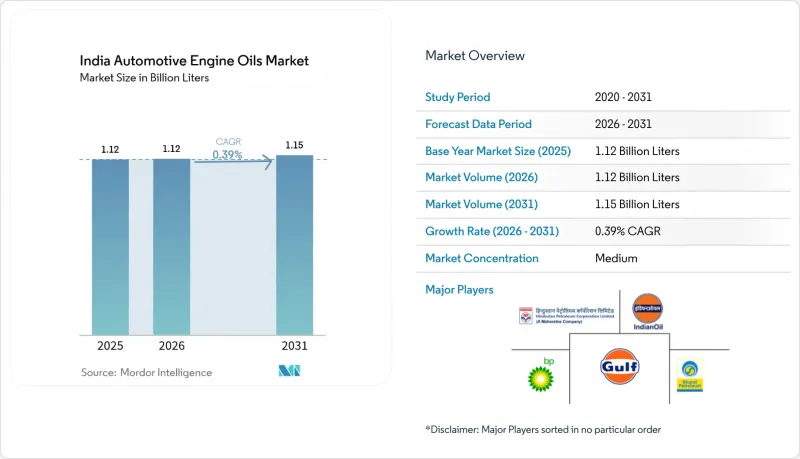
Mordor Intelligence에 의하면, 인도 자동차 엔진오일 시장 규모는 2025년에 11억 2,000만 리터로 평가되어 2026년 11억 2,000만 리터에서 2031년까지 11억 5,000만 리터에 이를 것으로 예측되며, 예측 기간(2026-2031년) CAGR은 0.39%를 나타낼 전망입니다.
본 보고서는 제품 유형(승용차용 엔진오일, 대형차용 엔진오일, 이륜차용 엔진오일) 및 베이스 오일(광물유, 합성유, 반합성유, 바이오)별로 세분화되어 있습니다. 시장 예측은 판매량(리터) 기준으로 제시되어 있습니다.
인도 자동차 엔진오일 시장 동향 및 인사이트
BS-VI 2단계 규제가 프리미엄 저점도 오일로의 전환을 촉진
2023년 4월 실제 주행 배기가스 시험이 도입됨에 따라, 각 OEM 업체들은 실제 주행 조건에서 후처리 시스템을 보호하는 저SAPS 오일의 채택을 피할 수 없게 되었습니다. 광물유 제형은 더욱 엄격해진 산화 제한 및 침전물 억제 요건을 충족하지 못하기 때문에 현재는 합성유 및 반합성유 등급이 공장 충전 입찰 시장을 주도하고 있습니다. 차량 운영 사업자들은 오일 교환 주기 연장으로 가동 중단 시간이 단축되고 유지보수 비용이 절감되므로 30-50%의 가격 프리미엄을 수용하고 있습니다. 각 정유사는 첨가제 패키지를 개선하여 최신 가솔린 및 디젤 차량 플랫폼에 적합한 저점도 5W-30 및 0W-20 등급을 포지셔닝하고 있습니다. 중앙공해관리위원회의 감사가 규정 준수를 강화하고 있으며, 이러한 규제의 추진은 인도 자동차 엔진오일 시장 전체의 프리미엄화를 뒷받침하는 더 이상 되돌릴 수 없는 요인이 되었습니다.
CNG 차량의 급속한 보급과 고온 환경에서의 윤활유 수요
인도에서 버스, 택시, 소형 트럭 등 CNG 차량이 증가함에 따라 윤활유의 사용 온도가 상승하고, 폴리머의 전단 및 니트로화가 가속화되고 있습니다. 디젤용 오일보다 15-20% 비싼 CNG 전용 프리미엄 오일은 이러한 엔진에 요구되는 높은 열안정성과 밸브 시트 보호 성능을 제공합니다. 북부를 중심으로 한 급유 네트워크가 정비됨에 따라 지역별 수요 클러스터가 형성되고 있으며, 판매업체들은 CNG 대응 제품을 우선적으로 취급하고 있습니다. 2030년까지 전체 운송용 연료의 15%를 CNG로 충당하겠다는 정부의 목표가 꾸준한 판매량 증가를 뒷받침하고 있으며, 도시 지역 화물 운송에서 BEV로 인한 수요 잠식으로부터 공급업체를 보호하고 있습니다.
BEV 및 전기 이륜차의 보급 가속화가 엔진오일 판매량을 잠식하고 있습니다.
FAME-II의 우대 조치와 리튬 이온 배터리 팩의 가격 하락으로 인해 전동 이륜차의 보급이 가속화되고 있으며, 현재 인도 자동차 엔진오일 시장의 성장을 뒷받침하고 있는 오토바이를 대체하고 있습니다. 전기 스쿠터 1대당 연간 800-900밀리리터의 오일 수요가 감소하고 있으며, 그 보급은 우선 방갈로르, 첸나이, 푸네에 집중된 후, 소규모 도시로 확산되고 있습니다. 대형 차량의 전기화는 다소 뒤처지고 있지만, BEV 트럭 1대당 오일 교환 1회 시 최대 40리터 수요가 감소하기 때문에 장기적인 판매량 감소 압력이 더욱 강해지고 있습니다.
부문 분석
승용차용 엔진오일은 승용차 보유 대수의 확대와 중형차 부문에서 전기차 보급 속도의 둔화로 인해, 2025년에는 인도 자동차 엔진오일 시장 점유율의 51.94%를 차지하며 최대 점유율을 기록했습니다. 현재 OEM의 공장 출고 시 충전 오일로는 멀티그레이드 5W-30 및 5W-40 합성유가 주류를 이루고 있지만, 대도시권 이외의 지역에서는 구형 소형차에 15W-40 광물유가 여전히 사용되고 있습니다. 오토바이용 엔진오일은 인도에서 연간 2,500만 대의 이륜차 생산의 혜택을 받아, 2031년까지 0.53%라는 가장 높은 연평균 성장률(CAGR)을 기록했습니다. OEM 주도의 점도 사양 10W-30 및 10W-40 합성 오일로 전환됨에 따라, 저온 시동 시 보호 성능과 클러치 성능이 향상되어 프리미엄화 추세를 뒷받침하고 있습니다. 대형 트럭용 엔진오일은 장거리 주행용 디젤 차량과 신흥 CNG 트럭에 공급됨으로써 판매량의 안정성을 유지하고 있습니다. 합성 오일의 보급이 확대되는 가운데에서도, 가격에 민감한 개인 소유·운전자층 사이에서는 구형 광물유인 20W-40 단일 점도 오일에 대한 수요가 여전히 존재합니다.
OEM 및 리필 브랜드 각사는 API SP 및 JASO MA2 인증을 획득하기 위해 첨가제의 화학 조성을 개선하고 있으며, 더욱 엄격해지는 배기가스 규제 및 연비 기준에 대응하고 있습니다. 그 결과, 제품 포트폴리오는 최신 차량용 프리미엄 합성유와 구형 차량용 합리적인 가격의 광유 라인을 모두 아우르고 있어, 공급업체는 모든 소득 계층에서 시장 점유율을 유지할 수 있게 되었습니다.
기타 혜택:
- 엑셀 형식 시장 예측(ME) 시트
- 3개월간의 애널리스트 지원
자주 묻는 질문
목차
제1장 서론
제2장 조사 방법
제3장 주요 요약
제4장 시장 구도
제5장 시장 규모와 성장 예측
제6장 경쟁 구도
제7장 시장 기회와 향후 전망
제8장 CEO가 직면하는 중요 전략적 과제
JHS 26.08.28According to Mordor Intelligence, the India automotive engine oils market size was valued at 1.12 Billion Liters in 2025 and estimated to grow from 1.12 Billion Liters in 2026 to reach 1.15 Billion Liters by 2031, at a CAGR of 0.39% during the forecast period (2026-2031).
This report is Segmented by Resin Type (Passenger Car Motor Oil, Heavy Duty Motor Oil, and Motorcycle Engine Oil), Base Stock (Mineral, Synthetic, Semi-Synthetic, and Bio-Based). The Market Forecasts are Provided in Terms of Volume (Litres).
India Automotive Engine Oils Market Trends and Insights
BS-VI Stage-2 Norms Driving Shift to Premium Low-Viscosity Oils
The April 2023 onset of Real Driving Emissions testing forced OEMs to adopt low-SAPS oils that protect after-treatment systems under real-world conditions. Synthetic and semi-synthetic grades now dominate factory-fill bids as mineral formulations struggle with tighter oxidation limits and deposit control. Fleet operators accept the 30-50% price premium because extended drains lower downtime and cut maintenance spend. Refiners have upgraded additive packages, positioning low-viscosity 5W-30 and 0W-20 grades for modern petrol and diesel platforms. Central Pollution Control Board audits reinforce compliance, making this regulatory push an irreversible driver of premiumization across the India automotive engine oil market.
Rapid CNG-Vehicle Growth and Higher-Temperature Lube Demand
India's CNG fleet expansion in buses, taxis, and light-duty trucks raises lubricant operating temperatures, accelerating polymer shear and nitration. Premium CNG-specific oils priced 15-20% above diesel equivalents deliver the higher thermal stability and valve-seat protection these engines require. The north-centric refueling network sparks regional demand clusters where distributors prioritize CNG variants. Government targets that elevate CNG to 15% of all transport fuel by 2030 underpin steady volume growth, cushioning suppliers from BEV cannibalization in urban freight.
Accelerating BEV and e-2W Penetration Eroding Engine-Oil Volume
FAME-II incentives and cheaper lithium-ion packs accelerate electric two-wheeler adoption, displacing motorcycles that currently anchor growth in the India automotive engine oil market. Each e-scooter eliminates 800-900 milliliters of annual oil demand, and adoption is clustering in Bengaluru, Chennai, and Pune before cascading into smaller cities. Heavy-duty electrification is slower, yet every BEV truck removes up to 40 liters per drain, magnifying the long-term drag on volume.
Other drivers and restraints analyzed in the detailed report include:
- E-commerce Last-Mile Fleets Shortening Drain-Interval Cycles
- Scrappage-Policy Led Spike in Factory-Fill Demand (2026-28)
- Extended-Drain Synthetic Oils Cutting Per-Vehicle Consumption
For complete list of drivers and restraints, kindly check the Table Of Contents.
Segment Analysis
Passenger Car Motor Oil posted the largest 2025 share at 51.94% of the India automotive engine oil market share, thanks to an expanding passenger-vehicle parc and slower EV uptake in midsize cars. Multigrade 5W-30 and 5W-40 synthetics now anchor OEM factory fills, while 15W-40 mineral grades linger in older compact cars across non-metro regions. Motorcycle Engine Oil, benefiting from India's 25-million-unit annual two-wheeler production, delivered the fastest 0.53% CAGR through 2031. OEM-driven viscosity shifts toward 10W-30 and 10W-40 synthetics improve cold-start protection and clutch performance, supporting premiumization. Heavy Duty Motor Oil maintains volume stability by servicing long-haul diesel and emerging CNG trucks. Despite synthetic penetration, older mineral 20W-40 monogrades remain relevant among price-sensitive owner-drivers.
OEMs and refill brands are refining additive chemistries to secure API SP and JASO MA2 credentials, positioning for tighter emission and fuel-economy norms. Product portfolios therefore straddle premium synthetics for modern vehicles and affordable mineral lines for legacy fleets, allowing suppliers to protect share across income segments.
Complete Report Scope:
- By Resin Type
- Passenger Car Motor Oil (PCMO)
- 0W-XX
- 5W-XX
- 10W-XX
- 15W-XX
- Monogrades
- Other Grades
- Heavy Duty Motor Oil (HDMO)
- 0W-XX
- 5W-XX
- 10W-XX
- 15W-XX
- Monogrades
- Other Grades
- Motorcycle Engine Oil (MCO)
- 0W-XX
- 5W-XX
- 10W-XX
- 15W-XX
- Monogrades
- Other Grades
- Passenger Car Motor Oil (PCMO)
- By Base Stock
- Mineral
- Synthetic
- Semi-Synthetic
- Bio-Based
List of Companies Covered in this Report:
- APAR Industries Limited
- Bharat Petroleum Corporation Limited
- BP plc
- Chevron Alkhalij
- Exxon Mobil Corporation
- FUCHS
- Gulf Oil International
- Hindustan Petroleum Corporation Limited
- Idemitsu Lubricants India Pvt Ltd
- Indian Oil Corporation Limited
- Liqui Moly
- LUKOIL
- Morris Lubricants India
- Motul
- PETRONAS Lubricants International
- Saudi Arabian Oil Co.
- Savita Oil Technologies Limited
- Shell Plc
- TotalEnergies
- Veedol Corporation Limited
Additional Benefits:
- The market estimate (ME) sheet in Excel format
- 3 months of analyst support
TABLE OF CONTENTS
1 Introduction
- 1.1 Study Assumptions and Market Definition
- 1.2 Scope of the Study
2 Research Methodology
3 Executive Summary
4 Market Landscape
- 4.1 Market Overview
- 4.2 Market Drivers
- 4.2.1 Rising passenger-vehicle and two-wheeler parc expansion
- 4.2.2 Rapid CNG-vehicle growth and higher-temperature lube demand
- 4.2.3 BS-VI Stage-2 norms driving shift to premium low-viscosity oils
- 4.2.4 E-commerce last-mile fleets shortening drain-interval cycles
- 4.2.5 Scrappage-policy led spike in factory-fill demand (2026-28)
- 4.3 Market Restraints
- 4.3.1 Accelerating BEV and e-2W penetration eroding engine-oil volume
- 4.3.2 Extended-drain synthetic oils cutting per-vehicle consumption
- 4.3.3 Telematics-based condition monitoring reducing oil changes
- 4.4 Value Chain and Distribution Channel Analysis
- 4.5 Porter's Five Forces
- 4.5.1 Threat of New Entrants
- 4.5.2 Bargaining Power of Suppliers
- 4.5.3 Bargaining Power of Buyers
- 4.5.4 Threat of Substitutes
- 4.5.5 Industry Rivalry
- 4.6 Regulatory Framework
- 4.7 Automotive Industry Trends
5 Market Size and Growth Forecasts (Volume)
- 5.1 By Resin Type
- 5.1.1 Passenger Car Motor Oil (PCMO)
- 5.1.1.1 0W-XX
- 5.1.1.2 5W-XX
- 5.1.1.3 10W-XX
- 5.1.1.4 15W-XX
- 5.1.1.5 Monogrades
- 5.1.1.6 Other Grades
- 5.1.2 Heavy Duty Motor Oil (HDMO)
- 5.1.2.1 0W-XX
- 5.1.2.2 5W-XX
- 5.1.2.3 10W-XX
- 5.1.2.4 15W-XX
- 5.1.2.5 Monogrades
- 5.1.2.6 Other Grades
- 5.1.3 Motorcycle Engine Oil (MCO)
- 5.1.3.1 0W-XX
- 5.1.3.2 5W-XX
- 5.1.3.3 10W-XX
- 5.1.3.4 15W-XX
- 5.1.3.5 Monogrades
- 5.1.3.6 Other Grades
- 5.1.1 Passenger Car Motor Oil (PCMO)
- 5.2 By Base Stock
- 5.2.1 Mineral
- 5.2.2 Synthetic
- 5.2.3 Semi-Synthetic
- 5.2.4 Bio-Based
6 Competitive Landscape
- 6.1 Market Concentration
- 6.2 Strategic Moves
- 6.3 Market Share (%)/Ranking Analysis
- 6.4 Company Profiles (includes Global level Overview, Market level overview, Core Segments, Financials as available, Production Capacity, Strategic Information, Market Rank/Share for key companies, Products and Services, and Recent Developments)
- 6.4.1 APAR Industries Limited
- 6.4.2 Bharat Petroleum Corporation Limited
- 6.4.3 BP plc
- 6.4.4 Chevron Alkhalij
- 6.4.5 Exxon Mobil Corporation
- 6.4.6 FUCHS
- 6.4.7 Gulf Oil International
- 6.4.8 Hindustan Petroleum Corporation Limited
- 6.4.9 Idemitsu Lubricants India Pvt Ltd
- 6.4.10 Indian Oil Corporation Limited
- 6.4.11 Liqui Moly
- 6.4.12 LUKOIL
- 6.4.13 Morris Lubricants India
- 6.4.14 Motul
- 6.4.15 PETRONAS Lubricants International
- 6.4.16 Saudi Arabian Oil Co.
- 6.4.17 Savita Oil Technologies Limited
- 6.4.18 Shell Plc
- 6.4.19 TotalEnergies
- 6.4.20 Veedol Corporation Limited
7 Market Opportunities and Future Outlook
- 7.1 White-space and Unmet-need Assessment


