

|
시장보고서
상품코드
2116381
중국의 자동차 엔진오일 시장 : 점유율 분석, 업계 동향과 통계, 성장 예측(2026-2031년)China Automotive Engine Oils - Market Share Analysis, Industry Trends & Statistics, Growth Forecasts (2026 - 2031) |
||||||
 Mordor Intelligence
Mordor Intelligence에 의하면, 2026년 중국 자동차 엔진오일 시장 규모는 29억 리터로 추정되고 있어 2025년 29억 리터로에서 확대해, 2031년 예측은 29억 2,000만 리터가 되어, 2026년부터 2031년까지 CAGR 0.10%로 성장할 전망입니다.
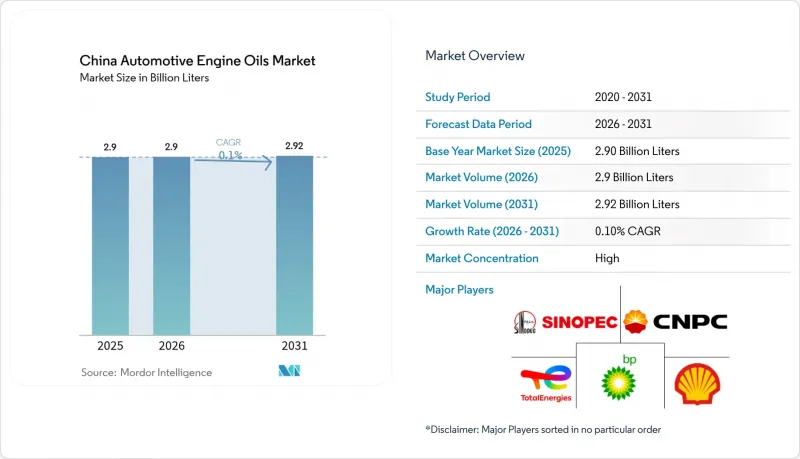
본 보고서는 제품 유형(승용차용 엔진오일, 대형차용 엔진오일, 이륜차용 엔진오일) 및 기유(광물유, 합성유, 반합성유, 바이오베이스)별로 분류되어 있습니다. 시장 전망은 판매량(리터) 기준으로 제시되어 있습니다.
중국 자동차 엔진오일 시장 동향 및 인사이트
차량 보유 대수 증가와 차량 연식 증가
2025년, 승용차 보유 대수는 계속 증가했으며, 전기차(EV)의 급증이라는 큰 화제에도 불구하고, 소폭이지만 꾸준한 교체 수요가 발생했습니다. 2·3급 도시에서는 구형 내연기관 차량이 주류를 이루고 있으며, 이러한 지역에서는 가정이 전기차로의 교체를 미루고 있기 때문에 차량 1대당 오일 소비량이 증가하고 보충 빈도도 높아지고 있습니다. 따라서 내륙 지역 성에서는 전국적인 판매량 감소를 완화하는 몇 년간의 완충 효과가 기대됩니다. 그러나 연안 지역의 주요 도시에서 시행되는 폐차 장려책과 검사 제도의 강화는 이러한 요인이 중국 자동차 엔진오일 시장에 미치는 기여도가 결국 정점에 달하게 될 것이라는 점진적인 변화의 전조로 작용하고 있습니다.
엄격한 중국 VI-b 배기가스 규제가 고성능 윤활유 수요를 견인
중국 VI-b 기준에 따라, 배합 제조업체는 SAPS 함유량을 줄이고 0W-20 등 연비 중심의 점도를 실현하는 동시에 후처리 장치를 보호해야 할 의무가 있습니다. 2025년 3월 시행 시작 후 9개월 동안 1,800개 이상의 제품이 API SQ/ILSAC GF-7에 따라 재인증되었습니다. 1선 도시들이 선두에 나서며 풀 합성 및 고그룹 III 블렌드에 대한 수요의 물결이 일었고, 그 물결은 내륙 지역으로 계속 확산되고 있습니다. 규제 준수에 드는 비용이 소규모 블렌딩 업체들을 압박하고 있어, 대형 기유 기업과의 합병이나 공급 계약이 가속화되고 있습니다. 이러한 동향은 중국 자동차 엔진오일 시장의 집중화를 더욱 심화시키고 있습니다.
OEM의 오일 교환 주기 연장 및 오일 수명 모니터링
현재 주요 OEM 업체들은 풀 합성 0W-20 및 5W-30 오일에 대해 서비스 주기를 7,500-8,000km로 정하고 있으며, 많은 프리미엄 브랜드에서는 주행 조건이 온화한 경우 오일 교환 주기를 연장하는 차량 탑재 알고리즘을 병행하고 있습니다. 1회 오일 교환량은 증가하고 있지만, 차량 1대당 연간 윤활유 소비량은 2020년 수준에 비해 약 20% 감소하여, 단가가 상승하고 있음에도 불구하고 중국 자동차 엔진오일 시장 규모에 압박을 가하고 있습니다.
부문 분석
2025년 판매량 중 승용차용 엔진오일이 58.10%를 차지하여, 중국 자동차 엔진오일 시장의 중심으로서의 역사적 역할을 입증하고 있습니다. 구형 소형차를 위한 기존의 10W-40부터 터보 GDI 모델용 최신 0W-20에 이르기까지 폭넓은 점도 범위가 존재하기 때문에 이 카테고리는 다양성을 유지하고 있습니다. 중국의 차량 공유 서비스는 여전히 내연기관(ICE)이 장착된 세단에 의존하고 있어, 도심 지역의 승용차용 엔진오일(PCMO)에 대한 기초 수요를 뒷받침하고 있습니다. 그러나 신규 등록 대수에서 배터리 전기자동차(BEV) 세단 및 크로스오버의 비중이 점점 높아지면서 내연기관 차량용 애프터마켓 점유율을 서서히 잠식하고 있습니다. 대조적으로, 이륜차용 엔진오일은 소포 배송 및 지방 운송 용도로 이륜차에 대한 견조한 수요에 힘입어 2031년까지 연평균 성장률(CAGR) 0.15%를 나타낼 것으로 전망됩니다.
대형 차량용 엔진오일 시장은 CK-4 수준의 성능을 의무화하는 배기가스 규제와 도시 지역 배송 분야의 전기화 시범 프로젝트라는 두 가지 요인에 직면해 있습니다. 레인지 익스텐더 방식의 트럭은 여전히 소형 디젤 발전기를 탑재하고 있어 당분간 판매량을 지탱하고 있지만, 주강 삼각주 지역의 순수 전기식 드레이지(단거리 배송) 도입 움직임은 향후 시장 축소를 예고하고 있습니다. 전반적으로 승용차용 오일은 여전히 가장 큰 부문으로 남아 있겠지만, 전동화가 가속화되고 내륙 지역에서 이륜차 기반 배송 차량이 새로운 활력을 얻음에 따라 그 점유율은 점차 감소할 것입니다.
기타 혜택:
- 엑셀 형식 시장 예측(ME) 시트
- 3개월간의 애널리스트 지원
자주 묻는 질문
목차
제1장 서론
제2장 조사 방법
제3장 주요 요약
제4장 시장 구도
제5장 시장 규모와 성장 예측
제6장 경쟁 구도
제7장 시장 기회와 향후 전망
제8장 CEO가 생각해야 할 중요 전략적 과제
JHS 26.08.28According to Mordor Intelligence, the China automotive engine oils market size in 2026 is estimated at 2.9 billion liters, growing from 2025 value of 2.90 billion liters with 2031 projections showing 2.92 billion liters, growing at 0.10% CAGR over 2026-2031.
This report is Segmented by Product Type (Passenger Car Motor Oil, Heavy Duty Motor Oil, and Motorcycle Engine Oil), Base Stock (Mineral, Synthetic, Semi-Synthetic, Bio-Based). The Market Forecasts are Provided in Terms of Volume (Liters).
China Automotive Engine Oils Market Trends and Insights
Rising Vehicle Parc & Ageing Fleet
The passenger-car parc continued to expand in 2025, adding a modest but steady flow of replacement demand despite the headline EV surge. Older ICE models dominate Tier 2-3 cities, where households postpone EV upgrades, translating into higher per-vehicle oil consumption and more frequent top-ups. Inland provinces, therefore, offer a multi-year buffer that slows the nationwide volume decline. Scrappage incentives and tighter inspection programs in coastal hubs, however, foreshadow a gradual shift that will ultimately cap this driver's contribution to the China automotive engine oils market.
Stringent China VI-b Emission Norms Driving High-Performance Lubricants
China VI-b standards oblige formulators to cut SAPS levels and deliver fuel-economy-oriented viscosities such as 0W-20 while still protecting after-treatment hardware. Over 1,800 products were relicensed under API SQ/ILSAC GF-7 in the first nine months after the March 2025 start date. Tier 1 cities moved first, triggering a ripple of demand for fully-synthetic and high Group III blends that continues to widen inland. Compliance costs have squeezed small blenders and are accelerating mergers or supply agreements with base-oil majors, a trend reinforcing the concentrated character of the China automotive engine oils market.
Longer OEM Drain Intervals & Oil-Life Monitoring
Mainstream OEMs now quote service intervals at 7,500-8,000 km with fully synthetic 0W-20 and 5W-30 oils, and many premium marques pair that with in-vehicle algorithms that push drains out when operating conditions are mild. Although each sump fill is larger, annual per-car lubricant consumption falls roughly 20% compared with 2020 practices, pressuring the China automotive engine oils market size even as unit prices rise.
Other drivers and restraints analyzed in the detailed report include:
- Turbo GDI Adoption in Passenger Cars Boosting Synthetic Demand
- Expansion of IAM Workshops & E-Commerce Retail
- Crack-Down on Counterfeit Oils Causes Grey-Channel Destocking
For complete list of drivers and restraints, kindly check the Table Of Contents.
Segment Analysis
Passenger car motor oil contributed 58.10% of 2025 volume, confirming its historical role at the center of the China automotive engine oils market. A broad viscosity spread-from legacy 10W-40 for older compact cars to modern 0W-20 for turbo GDI models-keeps the category diverse. The Chinese ride-hailing fleet still relies on ICE sedans and therefore underpins baseline PCMO demand in urban cores. Nonetheless, battery-electric sedans and crossovers account for an ever-larger share of new registrations, chipping away at the internal-combustion aftermarket. Motorcycle engine oil, by contrast, posts a 0.15% CAGR through 2031 thanks to the resilience of two-wheelers in parcel-delivery and rural transport duty cycles.
The heavy-duty motor-oil segment faces twin forces: emission norms that necessitate CK-4 level performance and pilot electrification projects in urban distribution. Range-extender trucks temporarily cushion volumes because they still carry small diesel generators, but pure-electric drayage initiatives in the Pearl River Delta foreshadow future shrinkage. Overall, passenger-car oil will remain the single largest bucket, yet its share will ebb as electrification accelerates and two-wheeler delivery fleets find new momentum in inland regions.
Complete Report Scope:
- By Product Type
- Passenger Car Motor Oil (PCMO)
- 0W-XX
- 5W-XX
- 10W-XX
- 15W-XX
- Monogrades
- Other Grades
- Heavy Duty Motor Oil (HDMO)
- 0W-XX
- 5W-XX
- 10W-XX
- 15W-XX
- Monogrades
- Other Grades
- Motorcycle Engine Oil (MCO)
- 0W-XX
- 5W-XX
- 10W-XX
- 15W-XX
- Monogrades
- Other Grades
- Passenger Car Motor Oil (PCMO)
- By Base Stock
- Mineral
- Synthetic
- Semi-Synthetic
- Bio-Based
List of Companies Covered in this Report:
- BP p.l.c.
- Chevron Corporation
- China National Petroleum Corporation
- China Petrochemical Corporation
- ExxonMobil Corporation
- FUCHS
- HF Sinclair Corporation
- Idemitsu Kosan Co., Ltd.
- Jiangsu Lopal Tech Co., Ltd.
- JX Nippon Oil & Energy Corp. (ENEOS)
- Lubrizol Corp. (Additive Vendor)
- Qingdao COPTON Technology Co., Ltd.
- Saudi Arabian Oil Co.
- Shell plc
- SK ZIC
- Tongyi Petrochemical Co., Ltd.
- TotalEnergies
Additional Benefits:
- The market estimate (ME) sheet in Excel format
- 3 months of analyst support
TABLE OF CONTENTS
1 Introduction
- 1.1 Study Assumptions and Market Definition
- 1.2 Scope of the Study
2 Research Methodology
3 Executive Summary
4 Market Landscape
- 4.1 Market Overview
- 4.2 Market Drivers
- 4.2.1 Rising vehicle parc and ageing fleet
- 4.2.2 Stringent China VI-b emission norms driving high-performance lubricants
- 4.2.3 Turbo GDI adoption in passenger cars boosting synthetic demand
- 4.2.4 Expansion of IAM workshops and e-commerce lubricant retail
- 4.2.5 Hybrid range-extender trucks needing low-viscosity diesel oils
- 4.3 Market Restraints
- 4.3.1 Surging EV penetration shrinking ICE lubricant pool
- 4.3.2 Longer OEM drain intervals and oil-life monitoring
- 4.3.3 Crack-down on counterfeit oils causes grey-channel destocking
- 4.4 Value Chain and Distribution Channel Analysis
- 4.5 Porter's Five Forces
- 4.5.1 Threat of New Entrants
- 4.5.2 Bargaining Power of Suppliers
- 4.5.3 Bargaining Power of Buyers
- 4.5.4 Threat of Substitutes
- 4.5.5 Industry Rivalry
- 4.6 Regulatory Framework
- 4.7 Automotive Industry Trends
5 Market Size and Growth Forecasts (Volume)
- 5.1 By Product Type
- 5.1.1 Passenger Car Motor Oil (PCMO)
- 5.1.1.1 0W-XX
- 5.1.1.2 5W-XX
- 5.1.1.3 10W-XX
- 5.1.1.4 15W-XX
- 5.1.1.5 Monogrades
- 5.1.1.6 Other Grades
- 5.1.2 Heavy Duty Motor Oil (HDMO)
- 5.1.2.1 0W-XX
- 5.1.2.2 5W-XX
- 5.1.2.3 10W-XX
- 5.1.2.4 15W-XX
- 5.1.2.5 Monogrades
- 5.1.2.6 Other Grades
- 5.1.3 Motorcycle Engine Oil (MCO)
- 5.1.3.1 0W-XX
- 5.1.3.2 5W-XX
- 5.1.3.3 10W-XX
- 5.1.3.4 15W-XX
- 5.1.3.5 Monogrades
- 5.1.3.6 Other Grades
- 5.1.1 Passenger Car Motor Oil (PCMO)
- 5.2 By Base Stock
- 5.2.1 Mineral
- 5.2.2 Synthetic
- 5.2.3 Semi-Synthetic
- 5.2.4 Bio-Based
6 Competitive Landscape
- 6.1 Market Concentration
- 6.2 Strategic Moves
- 6.3 Market Share (%)**/Ranking Analysis
- 6.4 Company Profiles (includes Global level Overview, Market level overview, Core Segments, Financials as available, Production Capacity, Strategic Information, Market Rank/Share for key companies, Products and Services, and Recent Developments)
- 6.4.1 BP p.l.c.
- 6.4.2 Chevron Corporation
- 6.4.3 China National Petroleum Corporation
- 6.4.4 China Petrochemical Corporation
- 6.4.5 ExxonMobil Corporation
- 6.4.6 FUCHS
- 6.4.7 HF Sinclair Corporation
- 6.4.8 Idemitsu Kosan Co., Ltd.
- 6.4.9 Jiangsu Lopal Tech Co., Ltd.
- 6.4.10 JX Nippon Oil & Energy Corp. (ENEOS)
- 6.4.11 Lubrizol Corp. (Additive Vendor)
- 6.4.12 Qingdao COPTON Technology Co., Ltd.
- 6.4.13 Saudi Arabian Oil Co.
- 6.4.14 Shell plc
- 6.4.15 SK ZIC
- 6.4.16 Tongyi Petrochemical Co., Ltd.
- 6.4.17 TotalEnergies
7 Market Opportunities and Future Outlook
- 7.1 White-space and Unmet-need Assessment


